
Joint session passes National Commission on Minority Rights Bill amid ruckus
Law Minister Azam Tarar says bill was tabled in light of SC verdict: Dar says govt incorporated presidential observations to strengthen bill: JUI-F chief Maulana Fazl opposes legislation: Laments opposition was not taken on board on 27th Amendment: National Commission on Minority Rights to consist of 16 members: Two minority members from each province will be part of commission
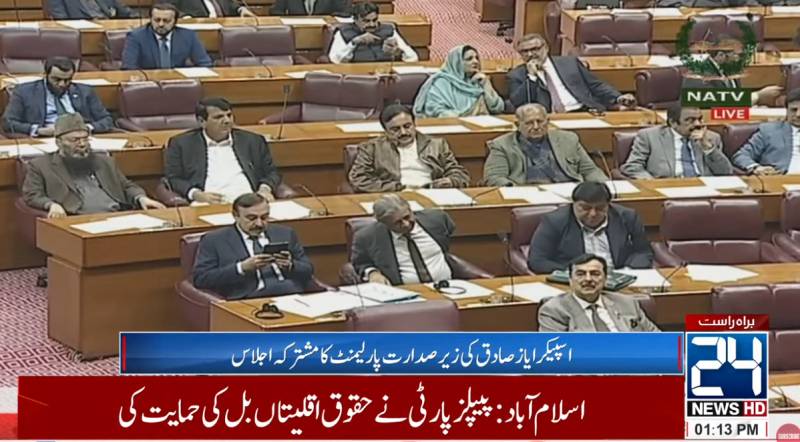

The joint session of the parliament on Tuesday approved the National Commission on Minority Rights Bill, 2025 clause by clause as the opposition staged a noisy protest and then walked out to protest its passage, reported 24NewsHD TV channel.
As many as 160 lawmakers voted in favour of the legislation while 79 opposed it, marking a significant legislative step toward establishing a statutory body for the protection of minority rights in Pakistan.
The PPP supported the bill, while the parliament also approved the amendment proposed by the JUI-F to remove clause 35 from the legislation.
The PTI, MWM and the ANP opposed the bill. Members of the parliament (MPs) belonging to the PTI created an uproar to disrupt the proceedings. They surrounded the speaker’s dais.
The bill was moved by Federal Minister for Law and Justice Azam Nazeer Tarar under clause (2) of Article 75 of the Constitution after being returned by the President. The bill was passed with majority votes as 160 lawmakers supported it.
Speaking in the House, the minister said that “No clause in the bill contradicts Quran and Sunnah.” He stressed that the legislation contained nothing contrary to the Quran and Sunnah and reaffirmed that neither the government nor the Constitution would ever allow any contradiction. He informed the House that all four amendments submitted by religious scholars had already been incorporated into the final draft.
“Nothing in this law overrides existing laws or court judgments. This commission is strictly for non-Muslim citizens as defined in the Constitution,” he said, adding that any group not accepting its constitutional status “automatically falls outside the ambit of this commission,” he added.
The Minister said the bill had undergone thorough scrutiny—first by the National Assembly Standing Committee, which included active participation from minority MNAs and then by the Senate, where Senator Ali Zafar chaired over six weeks of deliberations.
Azam Tarar emphasized that the government had proceeded with “full caution and responsibility,” ensuring protections for minorities.
He reminded the House that the bill had been pending for 14 years, despite a landmark 2014 Supreme Court judgment urging the creation of a statutory commission for minority rights.
“For fourteen years this issue has waited. Please do not make politics for the sake of politics,” he urged. “If there is even a single word here against the honour of our beloved Prophet (?), point it out. Our lives are devoted to him.”
Azam Tarar underlined that the proposed commission would not possess punitive powers, describing it instead as a platform enabling minority citizens to raise grievances directly with the state.
“Our Christian, Hindu, Parsi, Sikh, and other non-Muslim brothers and sisters deserve a forum to address issues – whether forced conversions, job quotas, sanitation workers’ rights, or other matters of dignity,” he said.
The minister thanked several parliamentarians for their contributions, including Maulana Fazl, Senator Kamran Murtaza, MNA Aliya Kamran, and minority representatives such as Keso Mal Kheal Das, Dr Darshan, senator Khalil Tahir Sandhu, Senator Danesh Kumar, Nalson Azeem, Ramesh Kumar Vankwani, and JUI-F’s minority MNA from Peshawar.
Speaking on the occasion, MNA Amir Jeeva expressed gratitude to the Law Ministry and all parliamentary parties for supporting a long-standing demand of religious minorities.
He recalled introducing earlier versions of the bill on July 6, 2024 and February 18, 2025, saying that today’s approval represented the culmination of years of advocacy. “Those who attempted to politicize this cause have only harmed a vulnerable community. But today Parliament has fulfilled a long-awaited promise,” he said.
Speaking in the House, Deputy Prime Minister Ishaq Dar reaffirmed that no law could compromise the sanctity of the finality of prophethood, noting the government had addressed the President’s observations and strengthened the National Commission for Minority Bill 2025, already passed by both Houses of Parliament.
He noted that the Law Minister, Azam Nazeer Tarar, had comprehensively addressed each point raised, and the government had also accepted the additional improvements proposed by Senator Kamran Murtaza under the guidance of Maulana Fazlur Rehman.
Dar regretted that some political quarters attempted to cast the legislation in a negative light, stressing that finality of prophet hood is an article of faith for every Muslim, and no law could ever compromise that belief. He said no institution or office holds greater sanctity for Muslims than the honour of the Holy Prophet (PBUH).
He added that sensitive legislative matters must not be politicized, and Parliament should operate through consultation and consensus just as it did during earlier major constitutional reforms. “All laws evolve through a process,” he said, adding that if improvements were needed in any legislation—including this one—the government was always willing to sit together and consider amendments.
Former Prime Minister Syed Yousaf Raza Gillani said that the rights of minorities were a constitutional responsibility and part of Pakistan’s foundational vision. He recalled that during his tenure he had formally introduced the observance of National Minorities Day to recognise their contribution and ensure inclusivity within state institutions.
Gillani said the white portion of the national flag was a reminder of the equality and protection guaranteed to non-Muslim citizens by Quaid-e-Azam. He urged the Law Minister to carefully consider the reservations raised by some members as well as the observations earlier communicated by the President, emphasising that broader consultation strengthens legislation and enhances national unity.
Maulana Fazlur Rehman, expressing his views, said Parliament is a forum of collective consultation, and Islamic principles encourage dialogue and consensus. He stressed that constitutional amendments should be built on broad agreement to avoid controversy and ensure national cohesion, noting that differing opinions must be respected within the democratic process.
Maulana Fazl said that there should not be such a legislation which could be later misused. He said it was unfortunate that the opposition was not consulted prior to the passage of the 27th Constitutional Amendment Bill. “On the contrary, the opposition was taken on board before the passage of the 26th Constitutional Amendment Bill,” he recalled.
Fazl said that the nation was not pleased with the 27th Amendment at all.
Fazl said it must be ensured that lawmaking should be done after developing a consensus. “Respect for the law and the constitution is binding on us,” the JUI-F chief said.
He asserted that the 27th Amendment was not the product of consensus. “Despite having two-third majority in the House, slain prime minister Zulfikar Ali Bhutto took the entire political leadership into confidence on the constitution of 1973,” he reminisced.
PTI Chairman Barrister Gohar said that there could be no legislation in the country which was against the constitution.
Senator Raja Nasir Abbas said that the bill had been passed in a rush.
Commission on Minority Rights to consist of 16 members\
As per details of the bill, the National Commission on Minority Rights will consist of 16 members.
Two minority members from each province will be the part of the commission, and they will be appointed by the provincial government.
There will also be one member from Islamabad.
Besides that, there will also be a representation of the National Commission for Human Rights and National Commission for Status of Women in the commission.
Grade-21 officers of Ministry of Law, Ministry of Religious Affairs, Ministry of Interior, and Ministry of Human Rights will also be the members of the commission.
The bill had been passed at the last joint session of the parliament.
But later President Asif Ali Zardari returned it to the parliament.
Several bills passed
The joint session also passed National Assembly Secretariat Employees Amendment Bill 2025 by majority vote, Pakistan Institute of Management, Sciences and Technology Bill 2023 by majority vote, Pakistan Institute of Management Sciences and Technology Bill 2023 by majority vote, National University of Security Sciences Islamabad Bill 2023 by majority vote, Akhuwat Institute Kasur Bill 2023 by majority vote and Gharki Institute of Science and Technology Bill 2025 by majority vote.
Reporter Usman Khan