
A new cold war beneath the waves
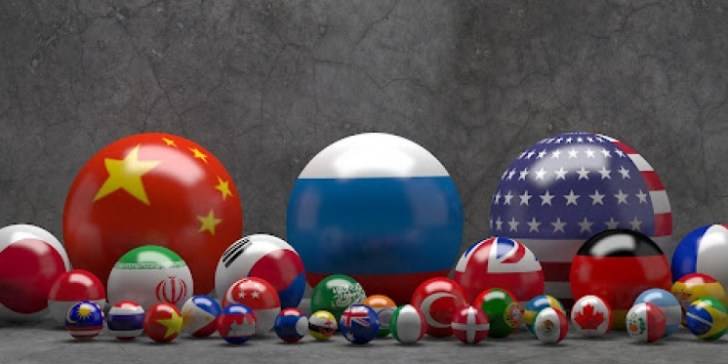

The world has, in a way, stepped back into a new Cold War era. This time, however, the competition for power and global dominance is not just ideological, it is sharply centred around economics, trade routes and strategic chokepoints, with the United States and China at the core of this rivalry. The United States became the world’s largest economy after overtaking the British Empire in 1890. By the 1960s, its industrial output accounted for nearly 36% of global production. But the global balance has shifted significantly since then.
Today, while the US economy is valued at around $31.8 trillion, China has risen rapidly to about $20.6 trillion, emerging as a serious industrial and economic rival. What makes this competition even more important is growth momentum. In 2025, China’s growth rate stood at around 5%, compared to 2.2% for the United States. In simple terms, if these trends continue, China could overtake the US as the world’s largest economy by around 2030. This shift reflects a broader reality: the US is no longer matching China’s pace of industrial expansion.
Instead of competing purely on growth, Washington is increasingly seen as focusing on limiting China’s rise. Rather than matching China step-by-step economically, the US is reportedly working to slow its expansion through strategic pressure; especially by targeting global supply chains and maritime routes. This approach is often described as a form of “global maritime containment strategy,” aimed at surrounding China through key sea lanes.
Recent tensions in the Strait of Hormuz offered what many policymakers in Washington reportedly viewed as a real-world lesson. When Iran threatened to close the strait, roughly 20% of global oil shipments were at risk. Oil prices surged and global markets reacted immediately. For the US, this was more than a regional crisis — it was a demonstration of how control over a narrow maritime passage can shake the global economy. The takeaway was clear: modern power does not always require missiles or tanks; disrupting supply routes can be just as effective. If Hormuz served as a testing ground, then the Strait of Malacca is widely seen as the real strategic focal point. Stretching about 900 kilometres, it connects the Indian Ocean with the South China Sea and is one of the busiest shipping lanes in the world.
China imports more than 80% of its crude oil and a large share of it passes through this route from the Middle East and Africa. Even more critically, nearly 90% of China’s maritime trade; worth trillions of dollars move through Malacca, including energy supplies, electronics, machinery and consumer goods. This heavy dependence is often referred to as the “Malacca Dilemma”; a situation where China’s economic lifeline depends on a waterway it does not control. In a conflict scenario, even a short disruption could severely impact China’s factories and trigger an energy crisis within weeks.
The United States, meanwhile, has been quietly strengthening its presence around this region through partnerships and military cooperation. One key area is Indonesia, which sits near the entrance of the strait. Joint military exercises like “Garuda Shield” in recent years have focused on improving coordination between forces and increasing operational readiness. Reports also suggest growing US engagement with regional countries on air access and surveillance capabilities, which would enhance monitoring in case of any crisis. At the same time, cooperation with Malaysia on maritime security and intelligence sharing has also expanded, given its strategic location and radar coverage over the strait.
Rather than directly controlling Malacca, the strategy appears to be about building influence through allied networks, creating the ability to monitor or pressure the route if needed. From Washington’s perspective, key pressure points define China’s vulnerability, including the Strait of Hormuz for energy flows, Malacca for trade dependence, the Taiwan Strait for military tension and the South China Sea, where most of China’s maritime activity passes under constant international monitoring under “freedom of navigation.” China, however, is far from passive. It has been preparing countermeasures for years. President Xi Jinping has referred to the “Malacca Dilemma” since 2013 and Beijing has developed a multi-layered strategy to reduce dependence on vulnerable sea routes, including the Belt and Road Initiative, the China–Pakistan Economic Corridor linking Gwadar Port to western China and pipelines through Myanmar bypassing Malacca. China is also exploring Arctic shipping routes with Russia. At the same time, it has modernized its naval forces, expanded aircraft carriers and strengthened positions in the South China Sea through artificial island bases. The rivalry increasingly resembles a modern “Great Game,” where control over chokepoints and supply chains matters more than direct military confrontation.
The United States appears to be relying on what analysts often call “Gray zone warfare”; applying pressure without open conflict, using influence, alliances and strategic positioning rather than direct confrontation. China, in response, is pursuing “anti-access and area denial” strategies designed to keep foreign navies away from its coastal waters. This evolving competition is gradually dividing the world into competing blocs. What begins in places like Hormuz today could easily extend to Malacca tomorrow. And because nearly a third of global trade passes through these waters, any escalation would not remain limited to the two superpowers.
Rising tensions would ripple through global oil prices, electronics supply chains and shipping costs, affecting economies far beyond Asia, especially import-dependent countries already vulnerable to global price shocks. Countries like Pakistan, Indonesia, Malaysia and Singapore etc are the centre of the expected conflict. For instance, about 30 percent international trade occurs through Strait of Hormuz. In such situation countries like Pakistan would face implications as its economy majorly depends on imports. In this emerging global order, the struggle is no longer just about who leads, it is about who controls the routes the world depends on. The recent US blockade and China’s efforts to undo will have immense and significant implications on international politics in the coming years.