
EU-Mercosur deal: a guid
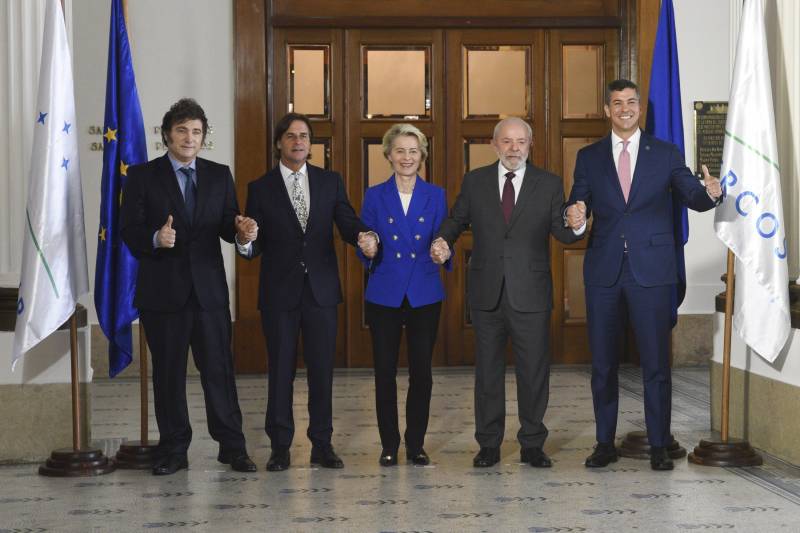

The European Union struck a controversial free-trade deal Friday with Mercosur members Argentina, Brazil, Paraguay, and Uruguay despite opposition from some EU nations.
Here is a look at the path toward an agreement that was years in the making:
What is the deal? -
Mercosur was launched by Argentina, Brazil, Paraguay, and Uruguay in 1991.
Venezuela joined later but was suspended from the bloc for democratic backsliding in 2016 while the newest member Bolivia is not a part of the Mercosur deal.
The EU and Mercosur began negotiating in 1999 with a goal of eliminating most import taxes and creating a 700-million-customer free-trade area.
South American countries are keen to tap European demand for their beef, poultry, sugar, rice, and other commodities -- plus minerals such as lithium, copper and cobalt, key ingredients in the clean-energy transition.
The 27-member EU wants to expand the market for its cars, machines, and pharmaceuticals.
The two sides reached a preliminary agreement in 2019, but opposition in parts of Europe stalled ratification.
Who would win?
European Commission chief Ursula von der Leyen called the deal a "win-win" as she announced the agreement at a Mercosur summit in Montevideo.
She said it would save EU companies four billion euros ($4.2 billion) worth of export duties per year.
Companies will be able to tap a market of 270 million people in Mercosur and 450 million in the EU.
Brussels says the deal would ease access to the South American market for key products including wine -- currently taxed up to 27 percent -- spirits and cheese.
Spain's government, which backs the deal, touts its impact on wine and olive oil exports, while Germany hopes to sell more cars.
The South American agricultural sector meanwhile hopes to ramp up exports of products including meat, soy and corn. The four countries exported $24 billion in agricultural goods to the EU last year.
The commission said the deal would ease customs procedures and allow EU firms to bid for public contracts on "equal terms" with Mercosur companies.
Who would lose?
The potential deal has drawn opposition from Europe's agricultural sector, notably in France, where farmers have protested noisily.
"The (European) agricultural community's fears have materialised," Europe's COPA-COGENA farmers group said Friday.
An official in President Emmanuel Macron's office said the deal remains "unacceptable" to France in its current form.
European farmers are crying foul over supposedly less-strict regulations on the sector in South America, pointing especially to the industry's role in destroying huge swathes of the Amazon rainforest, a crucial buffer against climate change.
"It's difficult to find the origin of every cow. We don't know how to trace them" to see if farmers followed environmental norms, said economist Maxime Combes.
The European Commission said Friday that, under the deal, "any product entering the EU market must comply with the EU's stringent food safety standards".
The agreement would eliminate import duties on around 60,000 tonnes of Mercosur beef.
The European Commission argues that is a relatively small amount -- about 1.6 percent of EU beef production.
It also said the deal now integrates the terms of the 2015 Paris climate accord -- something France had clamouring for -- allowing for a suspension if one party is in serious breach of its climate pledges.
Brazil has sought exemptions for sectors it considers strategic, such as automobiles.
What next?
The deal announced by von der Leyen at a Mercosur summit in Montevideo must now be ratified by EU states, but unanimity is not required.
EU ratification requires 15 member states accounting for 65 percent of the 27-nation bloc's population to approve it, then get a majority green-light in the European Parliament.
France has been lobbying to block it, recently joined by Poland. Italy, Austria and the Netherlands have also voiced reservations.