
Chinese-made industrial robots gain ground in smart manufacturing sector
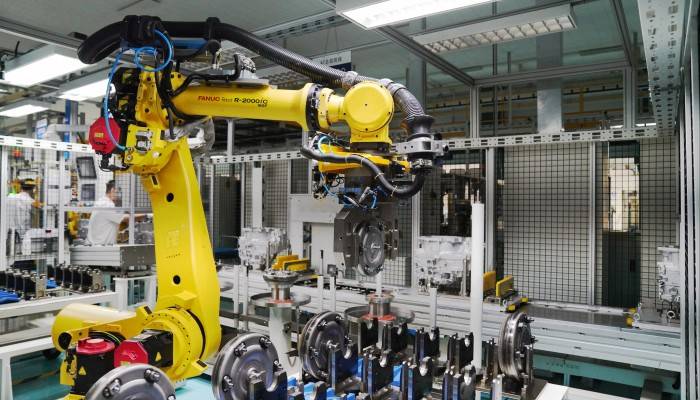

Chinese-made industrial robots are playing an increasingly prominent role in the country's smart manufacturing sector, marking a shift in an industry long dominated by foreign technology providers.
At a new energy vehicle plant operated by Geely in Yiwu, Zhejiang province, domestically developed industrial robots are being used on key welding lines to perform high-speed, precision welding.
The deployment is being viewed as a significant step for China's high-end equipment manufacturing industry, particularly in automotive body welding, which has traditionally been regarded as one of the most demanding applications for industrial robots.
The project was developed through cooperation between Geely and Siasun Robot & Automation Co., Ltd., a robotics manufacturer based in Shenyang.
According to company officials, nearly four years of research and development were required to overcome more than 1,000 technical challenges before almost 100 industrial robots were installed on Geely's main welding lines.
The system has since received approval for use in automotive production, opening the door for wider adoption by other car manufacturers.
Industry experts say the development reflects broader progress in China's robotics sector, which has expanded rapidly with support from government policies, including the country's 14th Five-Year Plan and the "AI Plus" initiative.
Official data shows China produced a record 602,700 industrial robots between January and October 2025, an increase of 28.8 percent compared with the same period a year earlier.
China has also strengthened its position in overseas markets. Customs figures show the country's robot exports reached 11.32 billion yuan in the first quarter of 2026, with products exported to 148 countries and regions.
Industrial robot exports rose by 42 percent during the period, reflecting growing international demand for Chinese automation technology.
Experts say the expansion of Chinese robotics exports is contributing to the spread of advanced manufacturing technologies and supporting the adoption of smart manufacturing systems in markets worldwide.