
Pakistan’s Economic Survey 2024-25: Unveiling the facade of growth
Behind the optimism lies a nation in economic distress

The release of Pakistan’s Economic Survey 2024–25 has once again highlighted a widening gap between government narratives and on-ground realities. As the government touts resilience, stark data and ground realities expose a stark decline across key sectors, from agriculture to textiles, and raise fresh questions about the reported growth. A closer look reveals a troubling story: one of shrinking opportunities, vanishing livelihoods, and manipulated data presented as progress.
Agriculture falters, food insecurity grows
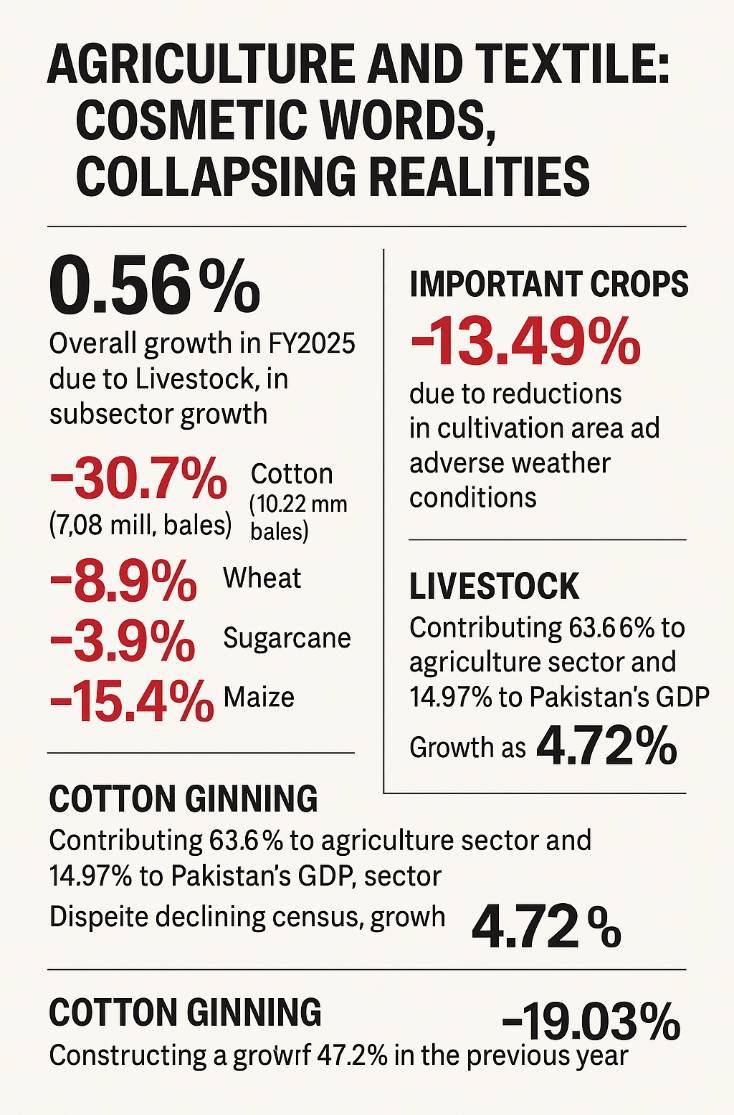
Agriculture, long considered the bedrock of Pakistan’s economy, has seen a steep downturn. Growth slowed to just 0.56%, down drastically from 6.25% the year before. Major crops, cotton, maize, wheat, and sugarcane, have all posted double-digit declines. These aren’t just numbers, they’re warnings. They point to reduced harvests, rising food costs, and an uncertain year ahead for millions who rely on the land.
In a country battling climate change, water scarcity, and rising input costs, the current trajectory is not only unsustainable but also dangerous. translating to empty pantries and soaring food prices in the real world.
Farmers, the backbone of nearly half the population, face a crisis that official optimism cannot mask.
Textile Industry: Export engine stalls
The textile sector, a linchpin of Pakistan’s export economy and employment, is teetering on the brink. Cotton ginning plummeted by 19.03% following a brief recovery, with factories slowing and orders drying up. The crisis in cotton production is not isolated; it ripples across the broader economy, dragging down employment and foreign exchange earnings. The situation underscores a sector in desperate need of revitalisation amid global competition and domestic instability.
Livestock: The convenient fiction
Perhaps the most disputed claim in the Economic Survey is the reported 4.72% growth in the livestock sector, up from 3.89% last year. Government officials attribute this rise to development initiatives in Punjab and private investment in dairy and poultry. But the numbers don't match the reality.
The Livestock Card initiative, Punjab’s much-hyped intervention, was launched only on January 9, 2025, barely six months ago. Its impact, by any serious metric, couldn’t possibly reflect in annual figures yet. Moreover, despite claims of sectoral growth, milk and meat prices have skyrocketed, placing basic nutrition beyond the reach of the middle class.
If livestock and poultry are truly thriving, citizens ask: Why is everything from milk to chicken unaffordable?
Ground reports tell a different story:
· In central Punjab, feed shortages and unaffordable prices are forcing farms to shut down.
· In southern Punjab, recurring floods and droughts continue to devastate herds.
· In Sindh, disease outbreaks have ravaged cattle populations.
· Across the country, vaccination drives are failing to find the animals to fulfil their targets, and census figures remain outdated or intentionally obscured.
The truth is stark: livestock has become a statistical crutch, a filler to prop up agricultural growth when crops fail. Development funds are issued, shared investment models are promoted, but when follow-up visits are made, fewer than 5% of funded farms remain active.
One agri-specialist put it bluntly: “If a livestock census were held today, the reality would shock us.”
This isn’t just a failure of execution, it’s a failure of policy. Livestock remains underfunded, under-prioritised, and over-reported. In an era of data-driven governance, Pakistan continues to weaponise unreliable data for political comfort.
Youth and mid-career crisis: A human toll
The survey’s silence on employment woes is deafening. The most significant job-related statistic is the 727,381 Pakistanis who sought work overseas in 2024, a grim reminder that brain drain remains the only viable escape for a generation abandoned at home.
Young graduates are funnelled into an economy that offers gig work at best. Meanwhile, mid-career professionals, often family breadwinners, face an unprecedented squeeze. With 15–20 years of experience, many are laid off by cash-strapped firms favoring low-cost hires, forcing them into underemployment or emigration. These individuals, pillars of private sector productivity, are now driving ride-hailing cars, freelancing for pennies, or waiting for visas.
This isn’t just economic instability, it’s a human capital disaster.
Policy by optics, not outcomes
Pakistan’s economic storytelling continues to chase optics at the expense of substance. While financial analysts produce upbeat forecasts and inflated growth rates, those in the field, farmers, factory owners, traders, office workers, laborers, and professionals, paint a different picture.
As one analyst candidly admitted: “I have no data to agree or disagree with. These numbers come from financial desks, not from fieldwork.” By contrast, grassroots insights, panel discussions, field reports, and stakeholder engagement, tell a story of decline and denial.
In a global landscape where data drives progress, Pakistan’s reliance on manipulated statistics undermines credibility. Investors and development partners see through the façade, while citizens endure rising food insecurity and informal employment. The lack of reliable livestock censuses and transparent policies amplifies this mistrust, turning official figures into tools of short-term optics rather than long-term planning.
Pakistan’s economy isn’t suffering from a lack of potential. It’s suffering from a lack of honesty. Pakistan needs more than cosmetic numbers: it doesn’t need better narratives, it needs better governance and policies grounded in fact, not fiction. Most importantly, it needs leaders willing to stop playing with numbers and start listening to people.
Because behind every skewed and inflated percentage is a family struggling to eat, a graduate without a job, a parent sacrificing health for a child’s education, and a farmer praying for a fair market, and a country fast losing hope.