
Dar says 27th Constitutional Amendment was agreed upon under CoD
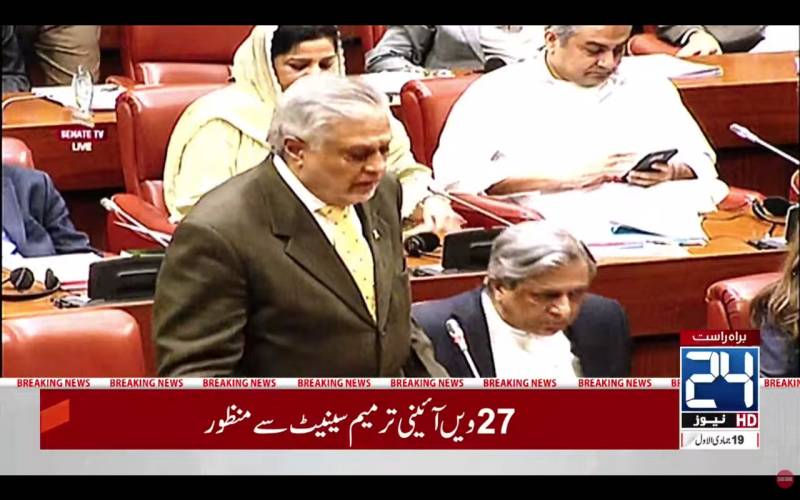

As the Senate passed the controversial 27th Constitutional Amendment Bill on Monday, Deputy Prime Minister Ishaq Dar described it as a “landmark step” agreed upon under the Charter of Democracy (CoD) and finalised after years of cross-party deliberations.
Speaking during the Senate session, Dar said that work on the amendment originally began in 2002 and that the new law maintains the seniority of Supreme Court judges while introducing procedural changes related to their transfers.
“Seniority of Supreme Court judges will remain intact. Changes have only been made in the matter of transfers of judges, and all of them were brought through this amendment,” he said.
Dar expressed gratitude to all political parties and independent members who supported the bill, noting that it reflected “collective wisdom and mutual understanding” across the political spectrum. “We advised the government to bring this bill in the Senate. The committees of both houses worked on it together, and many amendments were made and carefully considered,” he added.
The minister explained that the initial draft of the amendment was wide-ranging, covering issues from the National Finance Commission (NFC) to education and population management. “Negotiations were held with the People’s Party on matters related to NFC, and they took the matters to their Central Executive Committee for consultation,” Dar said, emphasizing that the process was rooted in cooperation and institutional dialogue.
He also credited Prime Minister Shehbaz Sharif for advancing the discussions beyond the negotiation stage. “Prime Minister Shehbaz Sharif took the matters beyond discussions and expanded the scope of reforms,” Dar noted, adding that the government was committed to addressing challenges “from health to education to population” through continued dialogue and consensus.
Raja Pervez Ashraf
Former Prime Minister Raja Pervez Ashraf urged restraint in personal attacks and emphasized that debate must be grounded in facts. Ashraf questioned allegations aimed at President Asif Zardari, noting the President’s lack of executive powers and pointing out that many cases have already been pursued through Pakistan’s legal system.
Ashraf condemned the May 9 incidents and called for accountability: perpetrators who desecrated memorials “should be punished as they should.” He warned against leniency toward those who foment disorder and underlined the Assembly’s duty to defend the constitution and the country’s institutions. Ashraf said lawmakers must not allow the chamber to be reduced to “noise,” insisting that parliamentary debate remain dignified and focused on legislation and national interest.
Alia Kamran
Alia Kamran reminded colleagues that “the Constitution is a contract between the people and the state,” calling for strict adherence to parliamentary rules and stronger committee oversight. Kamran raised concerns that repeated rule-breaking and sweeping changes — including alterations to nearly fifty articles — risked weakening the judiciary and parliamentary scrutiny. She argued the role of committees is central to sound lawmaking and warned that bypassing those processes undermines governance. Kamran urged lawmakers to ensure amendments and bills are crafted and debated in ways that strengthen institutions rather than creating confusion or anarchy.
Hanif Abbasi
Hanif Abbasi paid tribute to the country’s armed forces and framed today’s debate in the larger context of Pakistan’s security and international standing. Abbasi highlighted past successes — from the Swat operation to recent diplomatic inroads across the region — as proof that Pakistan’s national institutions can deliver for citizens when united.
Abbasi warned against political actors who, in his view, “want chaos in Pakistan,” and stressed that national security cannot be compromised for narrow political gain. He praised the country’s progress on regional influence and freedom from past baggage, urging that politics always put Pakistan’s interests first. He also cautioned that those who align the legal profession uncritically with political agendas risk undermining their own credibility.