
Pak–BD closeness: Setback for Akhand Bharat
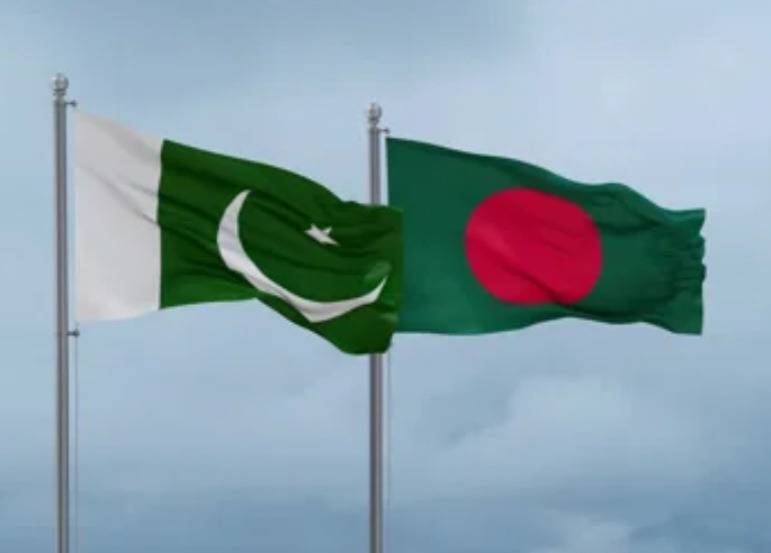

The recent visit of Pakistan’s Joint Chiefs of Staff Committee Chairman, General Sahir Shamshad Mirza, to Bangladesh has caused unrest among enemies. A significant aspect of this visit was the presentation of a map of “Greater Bangladesh” by Bangladesh’s interim leader, Mohammad Yunus, to General Mirza. The Indian media has reacted with hostility, claiming that this map aligns with the ideologies of extremist groups that advocate for the dream of a Greater Bangladesh. The map presented by Mohammad Yunus shows India’s northeastern states, including Assam, as parts of Bangladesh, prompting the Hindutva media to cry that Bangladesh is on the path to becoming East Pakistan again. In reality, the increasing proximity between Pakistan and Bangladesh deals a significant blow to the notion of ‘Akhand Bharat.’
Bangladesh’s interim leader, Mohammad Yunus, has become a source of disturbance for India. After Yunus’s ascent to power, there has been a clear shift in Bangladesh’s foreign policy. The interim government that came to power following the escape of Indian agent Sheikh Hasina has strengthened ties not only with Pakistan but also with China. This is why India has reverted to its traditional obstinacy. Pakistan and Bangladesh have reaffirmed their commitment to strengthening defence and security cooperation, marking the beginning of a new era of strategic ties between the two South Asian countries.
General Sahir Shamshad Mirza met with Bangladesh’s Chief Advisor, Mohammad Yunus; Army Chief, General Waqar Zaman; Navy Chief, Admiral Mohammad Nazim Hasan; Air Chief Marshal, Hasan Mahmood Khan; and Principal Staff Officer, Lieutenant General SM Kamruzzaman. General Mirza also visited the School of Infantry and Tactics in Sylhet, where he interacted with teachers and students. The civil and military leadership of Bangladesh praised the high professional standards of Pakistan’s defence forces and their sacrifices against terrorism. Laying flowers at the Sheikh Anirban (Eternal Flame) memorial in Dhaka marks a new journey towards brotherhood and friendship, putting past grievances behind and stabilising reconciliatory relations. There is no doubt that increasing cooperation in defence and security on both sides is a significant advancement in the current regional context. Both sides emphasised the importance of enhancing defence production, intelligence sharing and counter-terrorism cooperation while acknowledging the necessity of collective security in a rapidly changing regional environment. Earlier this year, Lieutenant General Qamar Hassan had also visited Pakistan.
After a long period, Pakistan and Bangladesh, two brotherly nations, are drawing closer to each other. Despite global imperialist conspiracies, the bond between them is strengthening. The enemy should know: brotherhood never ends. Now, Bangladesh has a moderate and organised government led by Nobel laureate Dr Mohammad Yunus, and at this time, not only are both governments filled with goodwill towards each other, but the hearts of the people on both sides also beat for one another. This time, the birthday of Quaid-e-Azam was celebrated with great fanfare in Bangladesh, followed by the uprooting of Sheikh Mujib’s statue and the removal of his name from history books. Most importantly, the slogan ‘Pakistan Zindabad’ echoed in the skies of Bangladesh. After a 13-year gap, a high-level Pakistani delegation led by the Foreign Minister visited Bangladesh on August 23, 2025. There is no doubt that Pakistan suffered the pain of separation from East Pakistan in 1971, losing a part of itself (with the irresponsible behaviour of its own and others to blame), yet Pakistan has always tried to maintain fraternal relations with Bangladesh and has considered it its younger brother, offering love and care like an elder brother. The services of East Pakistan’s leaders and founders are a bright chapter in our national political history. The All-India Muslim League was founded in 1906 at the home of Nawab Salimullah Khan. The leader who presented the Pakistan Resolution also hailed from Bengal, Molvi Fazlul Haq, known as ‘Sher-e-Bangal.’ Among other leaders from Bengal, Khawaja Nazimuddin is significant; he was appointed Governor-General after Quaid-e-Azam and led the country with dignity and propriety. Huseyn Shaheed Suhrawardy was also among the warriors of the Pakistan Movement. From the very beginning, India was active in scheming to break Pakistan. The infamous establishment of the Indian intelligence agency was aimed at undermining Pakistan. In 2011, former Deputy Speaker of the Bangladeshi Parliament, Shaukat Ali, gave full credit for Bangladesh’s independence to India and RAW. Indian Prime Minister Narendra Modi acknowledged the role of the Indian army and Mukti Bahini, as did the Hamoodur Rahman Commission report. Sheikh Hasina’s government never genuinely recognised Pakistan, consistently plotting against it under Indian influence. A genocide day was observed against the Pakistan Army at India’s behest. Allegiance to the two-nation theory and opposition to India became a crime in Bangladesh, while Sheikh Hasina fueled anti-Pakistan sentiments. India armed MuktiBahini, blaming the Pakistan Army for the bloodshed and rewarded remnants for enmity against Pakistan, some escaping to Agartala. General elections in Bangladesh are expected in February 2026; Sheikh Hasina announced a boycott after the Election Commission suspended the Awami League’s registration in May 2025 due to war crime investigations. The International Crimes Tribunal has completed probes into human rights violations during the 2024 student-led protests, with a decision expected on November 13. Approximately 1,400 people were killed and thousands injured. Historically dominant parties are Awami League and BNP, with BNP projected to have a chance in the upcoming elections. Pakistan and Bangladesh are now moving beyond historical differences toward unity and strategic cooperation, emerging as role models for a better and safer future.