
3.7% GDP growth misses 4.2% target in 2025-26: Economic Survey
Unveiling Pakistan Economic Survey for 2025-26, Finance Minister Aurangzeb says Middle East conflict impacted Pakistan’s growth target: Pakistan faced global tariff uncertainty and regional instability: Large-scale manufacturing and services sectors showed significant improvement: Remittances and exports of garments and home textiles recorded growth: Pakistan’s sports exports exceeded $3b: Debt-to-GDP ratio declines to 68.5 per cent: Launching new tax operating system next year: Acknowledges UAE’s continued support for Pakistan’s economy
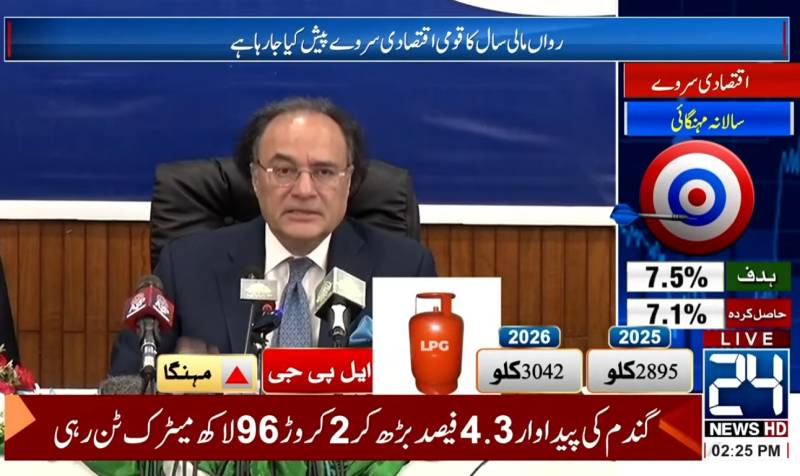

Federal Minister for Finance and Revenue Senator Muhammad Aurangzeb unveiled the Pakistan Economic Survey (PES) for the financial year 2025-26 at a news conference in Islamabad on Thursday, a day before the federal budget is due to be announced, reported 24NewsHD TV channel.
Aurangzeb said the survey told a story, reflecting the resilience and discipline shown during the previous year. He said the country began the outgoing fiscal year with uncertainty on account of the tariffs.
The Economic Survey provides a comprehensive overview of the country's economic performance during the outgoing fiscal year.
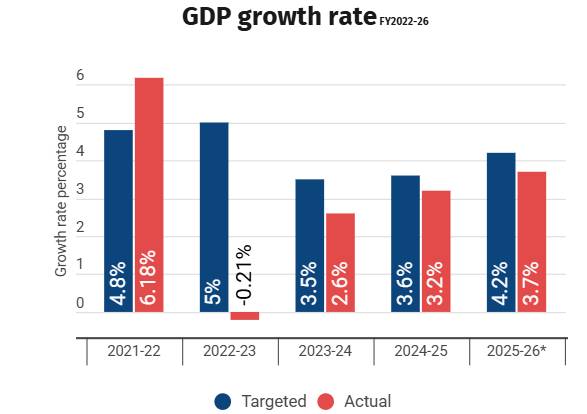
Unveiling the economy survey of Pakistan, Federal Finance Minister Aurangzeb said Pakistan’s economy recorded growth of 3.7 percent during the 2025-26 fiscal year despite regional tensions, global trade uncertainty and economic pressures caused by conflict in the Middle East.
He said the government had initially targeted gross domestic product (GDP) growth of 4.2 percent for the current fiscal year. However, he noted that the war-related instability in the Middle East had affected economic activity and created additional challenges for Pakistan.
Aurangzeb pointed out that Pakistan’s GDP had recorded negative growth of 0.20 percent in 2023, adding that the latest figures represented the highest level of economic growth in four years.
He said global trade conditions remained uncertain during July 2025 due to unclear tariff policies and international economic pressures. Despite these difficulties, Pakistan managed to withstand various economic challenges and also secured improved trade tariff arrangements with the United States.
The finance minister further stated that Pakistan experienced floods during July 2025, while regional tensions emerging from March 2026 onwards also placed additional pressure on the economy.
According to Aurangzeb, annual per capita income has now risen to 1,900 dollars, while demand for vehicles increased by 31 percent during the fiscal year.
He said large-scale manufacturing recorded growth of 6.1 percent, while cement demand rose by 10 percent. The services sector also expanded by 4.9 percent, with information and communication services posting growth of 7.5 percent.
Discussing fiscal indicators, the minister said the budget deficit stood at 0.7 percent of GDP, while interest payments declined by 23 percent. He added that Federal Board of Revenue (FBR) collections increased by 10 percent during the period under review.
Aurangzeb said Pakistan recorded a current account surplus of $72 million between July and March, supported by higher remittances from overseas Pakistanis.
According to Aurangzeb, annual per capita income has now risen to 1,900 dollars, while demand for vehicles increased by 31 percent during the fiscal year.
He said large-scale manufacturing recorded growth of 6.1 percent while cement demand rose by 10 percent. The services sector also expanded by 4.9 percent with information and communication services posting growth of 7.5 percent.
Discussing fiscal indicators, the minister said the budget deficit stood at 0.7 percent of GDP, while interest payments declined by 23 percent. He added that Federal Board of Revenue (FBR) collections increased by 10 percent during the period under review.
Aurangzeb said Pakistan recorded a current account surplus of $72 million between July and March, supported by higher remittances from overseas Pakistanis.
He noted that rice exports declined by $1.1 billion and sugar exports also fell during the fiscal year. However, exports of garments and home textiles showed positive growth.
The finance minister described the privatisation of Pakistan International Airlines (PIA) as encouraging, stating that the national carrier had been purchased by local investors.
He said investment worth $500 million had been made in the country’s 5G spectrum programme and that several foreign companies had entered the Pakistani market.
Aurangzeb said Pakistan’s debt profile mainly consisted of long-term liabilities and confirmed that the country had issued Panda Bonds during the fiscal year.
Highlighting growth in the sports sector, the minister said footballs manufactured in Pakistan would be used during the FIFA World Cup 2026, adding that Pakistan’s sports exports had exceeded 3 billion dollars.
He also urged industries to review and modernise their business models in order to remain competitive in changing economic conditions.
Aurangzeb said Pakistan’s debt burden is gradually declining in relation to the size of the economy, with the country’s debt-to-GDP ratio falling to 68.5 per cent during the current fiscal year.
The minister said the government remained committed to fiscal discipline and economic reforms aimed at improving long-term financial stability.
He expressed gratitude to the United Arab Emirates (UAE) for its continued support of Pakistan, noting that the Gulf nation had assisted the country over an extended period.
Drawing on his banking experience, he remarked that loans are expected to be repaid upon maturity and emphasised the importance of meeting financial obligations responsibly.
The finance minister also highlighted the significant contribution of overseas Pakistanis living in the UAE, saying that the country receives substantial remittances from the expatriate community there.
He also urged industries to review and modernise their business models in order to remain competitive in changing economic conditions.
Aurangzeb said Pakistan’s debt burden is gradually declining in relation to the size of the economy, with the country’s debt-to-GDP ratio falling to 68.5 per cent during the current fiscal year.
he minister said the government remained committed to fiscal discipline and economic reforms aimed at improving long-term financial stability.
He expressed gratitude to the United Arab Emirates (UAE) for its continued support of Pakistan, noting that the Gulf nation had assisted the country over an extended period.
Drawing on his banking experience, he remarked that loans are expected to be repaid upon maturity and emphasised the importance of meeting financial obligations responsibly.
The finance minister also highlighted the significant contribution of overseas Pakistanis living in the UAE, saying that the country receives substantial remittances from the expatriate community there.
Responding to reports regarding the future of Pakistan Telecommunication Company Limited (PTCL), Aurangzeb said he had received no information suggesting that the telecommunications company was planning to leave Pakistan.
On taxation reforms, the minister said the government had introduced a fixed tax scheme for traders and was preparing to launch a new tax operating system in the next fiscal year.
Aurangzeb further revealed that the government had collected an additional Rs60 billion in taxes from the cement and sugar industries. He added that tax audits had generated a further Rs34 billion in additional revenue.
Services
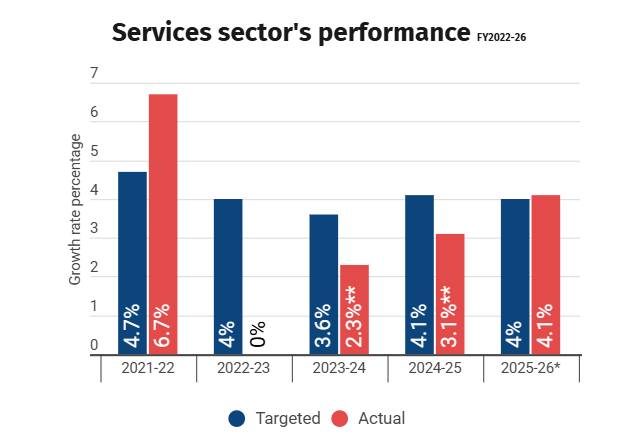
Noting that the services sector made up close to 58pc of Pakistan’s GDP, he said 4.9pc growth was recorded in this sector in the outgoing fiscal year.
“This, too, is the highest in the last four years,” he said.
He particularly mentioned communication and information services, which he said recorded a growth of 7.52pc. The growth in this sub-sector in FY26 was also the highest over the past four years.
Moreover, he continued, this sub-sector held significance for the digital economy.
Agriculture
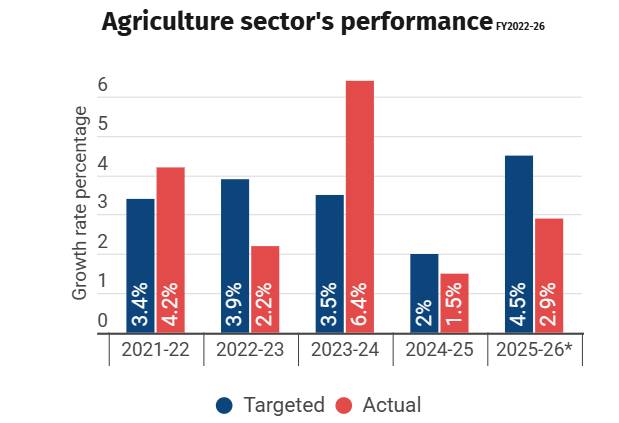
Giving a sector-wise breakdown, he said growth in agriculture was recorded at 2.89pc, compared to 1.53pc in the last fiscal year. “This was despite floods,” he said, adding that the crop sub-sector showed positive growth. It was recorded at 1.44pc, the finance minister said.
He added the livestock sector also “continues to go from strength to strength”.
Inflation
According to the economic survey, CPI inflation for the period between July-April FY20256 was recorded at 6.2pc, against 4.7pc during the same period last year.
“Inflation measured by the sensitive price indicator (SPI) stood at 4.1pc as against 4.8pc during the same period last year … The inflation remained broadly stable during the first three quarters of FY 2026. However, the emergence of an external shock amid geopolitical tensions at the end of the third quarter has increased its vulnerability to renewed price pressures, warranting continued vigilance and timely policy response to preserve macroeconomic stability,” the survey document said.
On this, Aurangzeb argued that inflation had been decreasing over the years. “We began with 28pc, and today we are at a point where the policy rate is 11.5pc,” he said.
The minister, accompanied by Federal Minister for Planning, Development and Special Initiatives Professor Ahsan Iqbal, Federal Minister for Information and Broadcasting Attaullah Tarar, Minister of State for Finance and Revenue Bilal Azhar Kayani and senior officials from the Ministry of Finance and Revenue, highlighted key economic indicators and performance.
https://www.youtube.com/watch?v=KXG-s5zT36s
Meeting with PM
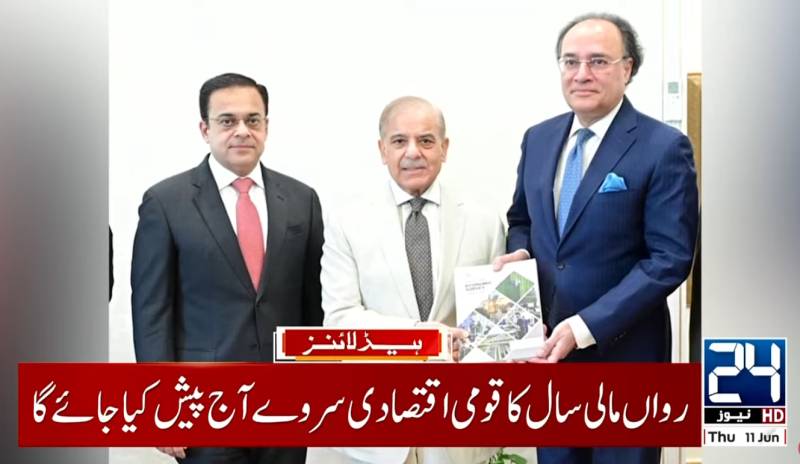
Finance Minister Aurangzeb called on Prime Minister Shehbaz Sharif at PM House in Islamabad on Thursday and handed him a copy of Pakistan Economic Survey 2025-26.
According to the survey, the government could not achieve the economic growth target fixed for 2025-26.
The targets fixed for agriculture and industrial sectors were also not surpassed.
The national development budget has been slashed by Rs1,046 billion.
Reporter Waqas Azeem