
Ex-Indian Army Chief slams Modi's failed war tactics; urges peace talks
Says war is serious thing, not a Bollywood film so diplomacy should be first priority: Operation Sindhoor exposes Modi's strategic folly as relying only on army not good in war: Indian defence analyst Sushant Singh says Modi will attempt to spin military defeat as a media success, ignoring Trump's crucial role in calming tensions: Hindutva ideology losing steam in India: Kashmir is key to peace in region:
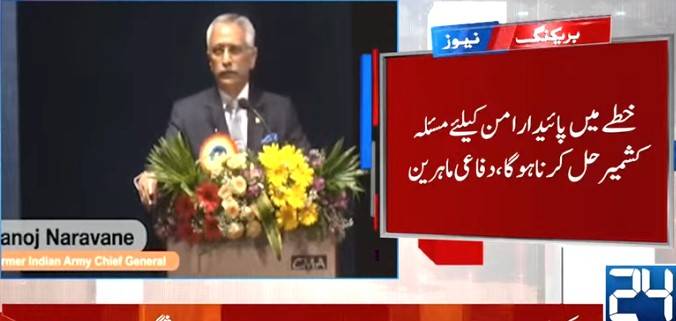

Pakistan's Operation Bunyan un Marsoos delivered a strategic jolt to India’s Operation Sindhoor, forcing top former Indian military officials and defence analysts to question New Delhi’s aggressive stance and call for dialogue with Pakistan on all unresolved issues, including Kashmir.
According to the 24NewsHD TV channel, former Indian Army Chief General Manoj Naravane openly criticised Prime Minister Narendra Modi’s war strategy, calling it flawed in the wake of the recent four-day-long Indo-Pak war from May 6 to May 9.
He stressed that diplomacy—not conflict—is the only way forward between the two nuclear-armed neighbours. “War is a serious and bitter reality, not a romantic tale or a Bollywood film,” said Naravane. “As a former soldier, my first priority will always be diplomacy.”
Following Pakistan's counteroffensive that effectively concluded Operation Sindoor, several retired Indian military officials started speaking in favour of diplomacy over war.
General Naravane dismissed concerns over the ceasefire as "irresponsible" and reiterated that all disputes must be resolved through dialogue.
Defence experts argue that Naravane’s statement clearly signals that lasting peace in the region hinges on a solution to the Kashmir issue. They believe India should also engage in dialogue rather than war over Kashmir with Pakistan.
It is also noteworthy that former U.S. President Donald Trump had earlier offered to mediate between Pakistan and India on the Kashmir dispute.
General Naravane highlighted that the consequences of war go beyond the battlefield—its psychological effects are felt most by innocent civilians, particularly children, many of whom suffer from post-traumatic stress disorder (PTSD).
He urged war advocates to also consider the plight of the affected families. “National security is not just the responsibility of the government or army—it is a shared duty of every citizen,” he added.
Kashmir is key to peace in region: Sushant Singh
Separately, following Pakistan’s operation against Indian forces, Indian defence analyst Sushant Singh launched a scathing critique of Modi’s leadership and the role played by Indian mainstream media. He said, “With time, the lies of the Modi government and the compliant 'Godi media' are being exposed.”
Singh called it “deeply shameful” that Modi succumbed to pressure from U.S. President Trump—marking a departure from India’s long-standing policy of treating conflicts with Pakistan as strictly bilateral issues.
According to Singh, the Hindutva ideology is losing steam in India. He pointed out that Modi has been forced to retreat from his past declarations, including his bold claim that no peace would ever be made with Pakistan.
Singh predicted that Modi will attempt to spin the military defeat as a media success, ignoring the crucial role played by Trump in calming tensions. “By once again referring to both Pakistan and India as great nations, Trump has placed them on equal footing—a major blow to Indian foreign policy,” he added.
Singh noted that Modi’s narrative—claiming China as India’s real enemy while dismissing Pakistan—has backfired. This conflict, he said, has exposed India's international vulnerabilities.
Modi’s decision to avoid other strategic options and rely solely on military action proved to be a misstep. “Good leaders move their countries forward using diplomacy, trade, and people-to-people contact,” Singh said.
He confirmed that Pakistan claimed to have shot down five Indian fighter jets, including three Rafales, and India has not officially denied the claim. This has amplified the issue beyond South Asia to the global diplomatic stage.
In contrast, the Indian media played a disgraceful role, spreading disinformation. Any outlet that tried to report the truth was silenced—The Wire was blocked, and The Hindu was reportedly forced to remove its story on the jet downings.
Singh remarked that international media outlets used satellite imagery to verify and report the destruction of Indian aircraft. “The destruction of Rafale jets with Chinese-assisted Pakistani technology is of significant geo-strategic importance,” he said.
Due to continuous falsehoods propagated by Indian media, even factual narratives began to be ignored globally. Meanwhile, Pakistani media channels gained credibility for their reliable and fact-based international coverage. Singh concluded that some Indian journalists and editors disgraced themselves by spreading fake news on social media, causing severe reputational damage to Indian media at large.