
IMF praises effective execution of reforms programme by Pakistan
Kristalina Georgieva warns of 'tough times' if oil prices stay high
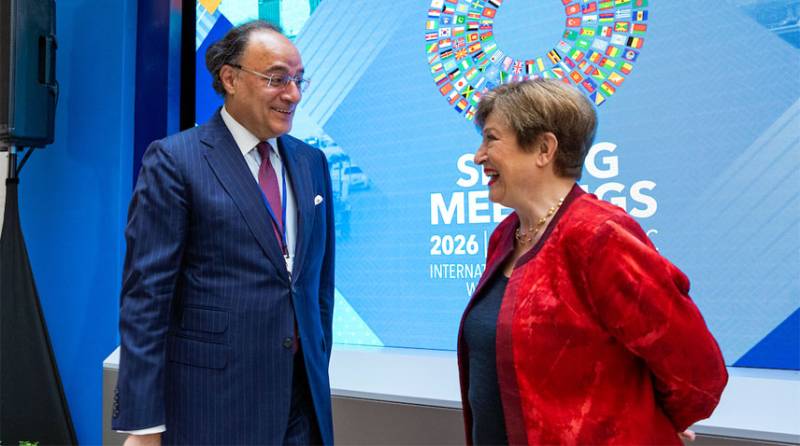

Praising the reforms introduced by Pakistan, the International Monetary Fund (IMF) Managing Director Kristalina Georgieva has said that an effective execution of reforms programme has helped the country maintain its economic stability, reported 24NewsHD TV channel on Thursday.
Speaking to Finance Minister Muhammad Aurangzeb on the sidelines of the 2026 Spring Meetings of the International Monetary Fund (IMF) and the World Bank, she said this had also increased the confidence of investors.
She further said that along with strong economic policies, the continuation of structural reforms would also play an important role in ensuring the wellbeing of the masses.
These remarks show the world’s increasing trust in the reforms programme being pursued by Pakistan so that it could maintain its economic stability.
Middle East crisis a significant supply shock
Minister for Finance and Revenue, Senator Muhammad Aurangzeb, has described the ongoing crisis in the Middle East as one of the most significant supply shocks in recent history.
He expressed these views while participating in a high-level meeting in Washington DC, convened by the Managing Director of the International Monetary Fund with Finance Ministers, Central Bank Governors, and heads of regional financial institutions from the Middle East, North Africa, Afghanistan, and Pakistan region, on the sidelines of the World Bank-IMF Spring Meetings.
The Finance Minister highlighted Pakistan's commitment to gradually shift from broad-based subsidies to well-targeted support mechanisms aimed at protecting the most vulnerable segments of society.
Earlier, addressing the fifteenth Ministerial Meeting of the Coalition of Finance Ministers for Climate Action at the World Bank-IMF Spring Meetings, the Finance Minister expressed appreciation to Pakistan's international partners for their continued support in advancing climate finance initiatives that enhance the country's evolving climate resilience.
Meeting with ADB President
Finance Minister Muhammad Aurangzeb has held a meeting with President of Asian Development Bank Masato Kanda in Washington D.C.
The Finance Minister highlighted the recent signing of the Country Partnership Strategy (CPS) as an important milestone in advancing bilateral cooperation between Pakistan and the Asian Development Bank.
He thanked President Kanda for ADB’s support in providing credit enhancement for the issuance of Pakistan’s inaugural Panda Bond.
Meanwhile, the Finance Minister participated in the launch of Borrowers’ Platform held on the sidelines of the World Bank–IMF Spring Meetings in Washington, D.C.
In his statement, he highlighted that the Borrowers’ Platform addresses a long-standing gap, as borrowing countries have lacked a dedicated forum to share experiences, identify emerging risks, and bring coherence to their collective perspectives.
He clarified that the Platform is not intended as a negotiating bloc, but rather as a voluntary, Member State-led initiative focused on peer learning, experience-sharing, and amplifying the voice of borrowing countries in the global financial discourse.
UN chief appreciates Pakistan’s role
UN Secretary-General Antonio Guterres has lauded Pakistan’s role in facilitating peace and stability in the region and beyond.
During a meeting with Finance Minister Muhammad Aurangzeb in Washington D.C, he expressed confidence in its continued constructive engagement on the global stage.
During the meeting, the two sides discussed the global economic implications of the ongoing situation in the Middle East, particularly its impact on food and energy security in developing countries.
Meanwhile, Finance Minister Muhammad Aurangzeb says Pakistan has secured external financing arrangements to meet its Financial Year 2026 obligations.
During a meeting with Fitch Ratings in Washington D.C, he elaborated on the Government’s strategy to maintain a strong presence in international capital markets through diversified instruments, including Panda Bonds, Eurobonds, international Sukuk and ESG-linked bonds.
The Finance Minister expressed appreciation for Fitch’s continued engagement with and assessment of Pakistan’s credit profile and thanked the agency for reaffirming Pakistan’s B-credit rating.
IMF chief warns of 'tough times'
IMF chief Kristalina Georgieva warned Wednesday of difficult times ahead for the global economy if war in the Middle East is unresolved and oil prices stay high, adding that inflation risks could seep into food prices.
"We must brace for tough times ahead" if the conflict persists, she told reporters at a press briefing during the International Monetary Fund and World Bank's spring meetings in Washington.
The gathering brings government and financial leaders to the US capital this week, with policymakers looking to limit economic fallout from the war.
US-Israeli strikes launched against Iran on February 28 sparked Tehran's retaliation, virtually closing the Strait of Hormuz, a key shipping route for oil and fertilizers.
Energy prices have since surged, squeezing countries -- especially vulnerable economies and those dependent on oil imports from the region.
"We are concerned about risks for inflation moving into food prices should the delivery of fertilizers at a reasonable price (not be) restarted soon," Georgieva said.
But as countries move to limit price shocks on their citizens, Georgieva urged central banks to "wait and see" before adjusting interest rates if they can do so.
She said this was particularly the case where the public has a "well-anchored" expectation of inflation being kept under control.
"If we are to move faster out of the war, it may not be necessary to take action," she said.
But she conceded that countries where central banks lack such credibility might need to send stronger signals.
For now, "we are still at a time when a faster resolution of hostilities is possible," she said.
Noting that fallout is "highly asymmetric," Georgieva urged IMF member countries to come forward to the Washington-based lender if they need financial assistance during the conflict.
Low-income countries spend around 36 percent of their consumption on food, while emerging markets spend about 20 percent, said the IMF's director of strategy Christian Mumssen in press remarks.
Advanced economies spend about nine percent, he added.
The IMF estimates for now that near-term demand for new fund financing would be in the range of $20 billion to $50 billion.
"Currently, we have 39 programs, and prospective demand for new programs from at least a dozen countries, a number of them in sub-Saharan Africa," Georgieva said of the fund's financial aid.
"The sooner we act, the more we would protect the economy and the people," she added.
She stressed the need to protect fiscal sustainability as countries move to help their populations, cautioning that "untargeted measures, export controls or broad-based tax cuts" could serve to "prolong the pain of high prices."
Reporter: Waqas Azeem/AFP