
Law and Justice Commission orders framework for free legal aid and advisory mechanism
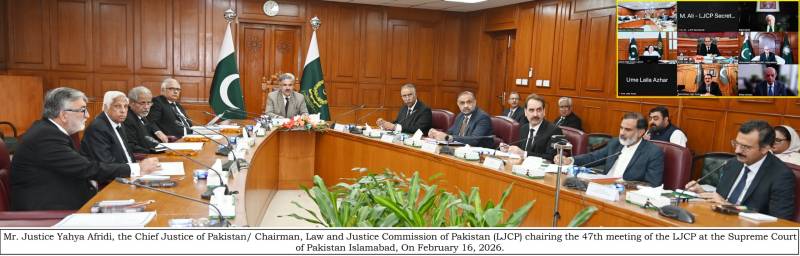

Chief Justice of Pakistan and Chairman of the Law and Justice Commission of Pakistan (LJCP) Justice Yahyah Afridi chaired the 47th meeting of the Commission today at the Supreme Court of Pakistan, to deliberate upon proposals for advancing law reform in line with constitutional mandates and contemporary societal needs.
The meeting was attended Justice Amin-ud-Din Khan, the Chief Justice of the Federal Constitutional Court. Other participants included the Chief Justice, Islamabad High Court; Additional Attorney-General for Pakistan; the Secretary, Ministry of Law and Justice; the Acting Chairperson, National Commission on the Status of Women; Muhammad Munir Paracha and Kamran Murtaza, Senior Advocates of the Supreme Court of Pakistan.
Chief Justice of the Lahore High Court, the Chief Justice, Peshawar High Court, the Chief Justice, High Court of Sindh, and the Chief Justice, High Court of Balochistan, along with Mr. Justice (Retd.) M. Shaiq Usmani and Barrister Sajid Zahid, Senior Advocate of the Supreme Court of Pakistan, attended the meeting virtually.
Under its statutory mandate to recommend reforms for improving the justice system, the Commission undertook a comprehensive review of key reform initiatives, including Family Laws, the Code of Criminal Procedure, procedural reforms for e-filing of cases, and other areas requiring legislative modernization.
In a landmark decision, the Commission tasked the LJCP Secretariat with developing a comprehensive framework for a free legal aid and advisory mechanism, including systemic arrangements in collaboration with the High Courts and the bar regulatory bodies.
The framework will explore modalities for institutionalizing pro bono commitments and funding out of relevant window of the Access to Justice Development Fund. The initiative is aimed at ensuring that no deserving litigant goes unrepresented and that every citizen, regardless of financial means, has access to legal advice and assistance. The Commission reaffirmed its resolve to inclusive and responsive law reforms to strengthen an accessible, efficient, and equitable justice system for all.