
Holy Kaaba is adorned with new Kiswa to mark new Islamic year
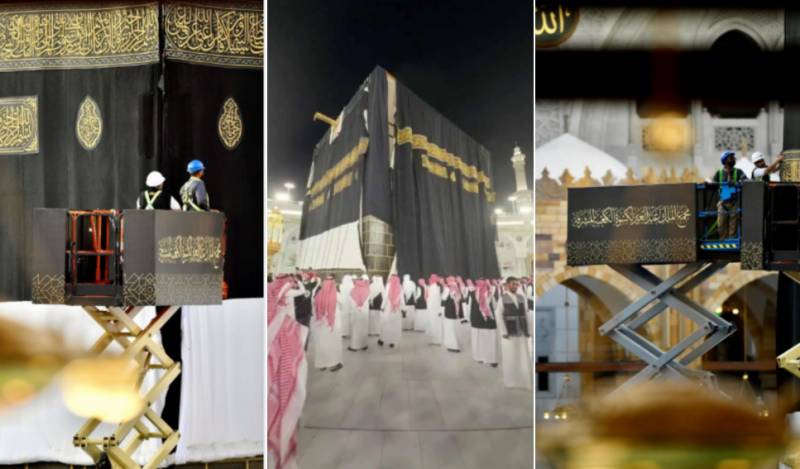

The Kiswa of the Holy Kaaba (Ghilaf-e-Kaaba) at the Grand Mosque in Makkah, Saudi Arabia, has been changed in an intricate annual ritual. The ceremony took place Tuesday morning, June 16, the first of Muharram, marking the beginning of the new Islamic year of 1448.
The process was carried out by the General Presidency for the Affairs of the Grand Mosque and the Prophet’s Mosque under the supervision of the President of the Presidency, Sheikh Dr Abdul Rahman bin Abdulaziz Al-Sudais.
A team of technicians and craftsmen from the King Abdulaziz Complex for Holy Kaaba Kiswa completed a ten-step process to replace an old cloth with a new one.
The team, based on their respective specializations, dismantled the old Kiswa, installed the new one, and fixed it at the corners and roof of the Holy Kaaba.
To install the Kiswa, each side of the four corners of the Holy Kaaba was lifted separately to the top, spread over the old side, fixed by tying and lowering, then moved up and down, lowering the old side from below and leaving the new side.
The process was repeated four times for each side until the Kiswa was completed and then the belt was weighed in a straight line by sewing it.
مشاهد من بداية رفع كسوة الكعبة.#واس pic.twitter.com/VEG2UqUBA4
— واس العام (@SPAregions) June 15, 2026
The sides and corners of the covering are fixed by sewing from the top to the bottom, followed by the placement of the curtain, which requires skill and time. A cut was made in the black fabric to match the size of the curtain, approximately 3.33 meters wide and 6.35 meters long.
The number of gilded pieces of the Holy Kaaba’s covering is 53, including 16 pieces for the belt, 7 pieces under the belt, 4 pendants, 17 lanterns, 5 pieces for the door curtain, a piece for the Yemeni corner, 2 kinars, and a gutter ornament.
The General Authority for the Care of the Affairs of the Grand Mosque and the Prophet's Mosque has started on Monday night the process of replacing the Kiswa such as removing the gold-embroidered ornaments, decorative elements, lamps, and other embellishments attached to the Kiswa, as well as lowering the curtain of the Kaaba's door, in accordance with the annual customary tradition associated with the Holy Kaaba.
The new Kiswa was transported from the complex to the Grand Mosque through an integrated operational system that adheres to the highest international standards.
The production of the Kiswa relies on premium raw materials, including 825 kilograms of natural silk, 47 rolls of black silk for the outer covering, 400 kilograms of raw cotton for the inner lining, 60 kilograms of pure silver for embroidery, and 120 kilograms of gold-plated silver used in embroidering Quranic verses and decorative motifs.
مشاهد لاستبدال كسوة #الكعبة_المشرفة.#واس pic.twitter.com/yxqXOqjFUd
— واس العام (@SPAregions) June 15, 2026
These materials undergo rigorous testing in the complex's laboratories to ensure compliance with the highest quality standards and durability under varying climatic conditions. During the printing stage, Quranic verses and Islamic motifs are transferred onto the fabric in preparation for embroidery. The verses and motifs are then embroidered with gold and silver threads using highly precise techniques that reflect the advanced level of Saudi craftsmanship.
Hand weaving continues to be used for specialized pieces and decorative elements that require exceptional skill and precision. Saudi craftsmen contribute to preserving the artistic and heritage character that has distinguished the Kiswa throughout its long history. Following completion of the manufacturing stages, the embroidered pieces are assembled to form the complete Kiswa, ready for installation on the Holy Kaaba.
هيبةُ المشهد وعظمةُ المكان.. المسجد الحرام يشهد لحظات استبدال كسوة الكعبة المشرفة.#واس pic.twitter.com/fXGz2y8Zvf
— واس العام (@SPAregions) June 15, 2026
The seven stages of production—dyeing, machine weaving, laboratory testing, printing, embroidery, hand weaving, and assembly—reflect an integrated system of quality and craftsmanship. Premium materials are combined with meticulous workmanship to produce a final masterpiece befitting the status of the Holy Kaaba and the sanctity of the Grand Mosque.
Through these efforts, Saudi Arabia continues to advance the production of the Kiswa by utilizing national expertise and modern technologies, ensuring the preservation of this important Islamic heritage. For a century, the annual replacement of the Kiswa has stood as a symbol of the Kingdom's commitment to serving the Two Holy Mosques and renewing the covering of the Holy Kaaba each year.
A Sacred Tradition: The Ceremony to Replace the Holy Kaaba’s Kiswa Begins.#SPAGOV pic.twitter.com/DW2RakjX35
— SPAENG (@Spa_Eng) June 15, 2026