
Khawaja Asif warns against politicising Kashmir, says state's future must be decided by Kashmiris
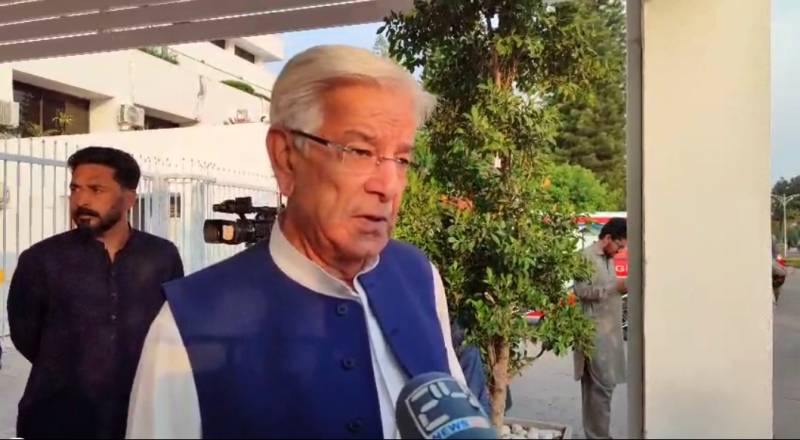

Defence Minister Khawaja Asif has stressed that the people of Azad Jammu and Kashmir (AJK) should be allowed to decide their political future through democratic means, warning against attempts to exploit the region's issues for political point-scoring.
Speaking during a discussion on national and political matters, the defence minister said that all legitimate demands of refugees from Indian Illegally Occupied Jammu and Kashmir (IIOJK) settled in Pakistan had been accepted, acknowledging the sacrifices they had made over the decades.
Referring to the political situation in Azad Kashmir, Asif criticized what he described as efforts to create unrest in the region. He noted that 12 seats in the AJK Legislative Assembly are reserved for Kashmiri refugees residing in Pakistan and emphasized that these refugees have paid a heavy price due to the Kashmir conflict.
“The people of Azad Kashmir should be allowed to decide who they want to vote for,” he said, adding that power cannot be handed over to mobs or pressure groups.
The defence minister urged political parties to avoid using sensitive national issues, including Kashmir, for political gains. He said that Pakistan’s political leadership must rise above partisan interests and focus on national unity.
Addressing broader political matters, Asif remarked that political parties often accuse one another while ignoring their own past actions. He recalled cross-party consultations on key legislation, including the Anti-Money Laundering Bill and amendments to the National Accountability Bureau (NAB) laws, saying such discussions involved politicians from different parties and state institutions.
On national security, Asif said Pakistan had successfully confronted external threats and rendered immense sacrifices in the fight against terrorism. He stated that more than 4,300 young Pakistanis had embraced martyrdom, adding that terrorism remains a major challenge originating largely from Afghanistan.
The minister also highlighted improving relations with Iran and expressed hope that easing international sanctions on Tehran could create economic opportunities for Pakistan.
Commenting on the economy, Asif said the country had emerged from a critical phase and was gradually stabilizing. He stressed the need for a balanced tax system that would encourage citizens to contribute to the national exchequer willingly.
He concluded by calling for collective responsibility in addressing security, economic, and political challenges, while reiterating that democratic principles must prevail in Azad Kashmir and across Pakistan.