
Salaries up 7%, pensions 3.5% as Punjab unveils Rs5.903 trillion budget
Development budget is worth Rs2,638 billion | Rs650 billion allocated for salaries | Rs505.8 billion for pensions | Only 47 percent amount earmarked for development purposes | Over Rs900 billion for education | Govt’s current expenditures estimated at Rs1962b | Rs25.30 billion proposed for school education | Rs30.50 billion for higher education | Rs5.50 billion for Sports, Youth Affairs | Rs4.30 billion earmarked for energy projects | Rs60 billion for agriculture | Rs9 billion for food safety, consumer protection | Rs1.65 billion for commerce and investment

The Punjab government on Tuesday unveiled a Rs5.903 trillion budget for fiscal year 2026-27, proposing a 7% increase in salaries for government employees and a 3.5% rise in pensions while earmarking record allocations for development, education, health, infrastructure, industrialisation and social welfare programmes.
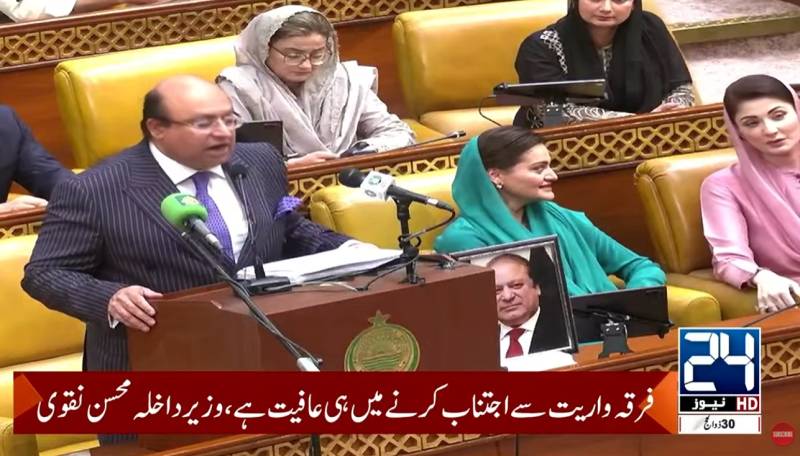
Punjab Finance Minister Mujtaba Shujaur Rehman presented the budget in the Punjab Assembly amid noisy protests by opposition lawmakers, who staged demonstrations inside and outside the assembly and demanded the release of PTI founder Imran Khan.
Punjab Finance Minister Mujtaba Shujaur Rehman delivered the budget speech in the Punjab Assembly with PML-N President Nawaz Sharif’s picture beside his dais.
The budget projects total expenditures of Rs3.57 trillion and a development programme of more than Rs2.63 trillion, reflecting the provincial government's emphasis on economic transformation, infrastructure development, digital governance and job creation.
The minister said the budget had been prepared after consultations with industrialists, traders and other stakeholders and was designed to balance fiscal discipline with public welfare and economic growth.
Punjab budget 2026-27 at a glance
Major headline numbers from the provincial budget.
Finance minister praises government performance
During his speech, Mujtaba Shujaur Rehman praised Chief Minister Maryam Nawaz for what he described as transformational governance initiatives across Punjab.
He credited Prime Minister Shehbaz Sharif and Field Marshal Asim Munir for Pakistan's diplomatic successes and said the country had played a constructive role in efforts aimed at maintaining regional peace.
The minister said the provincial government had adopted austerity measures, reduced official expenditures, cut ministerial salaries and focused on protecting citizens from inflation.
He said Punjab remained the backbone of Pakistan's economy and had contributed Rs546 billion to the federation.
Major Punjab budget allocations
Selected sector-wise allocations in billion rupees.
Government employees get salary increase
The government has proposed a 7% increase in salaries for provincial employees and a 3.5% increase in pensions, in line with the federal government's policy.
The pay and pension adjustments are expected to place an additional burden of Rs500 billion on the provincial exchequer.
However, the government expects expenditure on employees to decline by 1.4% due to rightsizing and administrative reforms.
Development spending tops Rs2.6 trillion
The development budget has been estimated at Rs2.638 trillion, while Rs803.88 billion has been proposed for public welfare projects.
Capital expenditures are projected at Rs1.679 trillion.
Punjab expects to receive Rs4.39 trillion from the federal government under the NFC Award, while provincial revenue has been targeted at Rs1.209 trillion.
The budget also incorporates a surplus of Rs910 billion under the financial framework agreed with the International Monetary Fund (IMF).
Where the spending goes
Comparison of development and current expenditure estimates.
Education receives largest allocation
Education emerged as the biggest beneficiary of the budget, receiving an allocation of Rs750 billion.
The government announced continuation of laptop and merit scholarship programmes, with more than 100,000 laptops to be distributed among students.
More than Rs20 billion has been earmarked for the Honhaar Scholarship Programme.
School education has been allocated Rs25.3 billion, higher education Rs30.5 billion, special education Rs3.7 billion and literacy and non-formal education Rs3.8 billion.
Health sector receives major boost
The health sector has been allocated Rs680 billion overall, while specific health allocations include Rs500.62 billion for health services and Rs43.1 billion for specialised healthcare and medical education.
The government plans to spend Rs100 billion on free medicines, including dedicated support for cancer and heatstroke patients.
Another Rs33.2 billion has been proposed for health and population welfare programmes.
Clean water, sanitation and local government
The government has proposed Rs507 billion for clean water and sanitation initiatives.
Projects worth Rs187.1 billion will focus on water, sanitation and urban development.
A Clean Water Programme costing Rs45 billion is underway, while the Chief Minister's Rural Sanitation Programme is planned at a cost of Rs300 billion.
The Punjab Rural Sustainable Water Supply and Sanitation Project, worth Rs96.2 billion, will benefit nearly 2,000 villages in 16 districts.
The Punjab Finance Commission has been allocated Rs900 billion, while local governments are expected to receive Rs803 billion.
Economic transformation plan
The budget includes a Rs1.22 trillion economic transformation strategy aimed at industrial growth, exports and investment.
The government plans to establish a Punjab Wealth Fund worth Rs700 billion and a Punjab Infrastructure and Guarantee Fund worth Rs300 billion.
Officials said the plan seeks to transform Punjab into a modern industrial and technology-based economy.
An investment of Rs783 billion is expected under the programme, supported by reforms designed to attract private investment and improve the business environment.
Economic transformation plan
Punjab’s proposed Rs1.22 trillion flagship economic plan.
Industry and exports
The budget proposes a series of incentives for export-oriented industries.
More than 40 new garment houses are planned, with the government expecting the creation of 20,000 jobs in the garments sector.
A wastewater treatment plant costing Rs4.6 billion will be established for the leather industry in Kasur.
The government expects leather exports to increase by up to $300 million annually.
Sports goods manufacturers will receive Rs5.5 billion in support, including international-standard testing facilities and global certification programmes.
More than 1,000 exporters are expected to benefit from reforms aimed at removing regulatory hurdles.
The budget also includes Rs4 billion for cutlery, hand tools and crafts industries, Rs250 million for ceramics development and Rs700 million for a testing laboratory for the fan industry in Sambrial.
Industrial estates and investment
Punjab has proposed Rs35 billion for industrial estates in Faisalabad, Vehari, Rahim Yar Khan and Bahawalpur.
The programme is expected to attract Rs80 billion in private investment and create more than 40,000 jobs.
Another Rs20 billion has been allocated for cluster infrastructure development.
The government has also announced a new land lease policy for special economic zones aimed at reducing business costs and attracting investors.
Agriculture and livestock
Agriculture, livestock and aquaculture have been allocated Rs132.54 billion.
The government expects total investment exceeding Rs615 billion in agriculture and rural development over the next three years.
A Rs135 billion agricultural mechanisation programme has been announced to modernise farming practices.
The Kisan Card Programme will receive Rs10 billion, benefiting approximately one million farmers.
Under tractor subsidy schemes, thousands of tractors will be distributed among farmers in the coming year.
The government has also announced agro-processing parks in Sargodha, Khanewal, Okara and Bhakkar.
Livestock and dairy development
Livestock programmes received substantial allocations.
Livestock Card Phase-II will receive Rs4.44 billion, while 300,000 livestock farmers are expected to benefit from interest-free loans.
The government will distribute milking animals to 10,000 rural women and establish 146 veterinary hospitals and 482 mobile veterinary dispensaries.
The Live Meat Programme and Live Milk Programme are expected to significantly increase exports and rural incomes.
Housing programmes expanded
The government announced expansion of the Apni Chhat Apna Ghar Programme.
Officials said 173,000 housing loans have already been issued and more than 101,000 houses completed.
In the next fiscal year, 200,000 families are expected to receive interest-free loans worth Rs300 billion.
The government pledged continued support for low-income and homeless families through expanded housing initiatives.
Social welfare and poverty alleviation
Punjab has proposed Rs40 billion for the Ration Card Programme and Rs35 billion for the Ramadan Package.
The Himmat Card Programme has been allocated Rs5 billion for persons with disabilities.
The Dhee Rani Programme, supporting mass marriages, will continue with fresh allocations.
The government has also earmarked Rs18.5 billion for financial assistance to mosque imams.
Additional funding has been proposed for minority welfare programmes, old-age homes and social protection initiatives.
Youth development and skills
The budget contains extensive programmes aimed at youth development and employment generation.
A Youth Development Initiative worth Rs39 billion has been announced.
The government plans to train hundreds of thousands of young people under Skilling Punjab, Skills for Global Needs and technology-focused programmes.
Officials expect these initiatives to increase overseas employment opportunities and boost remittances.
Technology and digital economy
Punjab plans major investments in digital governance and technology.
The budget allocates Rs12.3 billion for Frontier Tech Skills and Innovate Punjab, while Rs19.7 billion has been proposed for Accelerate Punjab Tech Skills.
More than 1,200 startups are expected to receive support under innovation programmes.
Sports and Film City
The government announced plans to establish Maryam Nawaz Sports City in Lahore at an estimated cost of Rs50 billion.
Sports development projects will receive Rs6.6 billion in the coming fiscal year.
A Film City Programme worth Rs55 billion has also been proposed to promote cultural and creative industries, including film studios, production facilities and training institutions.
Law and order
Punjab has allocated Rs252 billion for law enforcement and policing.
Smart Safe Cities projects are being expanded across the province with investments in digital surveillance, command-and-control centres and modern policing systems.
Crime scene units will be established in 28 districts, while new police stations and posts will be built in underserved areas.
Environment and climate initiatives
The Environment Department has been allocated Rs17.2 billion.
The government highlighted anti-smog initiatives, climate resilience programmes and environmental monitoring systems.
More than 10 million trees are planned to be planted in south Punjab under a plantation drive costing Rs8 billion.
The budget also includes funding for air quality monitoring, water quality testing, anti-smog guns and green building programmes.
Transport and electric buses
The government plans to significantly expand public transport through electric mobility projects.
More than 400 electric buses are already operating in Punjab, while another 700 will be introduced shortly.
The budget proposes the procurement of 2,000 additional electric buses at a cost of Rs168 billion.
Mass transit projects worth Rs143 billion are also underway in Faisalabad and Gujranwala.
Punjab budget key figures
Quick reference table for readers.
| Item | Allocation/figure |
|---|---|
| Total budget outlay | Rs5.903 trillion |
| Development budget | Rs2.638 trillion |
| Education | Rs750 billion |
| Health | Rs680 billion |
| Clean water and sanitation | Rs507 billion |
| Law and order | Rs252 billion |
| Electric buses | Rs168 billion |
| Ration Card Programme | Rs40 billion |
Opposition protests
The budget session was marked by protests from opposition lawmakers, who staged demonstrations outside and inside the Punjab Assembly.
Opposition members entered the assembly hall in the form of a rally and raised slogans demanding the release of PTI founder Imran Khan while the finance minister delivered his speech.
Despite the protest, the government proceeded with the budget presentation, describing the financial plan as a roadmap for economic transformation, industrial expansion, social welfare and sustainable development across Punjab.
Cabinet approves budget
Earlier, Punjab Chief Minister Maryam Nawaz signed the budget documents after the provincial cabinet gave its approval, which is 10.7 per cent more than last year's.
The chief minister, on the occasion, ordered the Punjab Revenue Authority to take steps to augment the revenue.
Applauding the team for preparing what she claimed the best budget, the chief minister said that the team worked like one unit in order to provide relief to the masses.
“Despite the fact, that there was lot of strain on the Punjab government’s purse after a huge amount was given to the Centre and also due to financial constraints and the situation in the region, still it was our endeavour not to put the burden on our people,” she said, and added, “That’s why, there are no new taxes in the budget and the provincial government is going to present people’s-friendly budget.”
She expressed the hope that just like the case had been in the past, this time, too, the provincial government would meet the expectations of the people.
It has been estimated that the province will receive Rs3,793 trillion under the National Finance Commission (NFC) Award, while the province expects to generate an income of Rs1,330 trillion under the head of duties. Rs800 billion is proposed for the Punjab Finance Commission, while over Rs900 billion is for education.
--Suthra Punjab programme--
Under the proposed allocations, Rs800 billion have been earmarked for the Punjab Finance Commission. Social protection programmes are expected to receive Rs25 billion, while the Suthra Punjab Programme is likely to be allocated Rs150 billion.
--Health budget--
The health sector is expected to receive an overall allocation of Rs680 billion. The budget proposes Rs100 billion for the provision of free medicines, while separate allocations are also expected for medicines and treatment support for cancer and stroke patients.
More than Rs200 billion has been proposed for ongoing initiatives launched by the Chief Minister.
The Parwaz Card programme has been allocated an estimated Rs7 billion, while the Kisan Card scheme is expected to receive Rs10 billion.
The Himmat Card and Minority Card programmes are likely to receive a combined allocation of Rs3 billion.
--Ramadan package--
In addition, the Ramadan Package is estimated to receive Rs35 billion, while more than Rs80 billion have been proposed for various subsidy programmes aimed at providing relief to the public.
PPP raises objections to budget
Pakistan People’s Party (PPP) raised objections to Punjab budget, reported 24NewsHD TV channel on Tuesday.
In this regard, PPP parliamentary leader Ali Haider Gilani has informed Senior Minister Marriyum Aurangzeb about reservations.
He said that there are objections to not making South Punjab a province and not providing better redress to the losses of farmers.
He said that the highest funds in the budget are for Lahore while other districts are being ignored.
He further said the government has not yet fulfilled the demand for South Punjab province.
The promise of green buses in South Punjab has also not been fulfilled, he added.
He said not a single promise made to farmers in the previous budget has been fulfilled.
Reporters Rao Dilshad Hussain and Ali Ramay