
US expects second stage of Iran peace deal to be ‘easier’, says Trump
US president says Washington has 'no obligation' to invest in Iran: FM Araghchi says talks on final accord with US 'likely' to start Friday: US says Strait of Hormuz will be toll-free under Iran deal: $300 billion reconstruction funds for Iran “tied to performance”: Trump, Vance, Ghalibaf electronically sign the peace MoU: IAEA inspectors to help Iran destroy enriched uranium
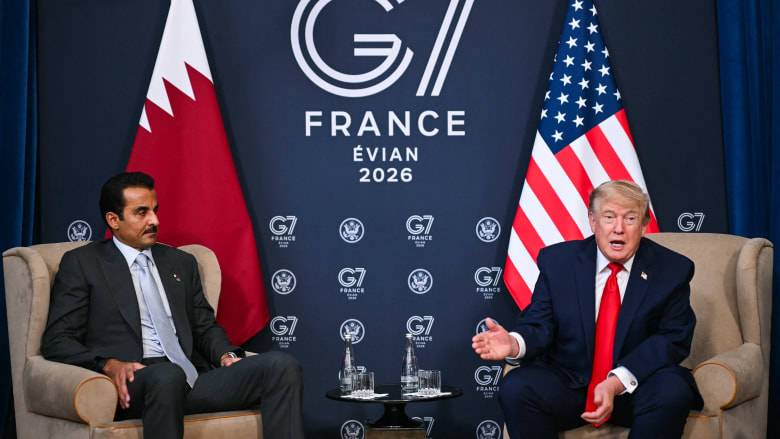

The United States has "no obligation" to invest in Iran even after its deal with the Islamic republic to end the Middle East war, President Donald Trump said on Tuesday.
"We are not investing any money" in Iran, Trump said at the G7 summit in France after talks with the Emir of Qatar, adding that the main focus of the deal was that Iran would not acquire a nuclear weapon and that "all hell" would "rain down" on the country if it did.
The US president said the announced deal with Iran “should be successful.”
Trump said he expects that negotiations to reach a planned second stage of the deal to “be actually easier”.
Trump said under the agreement being negotiated with Iran it “can’t have a nuclear weapon” or “they get blown up”. “This deal is a wall to a nuclear weapon,” said Trump, while describing the previous nuclear deal with Iran – reached under the administration of former US President Barack Obama – as “a road to a nuclear weapon”.
Trump said the Iran deal specifies that Tehran will not possess a nuclear weapon. “The only thing that really matters to me is Iran will never have a nuclear weapon, and it says it loud and clear,” he told reporters.
“All hell will rain down” on Iran if it intends to acquire a nuclear weapon, Trump added.
Talking about the Iranian regime change, Trump said the current Iranian leaders are “very rational people,” adding they are “not radicalised”.
“I never cared about the regime change,” Trump said. He further said that regime changes don’t work, and that countries should run on respect, not fear.
Trump appeared to criticise Israeli military action in Lebanon, saying it has been fighting Hezbollah “too long and too many people are being killed”.
“You don’t have to knock down an apartment house every time you’re looking for somebody because there’re a lot of people in those apartment houses — and they’re not all Hezbollah,” the US president said.
“I suggested to Israel to let Syria take care of Hezbollah because, to be honest with you, I think they’d do a better job of doing it,” Trump added.
Trump said he has a great relationship with Israeli Prime Minister Benjamin Netanyahu, but that he must be more responsible with respect to Lebanon.
Trump said he told Israel that he did not like its attack on Beirut and suggested that Syria should take care of Hezbollah instead of Israel.
Iran FM says talks on final accord with US 'likely' to start Friday
Iran's Foreign Minister Abbas Araghchi said on Tuesday that talks with the United States on a final agreement covering Tehran's nuclear programme will likely begin on Friday.
"Likely on Friday, at a location to be determined... a new round of negotiations between Iran and the United States to reach a final agreement will begin," Araghchi said in a briefing with foreign diplomats broadcast on state television.
Araghchi said that ending the war in Lebanon was the "most important issue" in the peace deal with the United States announced the day before.
"The important point I want to emphasise here is that in our view, there are two parties to this memorandum -- one side is America and Israel, and the other side is Iran and Hezbollah," said Araghchi.
"This is perhaps the most important issue in the memorandum -- the declaration of an immediate and permanent end to the war on all fronts, including in Lebanon," he said.
Ghalibaf to attend signing of US deal
Iran's top negotiator Mohammad Bagher Ghalibaf will attend the signing in Switzerland of the deal ending the war with the United States, an Iranian deputy foreign minister said on Tuesday.
"Switzerland will be the venue for the signing, but the exact location has not yet been determined. The next round of negotiations will begin immediately after the signing," said Majid Takht-Ravanchi, according to state television.
He said US Vice President JD Vance will represent Washington, while "from Iran, it will be Mr Ghalibaf".
US says Strait of Hormuz will be toll-free under Iran deal
The United States said that ships will move toll-free through the Strait of Hormuz under an Iran peace deal signed by President Donald Trump, and insisted Tehran would have to fulfill its commitments before getting any economic benefits.
They included a possible $300 billion reconstruction fund for the war-battered country, but the release of funds will be "tied to performance," a senior Trump administration official said in a call with reporters.
Trump, US Vice-President JD Vance and Iranian parliament speaker Mohammad Bagher Ghalibaf electronically signed the so-called memorandum of understanding (MoU) Sunday, the officials said.
"The president wanted to sign it personally because he wanted to show his dedication to the process," one of the US officials said on condition of anonymity.
But Vance admitted the brief outline deal kicks the thorniest issues -- especially Iran's nuclear programme -- down the road.
"The MoU is about a page and a half, so it is a very general document," Vance told CNN.
He later said on NBC that US and international nuclear inspectors will be allowed back into Iran to help destroy its enriched uranium.
Vance will lead technical talks this week and attend a physical signing ceremony expected in Geneva, Switzerland.
Trump, attending the G7 summit in France, said the text would likely be released after Friday -- but the US officials said it would be "put out in the next 24-48 hours."
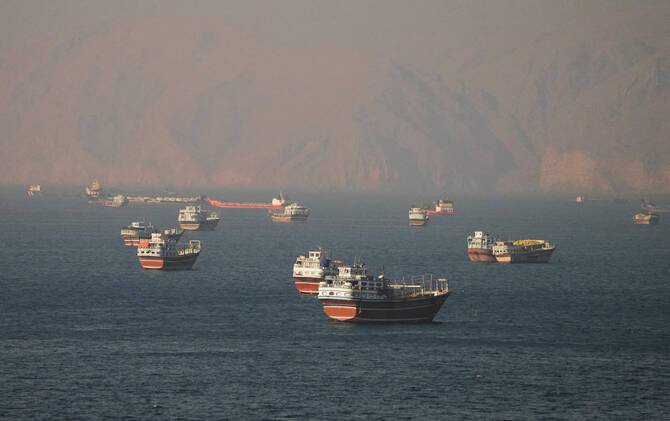
- Hormuz normal in 'couple of weeks'? -
The signing will kick off a 60-day period in which Tehran and Washington will try to hammer out a full-scale peace deal.
"We want to put the nuclear discussions up front," a US official said on the call.
But the Strait of Hormuz bottleneck is an immediate priority due to the global economic effects from the spike in oil prices.
Vance told CNBC there was an understanding with Iran that the strait would reopen "in a toll-free way for the long term, and that's the sort of thing that we're going to figure out in these technical negotiations."
Trump himself said the critical strait would be "completely open" from Friday but added there was still "hunting" going on to ensure it was de-mined.
Shipping traffic should return to pre-war levels "over the next couple of weeks" but there had already been a "substantial increase in traffic," the first US official said.
However, Iran's foreign ministry said Monday that the deal would allow it to charge maritime service fees on ships transiting the Strait of Hormuz, rather than imposing "tolls."
- 'Zero' funds released -
Uncertainty also surrounds other key aspects of the deal, including Iran's access to its frozen funds and relief from sanctions.
The issue is politically sensitive for Trump because he has alleged that a deal signed under Democrat Barack Obama -- which Trump scrapped in 2018 -- gave Tehran too much money.
"The very simple fact is zero dollars of frozen assets have been released by the United States or any other country," the first US official said.
"We discussed the possibility of releasing frozen funds, sanctions relief, a big $300 billion fund to rebuild their country, and all of these things are going to be tied to performance," added the second official.
Vance said no US taxpayer money -- "they never get a dime" -- will go to Iran under the deal and argued that Americans stand to benefit from lifting of sanctions against Iran by bringing it back into the international economy.
"There's a lot of benefit there, not American money, but there's a lot of economic prosperity that can flow from that," Vance told Fox News late Monday.
As part of a flurry of interviews to talk up the deal, he told NBC that US and UN nuclear inspectors will be allowed to enter Iran.
"In fact, one of the core parts of the agreement is that the (International Atomic Energy Agency) and the United States are going to help Iran destroy the highly enriched stockpile, and that's something that's spelled out very clearly" in the MoU, Vance said.