
IHC annuls Justice Tariq Jahangiri’s appointment as high court judge
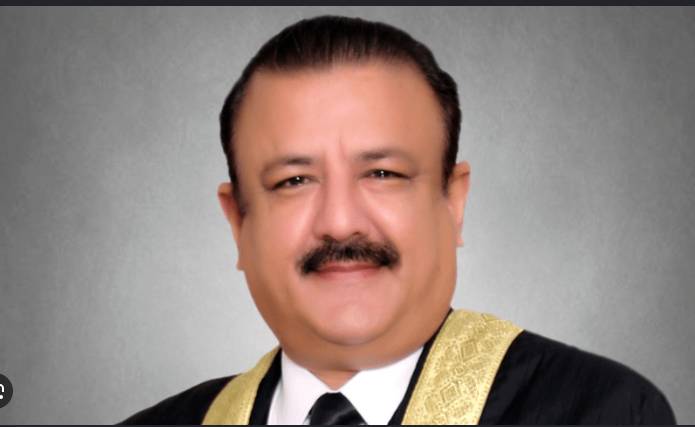

The Islamabad High Court (IHC) on Thursday declared the appointment of Justice Tariq Mehmood Jahangiri as the IHC judge null and void and ordered his removal as the judge of the high court, reported 24NewsHD TV channel.
A division bench of Islamabad High Court (IHC) ruled that Jahangiri’s degree was “invalid” at the time of his appointment. Chief Justice Sarfaraz Dogar and Justice Azam Khan pronounced the verdict on the petition filed by Mian Daud Advocate.
The division bench, led by Chief Justice Sardar Muhammad Sarfraz Dogar and Justice Muhammad Azam Khan, announced the judgement, which was reserved earlier in the day, on a plea that challenged the legitimacy of Justice Jahangiri’s law degree and appointment as a judge.
The bench directed Justice Jahangiri to cease his office forthwith for “having an invalid law degree at the time of his appointment and confirmation as a judge”.
The court also directed the law ministry to denotify Jahangiri as a judge.
Earlier, the court reserved the verdict after the completion of arguments in the judge’s fake degree case.
University of Karachi’s (KU) registrar Imran Ahmad Siddiqui, who appeared in court, presented the actual record pertaining to Jahangiri’s LLB degree.
The defendant did not turn up in court today.
His lawyers Akram Sheikh and Barrister Salahuddin represented him in his absence instead.
When the registrar started speaking, Sheikh tried to cut him short and said he could not show the record until and unless his applications were decided.
The Advocate General said that it had already been decided that the case was admissible for the hearing.
The chief justice asked the registrar what decision the university had taken.
The latter replied that the university had declared Jahangiri’s degree cancelled.
Barrister Salahuddin, counsel for Jahangiri, on the occasion said that the Sindh High Court (SHC) had suspended the KU’s declaration.
Another counsel for the defendant Akram Sheikh said that his client was entitled to a fair trial under Article 10-A.
Addressing CJ Dogar, Sheikh said it aloud that Jahangiri had filed a case against him in the Federal Constitutional Court. “So, therefore, he cannot hear the case,” he said, and added, “Maintain the dignity of court. Don’t violate the constitution. Or otherwise, Article 6 will apply to you.”
Mian Daud, the petitioner, said it was up to court to determine how to proceed.
“I take oath on holy Quran to prove that Jahangiri’s degree is fake,” the petitioner added.
Daud was of the opinion that despite stay granted by the SHC, the IHC could not stop hearing the case.
Speaking on the occasion, the registrar said that the Islamia Law College Principal had said that Jahangiri had never been enrolled in his institution. “As a matter of fact, Jahangiri had been caught teaching and a committee had imposed a three-year ban on him for cheating as well hurling threats at teachers.
“After the ban, Jahangiri was entitled to sit in the exam in 1992.”
Islamabad High Court (IHC) judge Justice Tariq Mehmood Jahangiri on Wednesday filed a complaint in the Supreme Judicial Council (SJC) against IHC Chief Justice (CJ) Sarfaraz Dogar, seeking his removal from the bench hearing his fake degree case.
In his complaint, Justice Jahangiri said that the IHC CJ discussed with him his case, which was sub judice. “During his discussion with me, CJ Dogar admitted he was under immense pressure to hear the case at the earliest,” the judge said, and added that by discussing with him a case, which was pending in court, the CJ had committed misconduct.
Justice Jahangiri further said that CJ Dogar advised him to resign from the post so that the pressure on him could ease. “By discussing a case, which is sub judice, the chief justice is no more eligible to sit on the bench hearing my case,” the judge said, adding now it was time that he recused from hearing the case.
Jahangiri went on to say it was desirable that the chief justice, instead of coming under pressure, should have followed the code of conduct. “But he did the opposite of that by pressuring me to resign.
Earlier on Wednesday, Justice Tariq Jahangiri challenged the Islamabad High Court’s decision declaring his degree case maintainable.
He filed an appeal in the Federal Constitutional Court.
According to the 24NewsHD TV channel, Justice Tariq Jahangiri's appeal seeks to have the high court’s ruling annulled.
The Islamabad High Court had previously declared the case against Justice Jahangiri, concerning the authenticity of his academic degree as maintainable.
Legal observers note that the appeal marks the next stage in a high-profile judicial matter that has attracted considerable attention in Pakistan.
Justice Jahangiri’s legal team argued that the high court’s decision was flawed and that the case should not proceed.
The Federal Constitutional Court will now examine the appeal to determine the next course of action.
On Monday, IHC judge Justice Tariq Mehmood Jahangiri, whose degree was declared fake by the Islamabad High Court (IHC), prayed to the court to refer the fake degree case against him to another bench, saying he did not trust IHC Chief Justice (CJ) Sarfaraz Dogar.
A two-member division bench, comprising CJ Dogar and Justice Azam Khan, heard the case.
The judge said he was willing to take oath on the holy Quran to prove that his degree is not fake.
The court directed Jahangiri to provide a copy of the petition and all other related documents.
The judge sought time from the court.
The IHC directed the University of Karachi’s registrar to appear at the next hearing along with the relevant record.
Later, the court adjourned the case’s hearing until December 18.
A few days earlier, the University of Karachi (KU) and the Higher Education Commission (HEC) submitted in the Islamabad High Court (IHC) their replies in the fake degree case of the IHC judge Justice Tariq Mehmood Jahangiri.
In its reply, the KU said that in 1989, the university’s unfair means committee imposed a three-year ban on the judge, who was a student at that time, for cheating and threatening the examiners. “In light of the ban, Jahangiri was supposed to sit in the exam in 1992,” it said, adding, “But despite the ban, the judge used a fake enrollment form in 1990.”
The university further said that Jahangiri used a fake stamp of the Government Islamia College on the form. “The enrollment number on the judge’s degree: 5968/87 had been allotted to a student named Imtiaz Ahmad. Moreover, in 1990, Jahangiri got himself allotted enrolment number 7184/87 for appearing in the LLB Part-II exam through illegal means,” the KU said in its reply, adding that the judge got the law degree and marks sheets by changing names and enrolment numbers.
It went on to say that on May 23, 2024, Irfan Mazhar, a citizen, submitted an application for the verification of Jahangiri’s degree.
In response to the application, the examiner again checked both enrolment numbers and declared that the degree and marks sheets were not genuine.
“On July 5, 2024, the registrar IHC sought the confirmation of the examiner’s letter via an e-mail,” the KU said, adding, “Responding to the e-mail, the university confirmed the examiner’s letter declaring the degree fake.”
Besides that, the reply read, Islamia College principal also confirmed that Jahangiri had never been their student from 1984 and 1991.
In its reply, the HEC said it had nothing to do with the awarding of a degree. “The awarding of a degree is the job of a university,” the commission said, adding, “If the university does not recognize the degree, the HEC does the same.”
The commission further said that it provided guidelines for an improvement in the system of education at universities, and that it had nothing to do with the internal matters of universities.
The HEC went on to say that no application was submitted to it for the verification of Jahangiri's degree.
Reporter: Ihtesham Kiani