
India’s Earth Observation Mission fails miserably
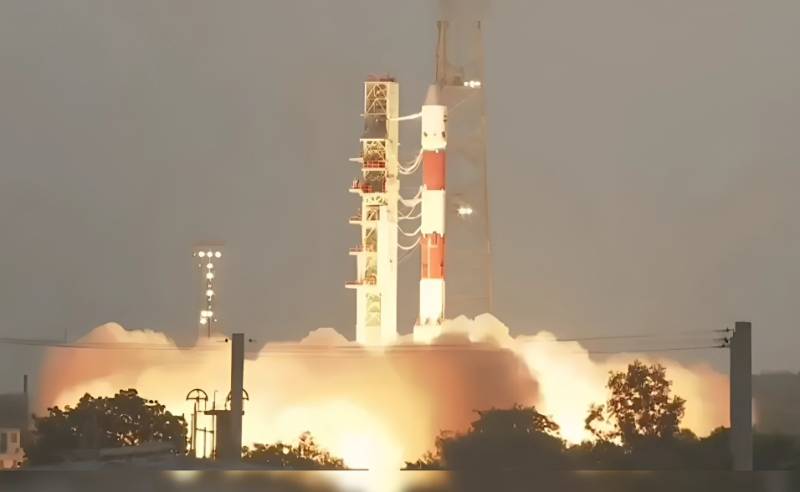

India’s highly anticipated 101st space mission suffered a major setback Sunday when the Indian Space Research Organisation’s (ISRO) PSLV-C61 launch failed to achieve its objective due to a technical glitch in the rocket’s third stage.
The mission, carrying the Earth Observation Satellite EOS-09, was launched at 5:59 am IST from the Sriharikota launch pad in Andhra Pradesh but could not be completed as planned.
ISRO Chief V. Narayanan confirmed the failure shortly after liftoff, explaining that while the Polar Satellite Launch Vehicle (PSLV), a four-stage rocket, performed normally up to the second stage, an abnormality was detected during the third stage.
“The third stage motor started perfectly, but during its functioning, we observed a drop in chamber pressure, and the mission could not be accomplished,” Narayanan stated. He added that a detailed analysis is underway, and the agency will report back with findings.
The 1,696-kg EOS-09 satellite was intended to be placed in a Sun-synchronous polar orbit and was designed to provide high-resolution, all-weather, day-and-night imaging for applications such as agriculture, forestry, disaster management, urban planning, and national security. The mission was also structured to be debris-free, with fuel reserved for controlled de-orbiting after its operational lifespan.
Despite the initial flawless lift-off and what appeared to be a textbook start to the 63rd PSLV flight—and 27th using the PSLV-XL configuration—the mission failure marks an embarrassing hiccup for ISRO. EOS-09 was a repeat satellite of EOS-04, launched in 2022, and was part of a broader effort to expand India’s remote sensing capabilities.
This failed attempt has cast a temporary shadow on India’s otherwise strong space ambitions, particularly as it continues to diversify satellite applications for strategic and civilian use.