
US Senate leaders say no Ukraine aid before year's end
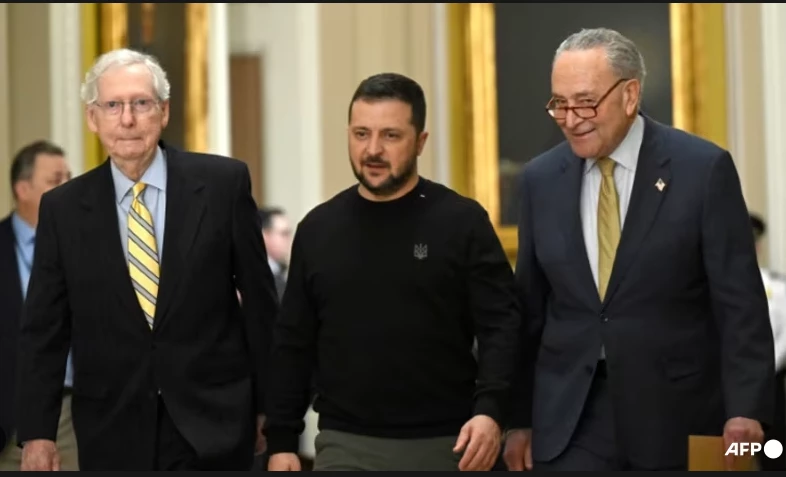

The Democratic and Republican leaders of the US Senate said Tuesday that Washington will not be able to approve new aid for Ukraine before year's end, as the two sides continue to seek a compromise.
"As negotiators work through remaining issues, it is our hope that their efforts will allow the Senate to take swift action... early in the new year," Democrat Chuck Schumer and Republican Mitch McConnell said in a joint statement.
"In the time remaining this year, Senate and Administration negotiators will continue to work in good faith toward finalizing their agreement."
"Challenging issues remain, but we are committed to addressing needs at the southern border and to helping allies and partners confront serious threats in Israel, Ukraine and the Indo-Pacific. The Senate will not let these national security challenges go unanswered."
The announcement from Capitol Hill marked another setback for Ukrainian President Volodymyr Zelensky, whose government has warned of the "dire need" for weapons ahead of winter.
Zelensky flew to Washington in mid-December -- his third trip to the US capital in a year -- to lobby for the aid.
Zelensky remains hopeful, saying at a press conference Tuesday that the United States "will not betray" his besieged nation.
Ukraine's military has failed to mount a major counteroffensive in recent months, and Russian pressure on the frontlines remains stiff.
- Conditions on new aid -
The congressional impasse is also a blow to President Joe Biden, who has made support for Ukraine and the strengthening of the Atlantic alliance hallmarks of his foreign policy.
Ten months ago, Biden visited Ukraine, the first trip by a US leader to a war-torn country not under US control, underscoring his commitment.
But almost two years after Russian forces invaded Ukraine -- and more than $110 billion in US taxpayer money released by Congress -- questions have come to the fore more insistently about how open-ended the US support is.
Republicans in particular have begun to find the cost too steep. They have made their support for the new package conditional on a drastic tightening of US immigration policy. However, haggling on this hot-button issue did not conclude in time.
To improve prospects for the proposal amid some fatigue over the grinding war, Biden tied his Ukraine request to a proposal to offer $14 billion to Israel, a US ally with broad bipartisan support.
So far, the tactic hasn't pay off.
- Hurdles in the House -
Since Russian tanks first rolled into Ukraine, the Kremlin has bet that Western military support would ebb. Any hesitation on the part of Kyiv's allies reinforces Russia's belief that its gamble will pay off.
However, the failure of Congress to approve this package does not mean the end of US support for Kyiv.
US lawmakers return to work on January 8, and Republican and Democratic leaders of the Senate have stated their intention to approve the package, which includes military, humanitarian and macro-economic components.
It is in the lower House, which must also approve the aid package, where things get complicated.
New House Speaker Mike Johnson, a Republican, is not opposed in principle to extending US aid, but claims that there is a lack of oversight.
What the Biden administration seems to want are "billions of additional dollars with no appropriate oversight, with no clear strategy to win, and none of the answers that I think the American people are owed," Johnson asserted after his interview with Zelensky on Tuesday.
Johnson, meanwhile, has the hard right of his own party to contend with, including those who don't want to disburse one penny more to Ukraine.
Among them are lawmakers, many close to former president Donald Trump, who were active in the effort to remove the past Speaker in October, accusing him among other things of concluding a "secret deal" on Ukraine with Democrats.
Zelensky voiced awareness of impending risks, saying the return of Trump to the White House could have a "strong impact" on the war in Ukraine.
'No one knows'
President Volodymyr Zelensky said Tuesday that there was no end in sight to Russia's invasion of Ukraine, as fatigue builds among Kyiv's allies nearly two years into the war and the Kremlin voices growing confidence of victory.
Zelensky said he had turned down a request from the military -- for now -- to mobilise as many as 500,000 Ukrainians for the army, an unpopular proposal that could hit his worsening poll ratings among Ukrainians.
His meeting with local and foreign journalists wraps a difficult year in Ukraine, with Kyiv's forces under pressure on the front and allies wavering on military and financial backing.
"No one knows the answer," Zelensky told reporters in response to a question of whether the war with Russia could end next year.
"Even respected people, our commanders and our Western partners, who say that this is a war for many years, they do not know," he said.
The question of how long Western countries will provide essential support for Kyiv has grown increasingly urgent.
Zelensky last week embarked on a tour of Western countries to make the case for more military and political support as Russia's invasion grinds closer to its two-year-anniversary in February.
But he failed to convince the US Congress to immediately approve $60 billion in support, while in Brussels, Hungarian leader Viktor Orban blocked an aid package of around 50 billion euros ($55 billion).
- Washington will 'not betray us' -
Zelensky said Tuesday that he wanted to organise talks with Orban to "find solutions" to their differences, and voiced confidence that Washington would follow through on aid.
"I am confident that the United States will not betray us," he said.
But hours later, the Democratic and Republican leaders of the US Senate, said that Washington would not be able to approve new aid for Ukraine before year's end as the two sides continued to seek a compromise.
With elections looming in the United States next year, Zelensky acknowledged that the result of the November poll could have a "very strong impact" on the course of the war, saying Republican favourite Donald Trump would "surely have a different policy" from Joe Biden.
Those setbacks on the diplomatic front come in the wake of a disappointing counteroffensive that Kyiv launched in June using Western-supplied tanks and weapons stockpiled over months.
Responding to growing weariness over the war, UN human rights chief Volker Turk said Tuesday that the world had become "jaded" by the Ukraine conflict, where war crimes continue to be committed "primarily by the forces of the Russian Federation".
In contrast, Russian President Vladimir Putin has vowed victory and said during a Tuesday meeting with defence officials that society had rallied behind the war effort.
Putin, who has announced he will run for re-election in March, lashed out at the West and claimed it was seeking Moscow's destruction.
"Well, we are not going to give up the goals of the special military operation, either," he said, using the Kremlin's term for the Russian invasion of Ukraine.
- Trust in leader waning -
Zelensky was facing growing discontent at home before becoming the global face of Ukrainian resistance after Russia's invasion, but he is once again feeling political pressure.
Recent polling shows that the number of Ukrainians who trust Zelensky has dropped to 62 percent compared to 84 percent one year ago, when Kyiv's forces were celebrating gains in the east and south.
The advances from this year's counteroffensive were much more modest, with just a few villages in the south and east recaptured after months of fighting against entrenched Russian forces.
Zelensky said he had received a request from the army to mobilise hundreds of thousands of people to replenish Kyiv's forces, but that he had told the military it "needed more arguments to support this idea".
Hours before Zelensky was due to speak, Russia's defence ministry said its forces had foiled a drone attack on a facility in Moscow.
But a senior Ukrainian military official at the same time conceded that fighting with Russian forces in the eastern Kharkiv region was "complicated", with Ukrainian forces outgunned and outnumbered.
In an overnight attack, meanwhile, Ukraine reported that nine people were wounded by Russian shelling in the southern city of Kherson, as drones also targeted the capital Kyiv and second-largest city Kharkiv.
Despite recent setbacks, Ukrainians still overwhelmingly back both the armed forces and its commander, Valery Zaluzhny.
In a move that illustrates growing political divides, Kyiv residents have been gathering in the city centre to demand more funds to help the military reclaim territory.
Zelensky has highlighted the Black Sea as a recent success story.
Ukrainian drones have forced some Russian warships to redeploy following several successful attacks.
Ukraine also re-opened a maritime corridor for commercial cargo ships using its Black Sea ports, despite threats from Moscow that vessels using the hubs could be treated as military targets.