
PM celebrates Pakistan victory over India in UN speech
Pushes for world peace: Vows to protect Pakistan’s water rights: Shows readiness for dialogue with India: Lauds Trump’s role in conflict with India terming him ‘truly is a man of peace’: Calls for independent Palestinian state with Al-Quds as capital
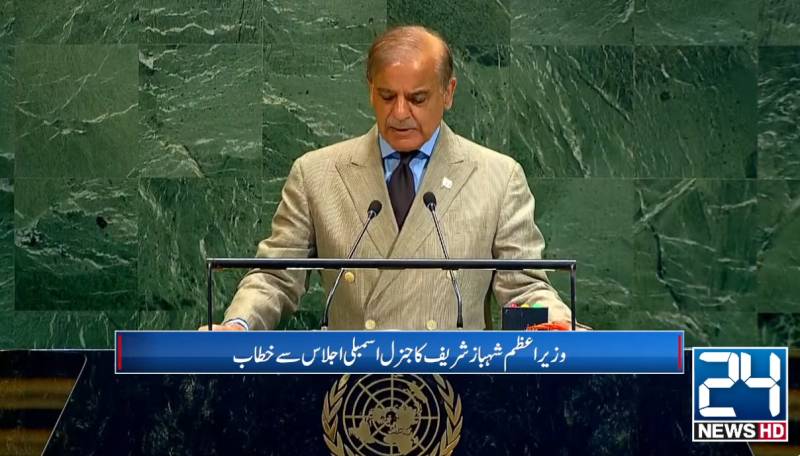

Prime Minister Shehbaz Sharif on Friday, highlighting the human rights violations in Kashmir and Palestine and condemning terrorism, reiterated Pakistan’s commitment to peace and dialogue but vowed to resolutely defend the nation against any external aggression or India’s usurpation of water rights.
The prime minister, in his 25-minute address at the 80th session of the United Nations General Assembly, encompassed all national, regional, and international issues, including the recent Pakistan-India war, Kashmir, Palestine, terrorism, Afghanistan, ongoing floods in Pakistan and multilateralism.
PM Shehbaz, who spoke for the third time to the 193-member world body, began his remarks highlighting the world’s complexities like intensifying conflicts, violation of international laws, humanitarian crises, disinformation, arms race, emerging technologies and climate change.
At the outset of his speech, the prime minister noted that the world is more complex than ever before, conflicts are intensifying, international laws are being brazenly violated, humanitarian crises are multiplying, terrorism remains a potent threat, disinformation and fake trust undermine trust, and climate change threatens are very survival and more so countries like Pakistan.
“Today, multi lateralism is no longer an option; it is a need of the hour. Pakistan's foreign policy, guided by Quaid-i-Azam, based on peace, mutual respect, and cooperation. We believe in the peaceful settlement of disputes through dialogue and diplomacy,” he said.
“Last year, from this very podium, I had warned that Pakistan would act and act most decisively against any external aggression. Those words of mine prove true. I hoped [they would not]. But then that is destiny. In May this year, my country confronted unresolved aggression from our eastern front. The enemy came shrouded in arrogance; we sent them back in humiliation, delivering a bloody nose.”
“India sought to extract political gains from a human tragedy by spurning my sincere offer of an independent international investigation into the Pahalgam incident,” he said.
The prime minister added: “Instead, it attacked our cities and targeted our innocent citizens. When our territorial integrity and national security were violated, our response was in accordance with the right of self-defence under Article 51 of the UN Charter.”
He hailed Pakistan’s armed forces and the military leadership, saying: “Our valiant armed forces, under the stellar leadership of Field Marshal Asim Munir mounted an operation of stunning professionalism, bravey and acumen. Repelling the enemy’s attack under Air Chief Marshal Zaheer Babar Sidhu, our falcons took flight and etched their answer across the skies, resulting in seven of the Indian jets being turned to scrap and dust.”
The prime minister Pakistan had agreed to a ceasefire following a four-day escalation with India in May from a position of strength. He also expressed gratitude to US President Donald Trump and his tams for “their active role” in bringing about the ceasefire.
“President Trump’s efforts for peace helped avert a … war in South Asia. Had he not intervened timely and decisively, the consequences of a full-fledged war would have been catastrophic,” PM Shehbaz said. “Therefore, in recognition of President Trump’s wonderful and outstanding contribution to promote peace in our part of the world, Pakistan nominated him for the Nobel Peace Prize. This is the least we could do … I think he truly is a man of peace.”
He also thanked Pakistan’s “friends and partners”, including China, Turkiye, Saudi Arabia, Qatar, Azerbaijan, Iran, the United Arab Emirates and the UN secretary general for extending diplomatic support to Pakistan during the escalation in May.
“We have won the war, and now we seek to win peace in our part of the world. This is my most sincere serious offer before this august assembly of the world nations. Pakistan stands ready for a composite, comprehensive and result-oriented dialogue with India on all outstanding issues,” he said.
PM Shehbaz emphasised that South Asia required “proactive rather than provocative leadership”.
INDUS WATERS TREATY
Coming to the Indian attempt to unilaterally hold in abeyance the Indus Waters Treaty, Prime Minister Shehbaz told the General Assembly that Pakistan would definitely and ardently defend the inalienable right of its 240 million people on these waters.
“Pakistan has made it abundantly clear, and let there be no doubt, we will definitely and ardently defend the inalienable right of our 240 million people on these waters. To us, any violation of this treaty represents an act of war,” he said.
He reminded the world that India’s unilateral and illegal attempt to hold the Indus Waters Treaty in abeyance defied the provisions of the Treaty itself, as well as the norms of international law.
KASHMIR DISPUTE
He told the world body that for nearly eighty years, India had tried to muzzle the voices of the brave people of Kashmir.
He assured the Kashmiri people, that the people of Pakistan stood with them and soon, one day, India’s tyranny in Kashmir would come to a grinding halt.
He said that the Kashmir would gain its fundamental inalienable right to self-determination through an impartial plebiscite under the auspices of the United Nations.
“Kashmir will gain its inalienable right to self-determination through an impartial plebiscite under the auspices of the United Nations,” he hoped.
ISRAEL’S AGGRESSION & GAZA
The prime minister, who spoke at length on the ongoing Israeli aggression in Gaza called it the “most heart-wrenching tragedies of our times” a stain on the global conscience, and a collective moral failure.
“In the West Bank, each passing day brings new brutality, illegal settlers who terrorize and kill with impunity and nobody can challenge them and question them. And in Gaza, Israel’s genocidal onslaught has unleashed unspeakable terror upon women and children in a manner we have not witnessed in the annals of history,” he said, underscoring that the Israeli leadership had unleashed a “shameful” campaign against the innocent Palestinians, which history would always remember as one of its darkest chapters.
“But speak we must,” he urged and condemned the killing of young girl Hind Rajab in an Israeli attack. Likening her to a daughter, he expressed shared global grief for failing her, drawing parallels to his anguish over carrying the coffin of seven-year-old Irtaza Abbas, killed in a recent India-Pakistan clash.
“Can you imagine that little girl—Hind Rajab—as if she were your daughter? … My agony, and the agony of the entire Muslim Ummah, indeed, I think the agony of all nations on the planet is that we failed Hind Rajab and she will not forgive us in this world and the world hereafter… We cannot – we must not, fail these children of Gaza, or any child anywhere—we must find a path to a ceasefire.”
Reiterating Pakistan’s support for the establishment of a sovereign Palestinian state, with pre-1967 borders, and Al-Quds Al-Sharif as its capital, he said Palestine must be liberated as it could no longer remain under Israeli shackles.
Prime Minister Shehbaz welcomed the recognition of the State of Palestine by a number of countries recently and urged others to also follow suit, besides thanking President Trump for inviting Arab-Islamic states for a consultative session at the United Nations, which rekindled hope for a ceasefire in the near future.
Calling Israel’s recent attack on Doha a reflection of “rogue” behavior, the prime minister told the world leaders that Pakistan also supported all efforts for a peaceful resolution of the Ukraine conflict, in line with the UN Charter, to end human suffering, and global turmoil, caused by the protracted war.
TERRORISM
He said that Pakistan condemned terrorism, in all its forms and manifestations as the country had been at the frontline of global counter-terrorism efforts – having suffered over 90,000 casualties and endured over US$150 billion in economic losses.
He said that terrorism could impact the world regardless of boundaries.
“For that Pakistan’s sacrifices are probably the biggest around the globe. It must be respected and appreciated because we are a bulwark. Had these terrorists not been encountered by us, they would have been roaming in the streets of New York and London and Far East. This is our humble contribution not only for the people of Pakistan but also the people all over the world,” he added.
“Today, we face externally sponsored terrorism, particularly from foreign-funded groups, such as the TTP, Fitna al-Khawarij, Fitna al-Hindustan, BLA and its Majeed Brigade. Operating from Afghan soil, these groups are responsible for some of the most heinous attacks inside Pakistan, including the dastardly Jaffar Express incident, earlier this year,” he highlighted.
He said that as Afghanistan’s neighbor, Pakistan sought regional stability and connectivity and also engaged with partners to provide humanitarian aid, support economic recovery, and promote an inclusive political framework in Afghanistan. However, the Interim Afghan Government must uphold human rights, including women’s rights, and ensure Afghan soil was not used for terrorism against any nation, he added.
HATE SPEECH & ISLAMOPHOBIA
The president also touched on the challenges of hate speech, discrimination or violence against any person, or religion, and said the hate-driven ideologies, like India’s Hindutva-driven extremism, posed a danger to the entire world.
“While there is growing recognition of the dangers posed by Islamophobia, the imperative of effectively combating this menace can hardly be overemphasized,” he remarked and welcomed the appointment of a UN Special Envoy to combat this scourge.
CLIMATE CRISIS & FLOODS
Coming to the climate crisis, he told the UN General Assembly that having suffered USD 34 billion losses due to 2022 floods, Pakistan was again currently dealing with another mega flood, which washed away thousands of villages, killed over a thousand people, displaced millions, and destroyed billions of dollars of crop, livestock and property.
“Our nation stands united in these testing times and we are dealing with this natural calamity with remarkable resilience. I have declared a climate emergency to cope with this challenge. The catastrophic floods of 2022 and 2025 are glaring examples of loss and damage caused due to climate change.”
He said that despite contributing less than 1% of global emissions annually, Pakistan was facing the relentless brunt of climate disasters.
Nevertheless, he said that Pakistan was enhancing its climate resilience and concurrently expanding the use of
clean energy.
However, he urged the developed countries – most responsible for the climate crisis – to deliver on climate finance commitments to support climate actions in developing countries.
He said the developing countries could not afford more debt burden to achieve climate resilience.
“This is not fairness, This is not equality. This is not fair play. This is not justice. How can we expect a country which is a developing country facing flood challenges every year due to climate change and there is no fault of ours… I think borrowing loans would be destroying your economy.”
STRUCTURAL REFORMS
Prime Minister Shehbaz said that Pakistan was addressing climate change while putting socio-economic development and public welfare on priorities.
Besides the structural economic reforms, modernized taxation, boosted investment, and embraced digitization, AI, and cryptocurrency are among the structural reforms introduced by the government, he added.
He told the UN that Pakistan’s strategic partnership with China, through the China-Pakistan Economic Corridor under President Xi Jinping’s Belt and Road Initiative, drove the country’s progress. He also commended President Xi’s Global Governance Initiative and other global efforts for promoting just and inclusive development.
PAKISTAN ROLE AT UN
Highlighting Pakistan’s role at the UN, the prime minister said that as a non-permanent UN Security Council member, Pakistan actively supported conflict prevention, as shown by the unanimous adoption of Resolution 2788 under its presidency, reinforcing multilateralism and UN Charter principles.
He said that Pakistan would always stand for peace, justice, and development – for a reinvigorated UN, and, for cooperative multilateralism, that was fair and inclusive, and delivered for all.
“Let this 80th anniversary not simply ‘commemorate’ history. Let us ‘make’ history and chart a future – for the next 80 years – with these United Nations, as humanity’s enduring hope for global good. Let us truly strive to become “Better Together,” he concluded.