
Law must prevail over force if multilateralism is to succeed at UN: Pakistan
Ambassador Asim Iftikhar says Indus Waters Treaty compliance is a cornerstone of the international legal order
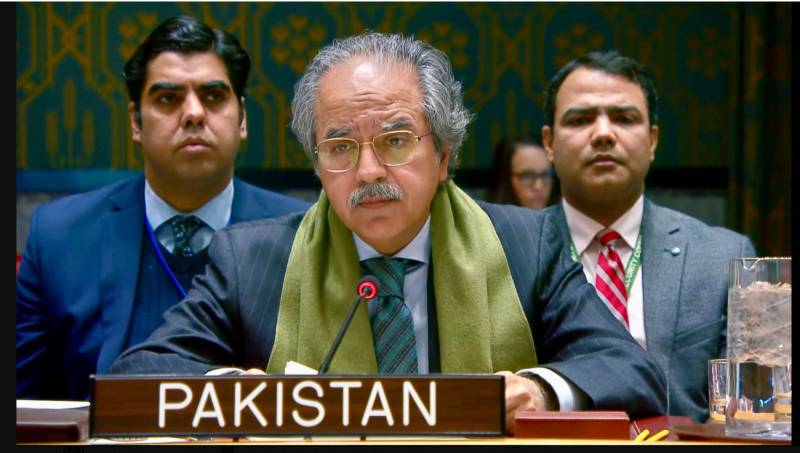

Pakistan has declared that the law must prevail over force if multilateralism is to endure at the United Nations as selective application of legal norms, erosion of treaty obligations, and unilateral actions have weakened trust among States and strained the multilateral system anchored in the UN Charter, reported 24NewsHD TV channel on Tuesday.
Pakistan Permanent Representative to the UN Ambassador Asim Iftikhar Ahmad said this while delivering a statement at the High-Level Open Debate of the UN Security Council titled "Reaffirming International Rule of Law: Pathways to Reinvigorating Peace, Justice, and Multilateralism" in New York on Monday.
Ambassador Asim Iftikhar told the Security Council that the international rule of law cannot be sustained by declarations alone, but by consistent conduct and credible accountability. “If multilateralism is to endure, law must prevail over force, principles over expediency, and justice over impunity. Pakistan remains committed to a UN Charter-inspired rules-based international order in which disputes are resolved peacefully, obligations are honoured, and the United Nations serves as a true guarantor of peace, justice, and dignity for all,” he added.
He further said the conflict between Pakistan and India in May last year reminded that the root cause of instability in South Asia remains India’s illegal occupation of Jammu and Kashmir, in gross violation of Security Council resolutions. “The continued denial of the right to self-determination of the Kashmiri people has grave human rights consequences and imperils durable peace. India’s unilateral suspension of the Indus Waters Treaty is another blatant breach of international obligations, threatening the lives and livelihoods of millions and endangering peace and security. Pakistan rejects the weaponization of water and other natural resources. Treaty compliance is a cornerstone of the international legal order,” he added.
Following the text of Ambassador Asim Iftikhar Ahmad’s statement:
“I wish to congratulate Somalia for its successful Presidency this month and for organizing this important debate. We see this as a continuation of series of high-level debates around the UN, multilateralism and international law over the year.
I thank Secretary-General Guterres, Chairperson of the AU Commission and Founding President of the African Institute of international law for their insightful remarks. Secretary General described rule of law as the beating heart of UN Charter and Judge Yusuf urged for fully respecting and strengthening it.
This debate is timely. The erosion of respect for international law is increasingly translating into conflict, humanitarian crises, and weakened multilateral cooperation. Reaffirming the international rule of law is therefore not an abstract legal exercise; it is a prerequisite for peace, justice, and collective security.
The purpose of international law is to inject stability into the international system by making inter-State conduct predictable and subject to agreed rules and boundaries. When that function is compromised, international law risks losing its meaning, and compliance becomes optional. A stable, peaceful, and productive international order can only endure if the rule of law is applied equitably, consistently, boldly and without discrimination.
Yet today, respect for international law is being tested as rarely before. Selective application of legal norms, erosion of treaty obligations, and unilateral actions have weakened trust among States and strained the multilateral system anchored in the UN Charter. When law yields to power or expediency, instability deepens, disputes entrench further, and peaceful coexistence jeopardized.
The core principles of the Charter — sovereign equality, non-interference, political independence and territorial integrity, the prohibition of the threat or use of force and self-determination — are being increasingly challenged. Attempts to normalize unilateral actions outside the Charter undermine collective security and weaken the credibility of multilateral institutions.
Pakistan has itself experienced such violations. Last May, India carried out an unprovoked military aggression in breach of international law and Pakistan’s sovereignty. Acting in accordance with Article 51 of the Charter, Pakistan exercised its inherent right of self-defence in a responsible, restrained, and proportionate manner. Our response established that there can be no “new normal” based on coercion or impunity. Respect for international law remains the only legitimate norm governing inter-State conduct.
That conflict also reminded that the root cause of instability in South Asia remains India’s illegal occupation of Jammu and Kashmir, in gross violation of Security Council resolutions. The continued denial of the right to self-determination of the Kashmiri people has grave human rights consequences and imperils durable peace. India’s unilateral suspension of the Indus Waters Treaty is another blatant breach of international obligations, threatening the lives and livelihoods of millions and endangering peace and security. Pakistan rejects the weaponization of water and other natural resources. Treaty compliance is a cornerstone of the international legal order.
As a country with unwavering faith in international law and multilateralism, Pakistan is committed to pacific settlement of disputes. This was evident when within weeks of defeating the military aggression Pakistan led the unanimous adoption of Resolution 2788 on Peaceful settlement of disputes by this Council last July, reaffirming the Council’s collective commitment to dialogue, mediation, judicial settlement, and other peaceful means as the first recourse in resolving disputes.
While some in the West are saying it now, we know that due to double standards and lack of full compliance, the international system has often fallen short of fully benefiting many countries, particularly in the Global South. Yet, developing nations have continued to place their faith in the UN Charter and in an equitable and just international order. Their aspirations for peace, security, and development must remain central to the evolution of multilateralism and reforms of the UN: a reform towards equality, democracy and accountability, away from power and entitlements; reform for all, privilege for none. Reinvigorating the rule of law is essential to restoring that confidence.
Not everything is pessimistic. Despite geopolitical tensions, the international legal framework remains resilient. The entry into force of the BBNJ Agreement and the International Law Commission’s work on sea-level rise demonstrate its capacity to respond to emerging challenges. We also welcome the Advisory Opinions of the International Court of Justice on Palestine and climate change. These opinions must be respected and applied universally; selective acceptance would undermine the authority of the Court and confidence in international adjudication.
As the Secretary General also noted, rule of law is foundational to our work in the Council. It requires full compliance with Council’s resolutions on all items of agenda. The situation in Palestine starkly illustrates the consequences of selective adherence to international law. The continued denial of the Palestinian people’s inalienable right to self-determination, persistent violations of international humanitarian law, and disregard for relevant UN resolutions erode the credibility of the international system and international legitimacy. A just and lasting peace can only be achieved through full respect for international law and equal application of legal principles to all.
Corpus of international law stems, amongst other sources, from the resolutions of this Council. It is imperative that Member States fulfil their obligation, under Article 25 of the Charter, to implement the Council’s decisions.
To strengthen compliance and prevent selective application of international law, we would like to make the following suggestions: First, the Security Council should devise effective mechanisms to systematically monitor the implementation of its own resolutions and to take action in cases of persistent non-compliance. Second, the Council should engage the International Court of Justice more systematically where legal disputes on its agenda risk undermining the implementation of its decisions, particularly in situations of prolonged political deadlock. Third, the Council should institutionalize regular legal briefings by the Office of Legal Affairs on situations on its agenda, including on the legal implications of non-compliance with Council resolutions and international treaties, to ensure that its deliberations and decisions remain firmly grounded in international law. Finally, the UN organs and bodies should have easier and more frequent recourse to the ICJ’s Advisory Opinions on specific disputes and on fulfilment of the legal obligations of Member States and international organizations.
The international rule of law cannot be sustained by declarations alone, but by consistent conduct and credible accountability. If multilateralism is to endure, law must prevail over force, principles over expediency, and justice over impunity. Pakistan remains committed to a UN Charter-inspired rules-based international order in which disputes are resolved peacefully, obligations are honoured, and the United Nations serves as a true guarantor of peace, justice, and dignity for all.
The conflict between Pakistan and India in May last year reminded that the root cause of instability in South Asia remains India’s illegal occupation of Jammu and Kashmir, in gross violation of Security Council resolutions. The continued denial of the right to self-determination… pic.twitter.com/hcXe3IQ6DE
— Permanent Mission of Pakistan to the UN (@PakistanUN_NY) January 26, 2026