
US again attacks Iran over ceasefire agreement ‘violation’
US President Trump says his patience is running thin; Threatens to annihilate Iran after new exchange of attacks: Says military solution to conflict will decimate Islamic Republic
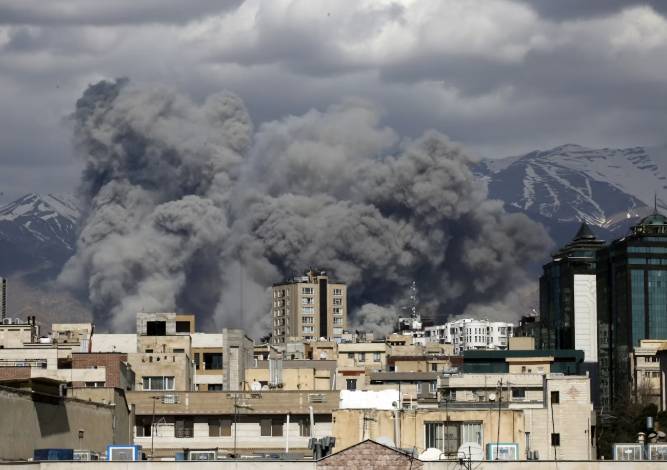

The US has once again attacked Iran as it has carried out attacks on the latter’s missile and drone storage as well as radar sites, reported 24NewsHD TV channel on Sunday.
US President Donald Trump has said that the US forces had targeted Iran because it had violated the ceasefire agreement. “Time may come when we may not be able to exercise any further restraint,” he said, adding, “And we may have to resolve the issue militarily. And if that happens, Iran will be decimated.”
On the other hand, there is a high alert in the region following Iran’s retaliatory attacks on the US installations in Bahrain and Kuwait.
Iran’s Revolutionary Guards have warned that all diplomatic efforts will be stopped in case the US goes ahead with its attacks.
They have made it clear that attacks by the US cannot dent Iran’s supremacy in the region.
Warning the US against any further attacks, they have said that in case that happens, Iran’s response will be far more ferocious, and that the region will be turned into a hell for the US forces and installations.
According to the CENTCOM, on June 25, Iran had attacked Singapore’s trade vessel in the Strait of Hormuz, which prompted the US Air Force to respond because the attack on the vessel was a violation of the ceasefire agreement.
Meanwhile, Lebanese president has urged the US to put pressure on Israel to withdraw its troops from southern Lebanon.
During a telephonic conversation with US President Donald Trump, Lebanese president has also requested him to stop Israel from violating the Lebanon-Israel Framework agreement.
Trump threatens to annihilate Iran
Tehran said Sunday it carried out a third day of retaliatory strikes against US attacks on Iranian territory, as both accused the other of violating their fragile ceasefire, straining negotiations meant to end the Middle East war.
The exchanges underscored the fragility of a Pakistan-brokered peace process aimed at ending a war launched by the United States and Israel in February, which disrupted shipping through the Strait of Hormuz and rattled global energy markets.
Iran's Revolutionary Guards said on Sunday they were taking measures to control traffic in the vital Strait of Hormuz and that violating vessels would be dealt with more firmly than before.
The only authorised passage by Tehran passes through a corridor running along Iran's coast.
The Guards said they had also carried out retaliatory strikes in Kuwait and Bahrain.
In a statement, they said the strikes "destroyed eight important US military facilities at the Ali al-Salem base in Kuwait and at the Fifth Fleet naval base in Port Salman in Bahrain".
"Any enemy aggression, whatever the pretext, even against insignificant targets... will have a crushing response," the Guards said.
Air raid sirens rang out twice in Bahrain on Sunday, according to the Gulf nation's interior ministry.
A memorandum of understanding was reached in mid-June under Pakistan's mediation, aimed at putting a lasting end to the war.
The text signed by the United States and Iran said both countries, and their respective allies, were "not to initiate any war or any military operation against each other and to refrain from the threat or use of force against each other".
- Iran would 'no longer exist' -
US President Donald Trump said Saturday that Iran would "no longer exist" if the United States is "forced" to resume the war.
The threat came after US forces said they struck "multiple" Iranian targets Saturday in another tit-for-tat response to attacks on shipping in the Strait of Hormuz.
"United States aircraft just struck Iranian missile and drone storage locations, and coastal radar sites, for violating the Cease Fire Agreement, AGAIN!" Trump wrote on Truth Social.
"There may come a point when we are no longer able to be reasonable, and will be forced to militarily complete the job that we very successfully started. If that happens, the Islamic Republic of Iran will no longer exist!" Trump wrote.
- Shipping lanes under fire -
US Central Command said Saturday's strikes were in response to an Iranian drone attack on the Panama-flagged oil tanker "Kiku," which was carrying some two million barrels of crude.
The US military said its operation targeted "surveillance infrastructure, communication systems, air defense sites, drone storage facilities, and minelayer capabilities".
Iranian media reported several explosions in the Sirik and Qeshm areas of southern Iran.
Washington had carried out similar strikes on Friday, saying they were a response to an earlier Iranian attack on another vessel, the "Ever Lovely".
Israel, meanwhile, launched strikes in Lebanon as Hezbollah's leader Naim Qassem rejected a deal to end that conflict, which has also threatened to derail the wider US-Iran peace effort.
Iran called "these brutal attacks... a blatant violation" of the interim truce deal.
Iran has warned vessels not to enter or leave the Gulf through the strait without permission, but ships have continued to move, some using a route not authorised by Tehran.
In the memorandum of understanding Iran had previously agreed "safe passage of commercial vessels with no charge, for 60 days only, from the Persian Gulf to the Sea of Oman, and vice versa" in the strait.
H.A. Hellyer, of London think tank the Royal United Services Institute, said "Iran is likely to continue calibrated, low-level coercive activity in and around the Strait of Hormuz... to create persistent pressure on international shipping without triggering a wider conflict."
He said November's US midterm elections for Congress give Washington "incentives for a quicker agreement" while, for Iran, "a drawn-out negotiation accompanied by controlled pressure in the strait can work to its advantage".
- Lebanon threats -
Lebanon was drawn into the Middle East war in early March, when militant group Hezbollah launched rockets at Israel in support of Iran. That provoked an Israeli invasion and fighting that has also undermined the US-Iran ceasefire.
Israel and Lebanon signed an agreement on Friday supported by the US aimed at securing long-term peace between the two countries.
Hezbollah's chief Qassem rejected the deal a day later, calling it "humiliating, shameful and a surrender of sovereignty."
He instead called for the full implementation of Washington's deal with Tehran, which includes an end to the fighting in Lebanon.
Hezbollah has repeatedly called for a full Israeli withdrawal from southern Lebanon, but the Washington deal does not appear to provide for that.
Israeli Prime Minister Benjamin Netanyahu has insisted Israeli troops will remain in the so-called security zone they occupy in southern Lebanon, with civilians prevented from returning until Hezbollah is disarmed.
The Israeli premier called the deal historic on Saturday and "a blow to Iran and Hezbollah."
But Netanyahu's far-right security minister Itamar Ben Gvir denounced it as "a big mistake" and insisted that only Israeli forces were capable of disarming Hezbollah.