
India’s Chenab diversion plan sparks fresh concerns
Islamabad may weigh legal, diplomatic options under Indus Waters Treaty as India advances Chenab-linked projects
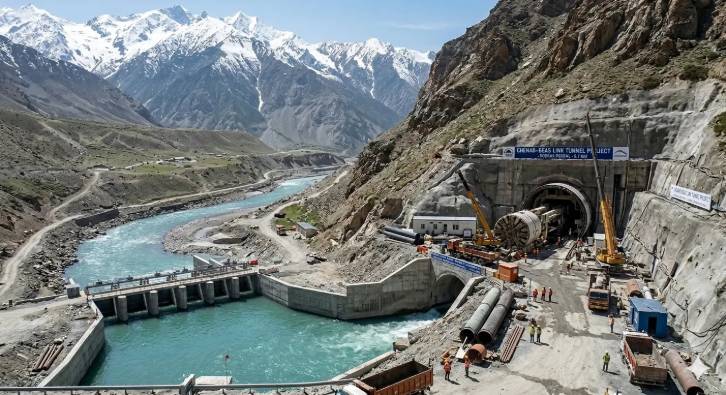

India’s decision to advance infrastructure projects aimed at diverting water from the Chenab river system into the Beas basin should alarm not only Pakistan, but also all those concerned with regional stability, international water law and the future of transboundary river cooperation in South Asia.
The proposed $245 million Chenab–Beas Link Tunnel in Himachal Pradesh is not merely another hydropower or irrigation project. It represents a potentially dangerous shift in how India interprets, and increasingly seeks to reshape, the 1960 Indus Waters Treaty (IWT), one of the world’s most enduring water-sharing agreements.
At the heart of the controversy lies a simple but critical question: can water from the Chenab, one of the western rivers allocated primarily to Pakistan under the treaty, be diverted outside its natural basin into another river system?
For Pakistan, the answer is straightforward. The spirit and structure of the treaty were designed to ensure that the western rivers, the Indus, Jhelum and Chenab, remain protected for Pakistan’s unrestricted use, subject only to limited and clearly defined uses permitted to India.
Any attempt to transfer Chenab waters into the Beas basin risks undermining both the legal framework and the mutual trust upon which the treaty rests.
The proposed project seeks to divert water from the Chandra River, an upper tributary of the Chenab, through an 8.7-kilometre underground tunnel beneath the Pir Panjal range.
Coupled with a barrage structure in the ecologically fragile Lahaul-Spiti region, the project forms part of a broader Indian strategy to maximise utilisation of waters under its control.
India may argue that the diversion falls within permissible treaty provisions or does not materially reduce downstream flows into Pakistan.
Yet such arguments ignore the broader implications of inter-basin transfers involving rivers that sustain millions of livelihoods downstream.
For Pakistan, the Chenab is not simply a river; it is a lifeline for agriculture, irrigation and hydropower generation.
Even the perception that upstream flows could be manipulated creates uncertainty in a country already facing mounting water scarcity, climate stress and declining storage capacity.
Equally troubling is the timing of the project. It comes amid worsening bilateral relations and after India effectively placed aspects of the Indus Waters Treaty cooperation process “in abeyance” last year.
Taken together, these developments reinforce fears in Pakistan that water is increasingly being viewed through a strategic and political lens rather than as a shared natural resource requiring cooperation.
The implications extend far beyond bilateral tensions. The Indus Waters Treaty has long been celebrated internationally as a rare example of successful water diplomacy between hostile neighbours.
Even during wars and periods of severe political confrontation, the treaty survived. Weakening its foundations now would send a deeply troubling signal to other regions already grappling with cross-border water disputes.
Pakistan must therefore respond with seriousness, clarity and professionalism rather than rhetoric alone. Emotional slogans like “If you stop the water, God willing, we will stop your breath, may resonate domestically, but international forums respond to evidence, legal reasoning and technical credibility.
Islamabad should immediately begin compiling a comprehensive hydrological and legal dossier examining whether the diversion violates treaty provisions governing the western rivers.
The issue should first be formally raised with the Permanent Indus Commission before pursuing treaty-backed mechanisms such as a Neutral Expert or Court of Arbitration if necessary.
At the same time, Pakistan must strengthen its diplomatic engagement with the World Bank and the broader international community by framing the issue not only as a bilateral dispute but also as a matter of regional water security and environmental stability.
Importantly, environmental concerns surrounding the project should not be ignored either.
Indian environmental groups themselves have warned that large-scale tunnelling and hydropower construction in the fragile Himalayan ecosystem could increase the risks of landslides, flash floods and ecological degradation.
Ultimately, the dispute is about more than a single tunnel or barrage. It is about whether long-standing international agreements can survive rising nationalism, climate pressures and strategic competition.
The Indus Waters Treaty has endured for more than six decades because both countries, despite their differences, recognised that water must remain insulated from conflict.
Preserving that principle is now more important than ever.