
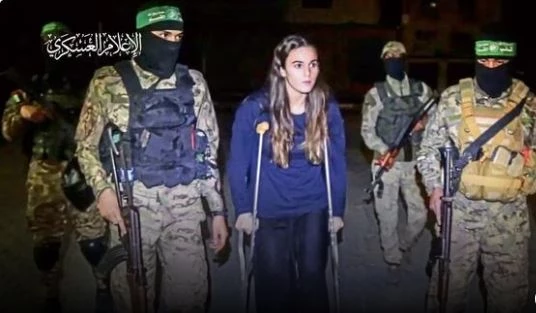

As of Wednesday, a total of 60 Israeli women and child hostages -- several of them dual nationals -- had been freed under a truce that saw fighting pause in the Gaza Strip after the Hamas attacks of October 7.
In exchange, 180 Palestinian prisoners have been released from Israeli prisons, in a three-for-one ratio.
More than 20 other hostages -- the vast majority of them Thai migrant workers -- have been freed separately alongside the truce process, with no accompanying prisoner releases.
The initial truce agreement, mediated by Qatar, Egypt and the United States, was for four days, and it was subsequently extended for another two. US Secretary of State Antony Blinken was due in Israel on Thursday to push for a further prolongation.
AFP looks at the implications of the truce and its extensions.
- How many hostages are still being held? -
Around 240 hostages were seized in the October 7 attacks, Israeli authorities say. Of those, according to AFP calculations, around 130 remain in Palestinian hands, at least 36 of them women and children.
But their fate remains unconfirmed and some -- possibly dozens -- are likely to have died, either on October 7 or later. Several weeks ago the military wing of Hamas claimed that 60 hostages had been killed in Israeli bombardments.
Bodies of the dead may also become part of the discussions.
- What's in a truce for Hamas? -
The longer the pause in fighting continues, the more time Hamas has to regroup, re-arm and recover after Israel went to war against it in retaliation for the attacks, which Israeli officials say killed about 1,200 people, mostly civilians.
"This truce addresses humanitarian needs but also tactical needs on the ground," a spokesman for Islamic Jihad, another Palestinian militant group holding hostages alongside Hamas, told AFP on Wednesday.
Israel has bombarded the Gaza Strip and launched a ground offensive against Hamas, with the territory's Hamas-led government saying more than 15,000 people have been killed, most of them civilians.
But the truce has been a propaganda boon for Hamas, and analysts say the group will count it as a victory if it survives in power in Gaza in any form.
In addition, the prisoner releases have seen Hamas's popularity soar in the occupied West Bank, where most of the detainees are from, and which is controlled by the rival Fatah party of Palestinian president Mahmud Abbas.
- What role are other Palestinian groups playing? -
The hostages freed on Tuesday night were released by both Hamas and Islamic Jihad, AFP journalists at the scene saw.
The two groups share some of the same aims in their fight against Israel, and often operate together.
A Hamas spokesman signalled Wednesday that some of the remaining hostages are held by Islamic Jihad and other groups, all of which are likely to want to secure some benefit from the truce.
- What's in it for the Israeli government? -
The government of Prime Minister Benjamin Netanyahu is under intense domestic pressure to secure the return of all the hostages.
The longer the truce persists, the more hostages come back.
But at the same time, the military momentum against the Islamist movement is dissipating, while diplomatic pressure is mounting against a resumption of military operations and the associated devastating humanitarian consequences.
- How long can truce extensions carry on? -
The existing truce agreement only covers women and child hostages, who are being exchanged for female prisoners in Israeli jails and males aged 18 and under.
With few such hostages remaining in Palestinian hands, attention is likely to switch soon to older men and the bodies of Israeli citizens.
The biggest stumbling block will be over the return of Israeli army soldiers and men of fighting age -- after military service, Israeli men remain reservists and can be called up until the age of 40.
According to the AFP tally at least 11 soldiers -- seven men and four women -- are being held, along with another 40-odd men of reservist age.
- What happened with previous soldier exchanges? -
Captured Israeli soldiers are the most valuable element Palestinian militants have in their negotiations with Israel.
When Israeli soldier Gilad Shalit was released in 2011 after five years in Hamas captivity and a tireless campaign by his family for his release, 1,027 Palestinian prisoners were released in exchange.
The resulting controversy led to the creation of an Israeli commission responsible for setting red lines in negotiations.
Those freed in 2011 included Yahya Sinwar, who went on to become the head of Hamas in the Gaza Strip and is accused of masterminding the October 7 attacks.
Earlier, 20 Palestinian prisoners had been released for just a proof-of-life video of Shalit.
As well as those seized on October 7, Hamas has for nine years been holding the remains of Oron Shaul and Hadar Goldin, two Israeli soldiers killed during Israel's 2014 invasion of the Gaza Strip.
The militant group has never confirmed their deaths, but giant versions of Shaul's identification tags feature on a statue of a raised fist in Gaza City.
The Palestinian groups will want to extract as high a price as possible for the soldiers and fighting-age men they are holding, and it is impossible to estimate how long those negotiations could last.
- What happens next? -
If fighting resumes, it will raise anew the prospect of a wider conflict in the Middle East involving Hezbollah in Lebanon and potentially Iran, which backs several of the Palestinian militant groups.
A longer-term ceasefire would be likely to see a resumption of the drive to normalise diplomatic ties between Israel and several Arab states, notably Saudi Arabia -- but at the cost of a continuing threat from Hamas.