
What obstacles threaten Trump's Gaza plan?
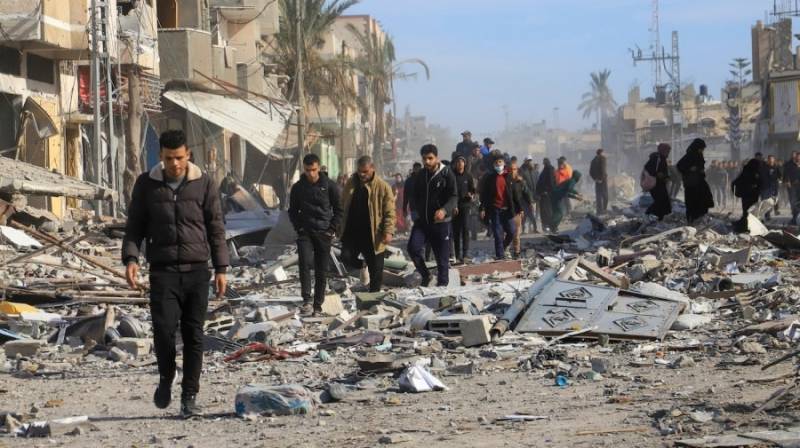

US President Donald Trump has unveiled a plan for Gaza that he called "historic", but with Hamas yet to respond and Israel divided on the proposal, several obstacles remain.
Here are the main hurdles:
- Hamas -
Hamas has not yet responded to Trump's 20-point plan, but a Palestinian source close to the group told AFP it was examining the proposal in discussions that could take "several days".
"Hamas is keen to achieve a comprehensive agreement to halt the war and aggression, ensure a full Israeli withdrawal from the Gaza Strip, end the blockade imposed since 2007, and rebuild the Strip," the source said.
But Trump warned Tuesday he was giving Hamas "three or four days" to respond to his plan, which remains vague on the timeline for an Israeli withdrawal and includes a broad demand for Hamas's disarmament, something the group has previously rejected.
"If this plan is a basis for negotiations, Hamas could respond favourably," said Hugh Lovatt, a senior policy fellow at the European Council on Foreign Relations.
"But if it is 'take it or leave it', I think it becomes problematic, because Hamas cannot accept something with such a lack of precision," Lovatt said.
"Hamas has already agreed to end its governance in Gaza and has accepted a process of decommissioning offensive weaponry... but many points will need to be clarified," he added.
A Hamas political bureau member, Hossam Badran, reiterated to AFP the group's position that it had the "right to resist the occupation".
Iyad al-Qarra, a political analyst in Gaza, agreed that disarmament was "a decision that will be very hard for Hamas to make".
"If Hamas rejects the plan, it will appear to the world that Hamas is the one obstructing and undermining international peace," he said.
"But if Hamas accepts the plan in its current form, it would be granting legitimacy to the destruction and elimination of the resistance."
- Netanyahu -
Despite giving his support to Trump's peace plan, Netanyahu already appears to have contradicted one of its key provisions.
The proposal includes a gradual Israeli withdrawal from the territory, but in a video statement Tuesday, Netanyahu said Israeli forces "will remain in most of the Gaza Strip".
Gayil Talshir, a political science professor at Hebrew University in Jerusalem, said "Netanyahu speaks with two voices."
"One is the voice that he speaks to the world and the second is the voice that he speaks to the electoral base of the right wing in Israel," she told AFP.
In addition, Netanyahu has pointedly left the door open for military operations if Hamas appears to go against the deal.
"If Hamas rejects your plan, Mr President, or if they supposedly accept it and then basically do everything to counter it, then Israel will finish the job by itself," he said during his White House press conference with Trump.
Talshir said Netanyahu was counting on Hamas to either say 'no' to the agreement or 'yes but,' introducing conditions that Israel could then seize upon to renege the deal.
Netanyahu's critics in Israel and families of hostages held by militants in Gaza have long accused him of scuppering indirect ceasefire negotiations for his own political gains.
- Israel's far right -
Netanyahu's government, one of the most right-wing in Israeli history, relies on the support of hardline coalition partners who reject an end to the war unless Hamas is defeated.
Far-right Finance Minister Bezalel Smotrich on Tuesday slammed Trump's peace plan as "a resounding diplomatic failure".
Netanyahu's far-right coalition partners also reject the prospect of a future Palestinian state, something the US plan envisions.
"From the perspective of the right-wing in Israel, what Netanyahu did yesterday is nothing short from signing on the vision of the two-state solution," Talshir said.
But in a Telegram video Tuesday, Netanyahu reiterated his opposition to a Palestinian state, saying it was not written in Trump's peace agreement.
"So he's in a very tough position from the perspective of the Israeli right," Talshir said. "If Hamas says yes, then Netanyahu does not have a government."
Yossi Dagan, a leading Israeli settler, also insisted Tuesday on a "red line" against a Palestinian state.
"The mission of this generation is to ensure the existence of the state by applying Israeli sovereignty over the settlements and territories," he wrote on X, referring to the annexation of the Israeli-occupied West Bank.