
Iran's Supreme Leader Ayatollah Khamenei, defence minister martyred in US-Israeli strikes
Khamenei's daughter, son-in-law, daughter-in-law, granddaughter also martyred; Revolutionary Guards chief, security adviser also martyred; 207 people martyred, over 700 injured in strikes; Seven days of national holiday and 40 days of mourning declared across Iran; Iranian military and Revolutionary Guards vow strong, decisive retaliation; Anti-US, Israel protests erupt in Tehran, other cities; Trump hints at awareness of new power center in Tehran after Khamenei but withholds name in interview
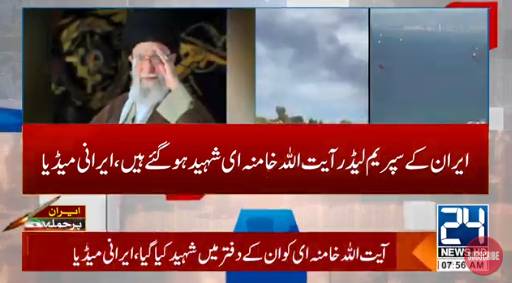

Iran’s Supreme Leader Ali Khamenei and the country's Defence Minister, who was also the Pasdaran-e-Inqilab chief, have been martyred in attacks carried out by the United States and Israel, state media confirmed on Sunday morning.
Authorities declared seven days of public holiday across the country and announced 40 days of national mourning, a traditional observance marking the passing of a senior religious and political figure in the Islamic Republic.
According to the 24NewsHD TV channel, Iranian state television reported that Ayatollah Khamenei was martyred during coordinated strikes by US and Israeli forces at his office.
Iranian state media also said that members of the Supreme Leader’s family were among those martyred in the attacks, including his daughter, son-in-law, daughter-in-law and granddaughter.
The Iranian media reports described the deaths as martyrdom and framed the strikes as an assault on the heart of the Iranian state.
The Iranian armed forces swiftly vowed retaliation. In a statement carried by official media, the military described the martyrdom of the country’s supreme leader as a grave and unprecedented act, promising a “strong and decisive response".
The statement said Iran would take all necessary measures to defend its sovereignty and security and warned that the aggressors would “pay the price” for their actions.
The Islamic Revolutionary Guard Corps, known as the Revolutionary Guards, issued a separate statement underscoring that those responsible for the death of the Supreme Leader would face a severe and decisive punishment.
The Guards said they would not allow the opportunity to respond to slip away and characterised the martyrdom as an unforgivable crime.
Ayatollah Khamenei was born on April 19, 1939, in the northeastern city of Mashhad. He pursued his early religious education there before moving in 1958 to the seminary city of Qom, where he furthered his theological studies.
A close associate of the founder of the Islamic Republic, Ruhollah Khomeini, Khamenei rose through the ranks of the revolutionary leadership following the 1979 revolution.
He served as Iran’s president from 1981 to 1989, navigating the country through the latter years of the Iran-Iraq War and a period of intense political consolidation.
After the death of Ayatollah Khomeini in 1989, Khamenei was appointed Supreme Leader, a role that placed him at the apex of Iran’s political and religious hierarchy.
His tenure as Supreme Leader spanned 36 years, during which he shaped Iran’s domestic policies and regional posture, oversaw its nuclear programme and maintained ultimate authority over the armed forces and judiciary.
Trump's interview after Khamenei's martyrdom
In Washington, President Donald Trump suggested that the United States was closely monitoring developments in Tehran. In a telephone interview with an American television network, Trump said he was aware of who was issuing orders in Iran following Khamenei’s death.
“I know who is effectively giving the orders right now,” Trump said, though he declined to identify the individual.
When asked whether the person now exercising authority was someone he would like to see leading Iran, the president replied that he believed so and added that there were “some good candidates".
Trump’s remarks appeared to signal that Washington anticipates a managed transition of power within Iran’s leadership structure, though the identity of any interim authority or successor has not been officially confirmed by Tehran.
The death of the Supreme Leader and the promises of retaliation from Iran’s military and the Revolutionary Guards are likely to intensify already fraught tensions in the region.
With Iran vowing decisive action and the United States indicating awareness of a new command structure in Tehran, the coming days may prove critical for the stability of the Middle East.
According to AFP, Iran's judiciary confirmed on Sunday that US and Israeli strikes killed the chief of the Revolutionary Guards and another top security advisor.
The Guards' commander, General Mohammad Pakpour, and Ali Shamkhani, the head of the national defence council, were "martyred" in Saturday's attacks, the Iranian judiciary's Mizan online news portal reported.
A large number of people, carrying Iranian flags in their hands, took to streets in Tehran, Qom and other cities to vent their anger at the USA and Israel over their attacks against the Islamic republic.
They shouted slogans against the USA and Israel.
On the other hand, Reuters claimed that Iran's Chief of Army Staff Abdur Raheem Moosvi had been martyred in the attack.
According to Iran’s Hilal-e-Ahmar, so far 207 people have been martyred while over 700 have been injured in the US-Israeli strikes.