
More water from India enters Punjab; Sindh faces super flood risk
Millions of people at risk as Sutlej, Ravi, Chenab, Indus rivers swell beyond danger levels: Floodwaters submerge hundreds of villages in Arifwala, Jhang, Baloki, Harike, Nowshera, Trimo, Head Marala, Okara, Katcha area in Dadu, and Khairpur: 11 police stations; Katcha areas in Sindh also submerged: Govt declares 1000 schools as relief camps in interior Sindh: PDMA issues high flood warning in Punjab again
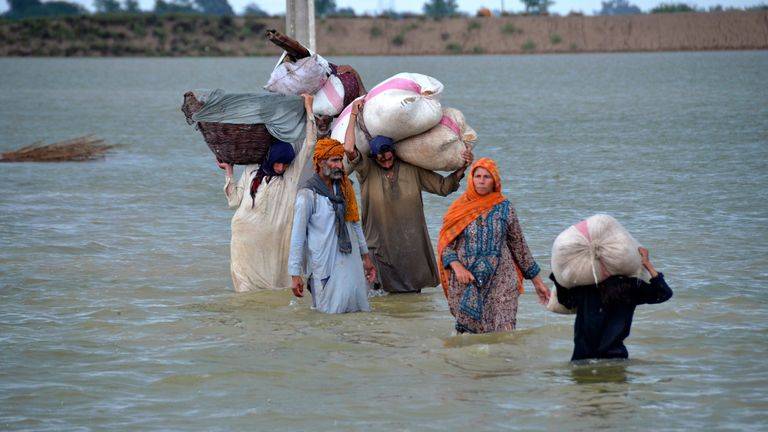

Fears of a super flood in Sindh escalated on Monday as a massive inflow from India entered Pakistan through Rangpur, inundating dozens of villages and cutting off road access, reported 24NewsHD TV channel.
According to flood forecasts, 1 million cusecs of water is expected to reach Head Panjnad between September 2 and 3, while Guddu Barrage is likely to receive 800,000 to 1.1 million cusecs between September 5 and 6, raising alarms across Sindh.
In Dadu district, floodwaters surged into three union councils of the katcha (riverine) belt, submerging villages and homes. Locals were forced to evacuate by boat. Over 30 villages in UC Sial, Munder, and Pat Sharif were flooded, leading to severe shortages of food and drinking water.
In Khairpur, the flood wreaked havoc in the katcha belt, submerging multiple villages. Even 11 police stations were completely washed away, forcing police personnel to vacate and shift to embankments.
The Sindh Education Department declared over 1,000 government primary schools across Larkana district as flood relief camps.
A notification issued by District Officer Primary Anis Jilbani confirmed that 32,900 flood victims will be accommodated in classrooms across four tehsils — Larkana (307), Ratodero (308), Bakrani (214), and Dokri (146).
Meanwhile, in Punjab, the situation remains equally critical. Flood Commissioner Punjab confirmed that over 2,200 villages and 2.3 million people have been affected so far.
At Trimmu Headworks, the water flow surged to 700,000 cusecs by Monday evening, with a massive flood expected to hit Head Marala within two days.
The Sutlej and Ravi rivers at Bloki reached extremely high flood levels, with rescue operations underway to evacuate women, children, and the elderly via boats in Nowshera and Okara’s Mari Patan.
In Jhang, the Chenab River flood devastated hundreds of settlements, submerging link roads and highways. Key routes, including Sargodha Road, Pakkewala Bypass, and Pir Kot Masan Road, were submerged.
Heavy machinery from the Highways Department has been deployed for the restoration of roads, while Trimmu Barrage recorded an outflow of 479,000 cusecs. In 2014, 626,006 cusecs of water flowed into the Chenab River.
The Punjab Disaster Management Authority (PDMA) issued a high flood warning at Harike (Sutlej), putting district administrations of Lahore, Sahiwal, Multan, Bahawalpur, DG Khan, Kasur, Okara, Pakpattan, Vehari, Bahawalnagar, Lodhran, and Muzaffargarh on high alert.
Rescue teams and district administrations remain on the ground, but with rising inflows, experts fear the worst is yet to come.
Ravi wreaks havoc in Narowal
As the River Ravi continues to wreak havoc in Punjab, Narowal is the latest casualty. Floodwater released by India into Ravi has completely destroyed the road network in the northern district of Punjab, Pakistan.
In Dawood village near Narowal, floodwater overflowing from the Ravi River swept away an elderly woman who had come from some other place to attend a funeral of a relative in the village. The only road leading to the village has been washed away and now people have to wade their way to their homes through the floodwater.
Embankment breaches near Arifwala
Several houses and fields were inundated when a key embankment breached near Momike, Arifwala.
As a result, the submerged area was cut off from the mainland and roads were washed away by floodwaters.
As no rescue or administrative officials reached the area to help the flood-affected people, they are waiting for the crisis unfold helplessly.
Reporters: Shehzad Khan, Waqar Hussain Manghi, Kamran Korai, Abdul Khaliq Mughiri, Rana Pervaiz Akhtar, Malik Habib Lang, Waseem Aziz, Imran Joya, Shehzad Ahmed, Shehzad Khan, Junaid Anwar, and Fakhar Diwan