
Bilawal exposes Indian aggression in meetings with world leaders at UN
PPP chairman briefs UN Security Council members, US, Russia, China, OIC, and other diplomats about India’s weaponization of water: Tells UN about India’s aggression threatening regional peace: Rejects Indian Pahalgam allegations and calls for dialogue: OIC asks Delhi to uphold UN Charter and international agreements: Bilawal also meets US and Russian envoys to UN: Pakistan and China call for peace in South Asia
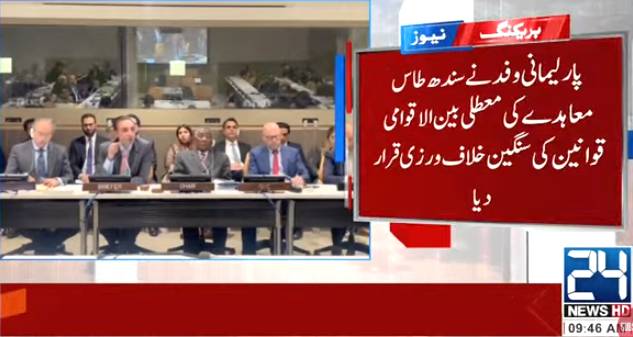

Pakistan properly exposed the Indian government's aggressive and inhuman stance before the world's key powers and United Nations Security Council (UNSC) members, reported 24NewsHD TV Channel on Tuesday.
During a high-level diplomatic visit to the United States, Pakistan’s parliamentary delegation led by Chairman Pakistan Peoples Party and former Foreign Minister Bilawal Bhutto Zardari presented Pakistan’s case against India’s aggression and baseless accusations before key global powers including the United States, China, Russia, OIC member states, Denmark, Greece, South Korea, Panama, Somalia, Algeria, Guyana, Sierra Leone, and Slovenia.
The delegation warned that India’s aggressive posture, particularly its move to weaponise water by unilaterally suspending the Indus Waters Treaty, was a direct threat to millions of lives and a gross violation of international law. Bilawal Bhutto Zardari termed this behaviour alarming for the civilised world.
Bilawal rejected India's attempt to link the recent Pahalgam attack to Pakistan without any investigation and criticised India’s stubborn stance. He emphasised that despite Indian hostility, Pakistan has consistently pursued a policy of peace, dialogue, and avoidance of large-scale conflict in the region.
Special meeting with US envoy to UN Dorothy Shea
In a meeting with Dorothy Shea, the acting permanent representative of the United States to the United Nations, Bilawal reiterated that India’s move to use water as a weapon is reprehensible and that attacking Pakistan based on unverified accusations is itself a glaring question mark. He argued that to disprove India’s narrative, one does not need evidence; simply stating India’s position is enough to expose its fallacy.
Meeting with Russian envoy to UN Vasily Nebenzya
Earlier, the Pakistani delegation met with Vasily Nebenzya, Russia’s permanent representative to the United Nations. Bilawal reiterated that Pakistan, in the face of Indian provocation, has exercised strategic restraint and remains committed to regional peace.
Addressing the Kashmir issue, Bilawal stated that India deliberately avoids a UN sanctioned resolution to the conflict and continues to support terrorist activities in Pakistan. He said Pakistan is one of the largest victims of terrorism in the world, largely due to India’s involvement in cross-border terrorism.
Bilawal meets China's envoy to UN Fu Cong
In a significant meeting with China's Permanent Representative to the United Nations, Ambassador Fu Cong, Bilawal expressed gratitude on behalf of the Pakistani people for China’s unequivocal support during Indian aggression. Discussions focused on the evolving security situation in South Asia.
Bilawal shared evidence of India’s attacks on Pakistani territory, its deliberate targeting of civilians, and funding of terror inside Pakistan. He also condemned India’s provocative decision to suspend the Indus Waters Treaty, calling it an illegal and dangerous escalation.
Both Pakistan and China agreed that aggressive and unilateral actions threaten regional peace and must be firmly opposed. They emphasised their commitment to resolving disputes peacefully, promoting multilateralism, honouring international treaties, and upholding the UN Charter.
UNSC members briefed
The Pakistan delegation also briefed the Permanent Representatives of the 10 elected members of the UN Security Council on the deteriorating regional security environment resulting from the recent Indian aggression against Pakistan.
Bilawal briefed the elected representatives on the grave implications of India’s aggression against Pakistan in the aftermath of the Pahalgam attack. He categorically rejected India’s baseless and premature allegations against Pakistan, which were made in the absence of any credible investigation or verifiable evidence, according to a press release issued by the Pakistan Mission to the UN.
Bilawal highlighted that India’s “reckless” actions, including targeting of civilian areas and the unilateral holding in abeyance of the Indus Waters Treaty, represent a dangerous departure from established rules-based international order and conduct of inter-state relations and pose serious risks to regional stability.
The Federal Minister for Climate Change and Environmental Coordination, Musadik Malik, also apprised the elected Council members of the humanitarian implications of holding in abeyance the Indus Waters Treaty, which would cause water scarcity and food insecurity and exacerbate the adverse impacts of climate change for 240 million people in Pakistan.
The delegation emphasised that Pakistan’s response to Indian aggression was calibrated, responsible, and fully consistent with international law, including the right of self-defence under Article 51 of the UN Charter. It underscored Pakistan’s commitment to restraint, revival of the Indus Waters Treaty, and initiation of a comprehensive dialogue to address all outstanding issues with India, particularly the Jammu and Kashmir dispute.
The delegation urged the members of the Security Council to move beyond conflict management and actively support conflict resolution in South Asia.
The elected Council members appreciated Pakistan’s outreach and welcomed its reaffirmation of commitment to peace and diplomacy. They noted the importance of de-escalation, respect for international law, and the peaceful settlement of disputes.
They also emphasised that the UN Charter and its principles must guide state conduct, particularly in regions of high sensitivity such as South Asia. They acknowledged the risks posed by any further escalation and stressed the need to pursue diplomatic solutions.
Briefing to OIC member countries
The Pakistani delegation also held a detailed briefing with OIC member countries at the UN, outlining India’s baseless allegations and ongoing hostilities. Bilawal strongly rejected India’s attempt to link the Pahalgam attack to Pakistan and accused India of using false claims to justify cross-border aggression.
The delegation highlighted the suspension of the Indus Waters Treaty as a serious violation of international law and an attempt to weaponize a basic human right. Bilawal stated that Indian aggression has destabilized the region and warned the world community to act before such dangerous trends become normalized.
Bilawal thanked the OIC for its role in de-escalation, mediation, and ceasefire efforts and praised the organization for emerging as a moral conscience in these difficult times. He called for comprehensive dialogue, restoration of the Indus Waters Treaty, and a UN-based resolution of the Kashmir dispute, stressing that peace can only be achieved through diplomacy and dialogue.
OIC member states appreciated Pakistan’s transparent briefing and expressed solidarity, reaffirming their commitment to the UN Charter and respect for international agreements.
--Pakistan's delegation--
The nine-member multi-party delegation was headed by Bilawal Bhutto Zardari and included Minister for Climate Change Dr. Musadik Masood Malik, Senate Standing Committee on Climate Change Chairperson Sherry Rehman, former foreign minister Hina Rabbani Khar, former commerce minister Khurram Dastgir Khan, former minister for maritime affairs Syed Faisal Ali Subzwari, Senator Bushra Anjum Butt, and two former Foreign Secretaries, Ambassador (r) Jalil Abbas Jilani and Ambassador (r) Tehmina Janjua.
Bilawal's exclusive interview to Chinese TV
During his visit, Bilawal in a television interview on a Chinese TV channel said a resolution of the Jammu and Kashmir dispute is a prerequisite for a lasting solution to the tensions between India and Pakistan.
Bilawal said the current ceasefire should lead to permanent peace, which, he said, will come through the resolution of the decades-old Kashmir dispute in line with the UN Security Council resolutions and the aspirations of Kashmiris.
Stressing Pakistan’s desire for peace through dignity, strength, and diplomacy, he termed India’s actions “dangerous” and in violation of international law. “No lasting solution is possible without resolving the Jammu and Kashmir dispute,” the delegation leader added.
Bilawal said India’s unilateral decision to hold the 1960 Indus Waters Treaty in abeyance also violates international law and treaty obligations, adding, “By unilaterally suspending IWT, India has set a dangerous precedent with implications for regional peace and security.
In this regard, he urged the international community to play its role in facilitating dialogue between Pakistan and India. “We are ready to talk with India on Jammu and Kashmir, IWT, and terrorism,” the delegation leader added.
Pakistan, he said, is a victim of terrorism, and from the political leadership to the military to Pakistani citizens, the country has been affected by terrorism. While India committed a naked and blatant act of aggression by violating the international borders, Pakistan had acted in self-defence, he said.
Reporters: Anwar Abbas and Rozeena Ali