
Bilawal urges UN to push India for dialogue with Pakistan
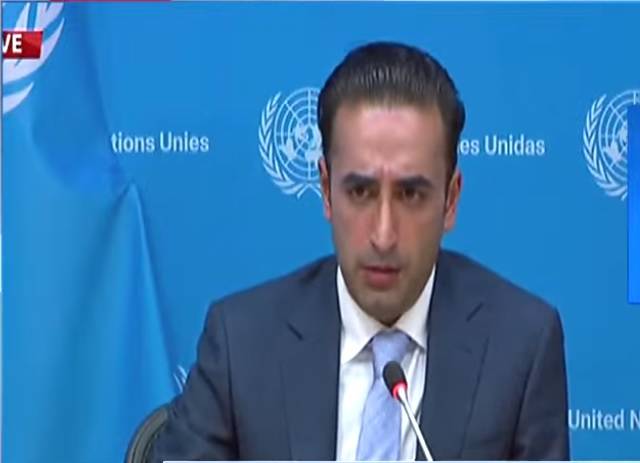

Pakistan People's Party (PPP) Chairman Bilawal Bhutto-Zardari, speaking at a press conference at the United Nations Headquarters in New York on Tuesday, called on the international community and the United Nations to urge India to engage in a comprehensive dialogue with Pakistan. He emphasized the urgent need to resolve longstanding disputes and maintain peace following the recent military confrontation triggered by the Pahalgam attack.
The press conference coincided with the visit of a high-level Pakistani delegation, comprising former foreign ministers, senior diplomats, and lawmakers. The delegation included Bilawal Bhutto-Zardari, Hina Rabbani Khar, Khurram Dastgir Khan, Senators Sherry Rehman, Musadik Malik, Faisal Sabzwari, Bushra Anjum Butt, and former foreign secretaries Jalil Abbas Jilani and Tehmina Janjua.
Bilawal reaffirmed Pakistan’s readiness to hold a comprehensive dialogue with India, including discussions on terrorism. He noted that Pakistan has endured the highest number of terrorist attacks globally and has suffered deeply from terrorism’s consequences. Stressing Pakistan's consistent condemnation of terrorism in all forms, he said the government had immediately offered cooperation for an impartial international investigation into the Pahalgam attack, which India rejected in favor of launching “illegal strikes” under “Operation Sindoor,” targeting civilian infrastructure in violation of international law and the UN Charter.
He clarified that Pakistan’s military response was solely in self-defense, stating, “We only responded to those planes we believed had dropped munitions on Pakistani territory.” India later escalated the conflict by launching missile strikes, to which Pakistan responded in kind.
Bilawal credited international mediation — particularly by U.S. President Donald Trump and Secretary of State Marco Rubio — with helping to secure a ceasefire. However, he warned that while welcome, the ceasefire was only a temporary measure. “The threshold for full-blown conflict between two nuclear-armed nations has been dangerously lowered,” he cautioned, stressing the need for continued dialogue and diplomatic engagement.
Highlighting the danger of rapid escalation, Bilawal warned, “Next time, the international community might not have enough time to intervene.” He emphasized that Pakistan’s civil and military leadership had made great sacrifices in fighting terrorism and deserved international recognition, not vilification.
Bilawal also criticized India’s use of terrorism as a political tool to marginalize Muslims and justify aggressive actions in Kashmir and against Pakistan. Despite this, he expressed Pakistan’s willingness to cooperate with India in combatting terrorism, stressing that regional peace could not be held hostage by non-state actors.
He condemned India’s attempt to set a precedent of war in response to every terror incident, calling it “untenable” for two nuclear-armed countries. Bilawal proposed the establishment of a dispute resolution mechanism between the two nations to investigate and address terrorism-related concerns jointly.
He reiterated that the root cause of the conflict remained the unresolved issue of Jammu and Kashmir — an agenda item at the UN Security Council — and stressed the importance of fulfilling international commitments made to the Kashmiri people.
Additionally, Bilawal raised concerns over India’s "weaponization of water," citing its threats to abrogate the Indus Waters Treaty as a violation of international law and a potential act of war.
“India claims to be a net security provider, but its actions have made it a source of insecurity in the region,” he said. “True security can only come through peace between India and Pakistan.”