
Smog from across the border worsens air quality in Pakistan
Polluted winds from India push Punjab and Karachi into hazardous air conditions
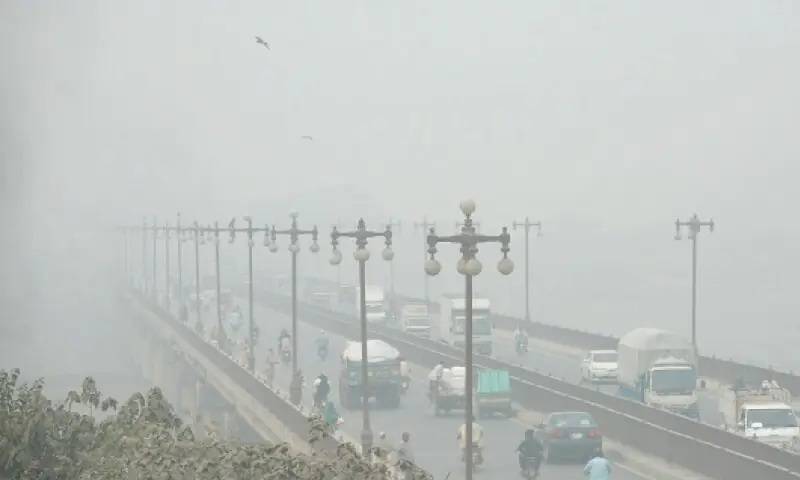

Pakistan’s air quality crisis deepened on Sunday as polluted winds blowing from India worsened smog levels across several regions, including Punjab’s major cities and Karachi, according to the Smog Monitoring Center and the Meteorological Department.
Experts at the Smog Monitoring Center confirmed that easterly and southeasterly winds are carrying smoke and PM2.5 particles from Indian Punjab into Lahore, Kasur, Sahiwal, Faisalabad, and Multan. This cross-border pollution has significantly deteriorated the air quality, pushing it into the “very unhealthy” category.
“The mixture of smoke and fine particles coming from India is contributing heavily to Pakistan’s smog,” officials said. “More polluted air is expected to move toward central Punjab during the evening and night.”
According to the Center, Lahore’s Air Quality Index (AQI) is fluctuating between 330 and 360, while other central Punjab cities are facing similar conditions. Although a minor improvement is expected between 2 p.m. and 4 p.m., experts warn that the overall pollution will persist, with air quality remaining unhealthy throughout the day.
The winds bringing pollution from India are moving at 10 to 13 kilometers per hour, providing only limited dispersion. Environmentalists say that crop residue burning (stubble burning) in Indian Punjab is a key contributor to this seasonal smog, which routinely engulfs the border regions every winter.
Meanwhile, Karachi — hundreds of kilometers south — is also struggling with hazardous air. The city ranked third among the most polluted cities in the world and second in Pakistan, with its AQI hitting 179.
The Meteorological Department reported dry and hot weather, with a current temperature of 25°C expected to rise to 36°C later in the day. Northeast winds blowing at 8 km/h and 70% humidity have trapped pollutants over the city, worsening the smog situation.
Experts urge both Pakistan and India to address the transboundary air pollution crisis through joint environmental policies. Without coordinated action, they warn, millions across the subcontinent will continue to breathe dangerously polluted air.
Reporters: Samra Fatima & Ahsan Abbasi