
Elections in Punjab will now be held on May 14, declares Supreme Court
CJP Bandial pronounces the verdict, annulling ECP’s March 22 decision to forward poll date: Describes ECP’s move as illegal and unconstitutional: Apex court rules ECP has no power to change election date: Orders federal govt to provide Rs21 billion poll expenses to ECP by April 10: Warns of action in case of funds non-provision: Centre to meet security requirements for elections: Court will continue to hear KP election matter: Orders Punjab govt to fully cooperate with ECP so that it can fulfil its constitutional responsibilities: Directs Punjab govt, chief secretary and IG police to provide complete security plan by April 10: Says Justice Isa’s decision does not affect current bench
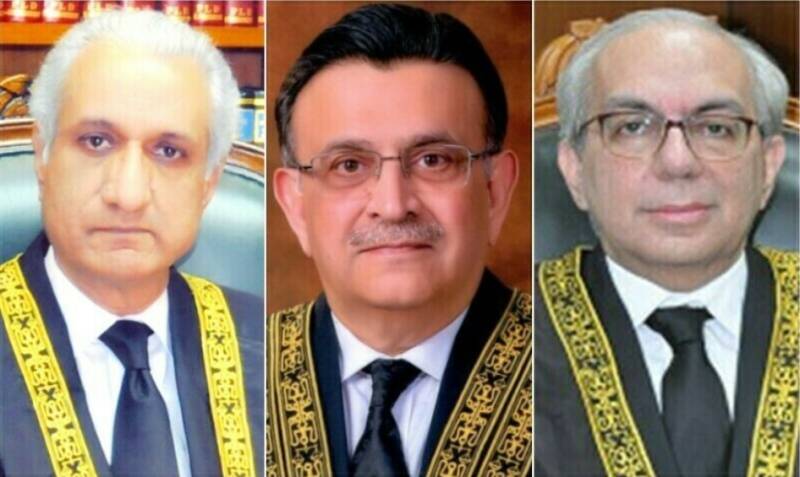

The Supreme Court of Pakistan has annulled the Election Commission of Pakistan’s March 22 decision to defer the elections for the Punjab Assembly to October 8, declaring it unconstitutional and illegal, reported 24NewsHD TV channel.
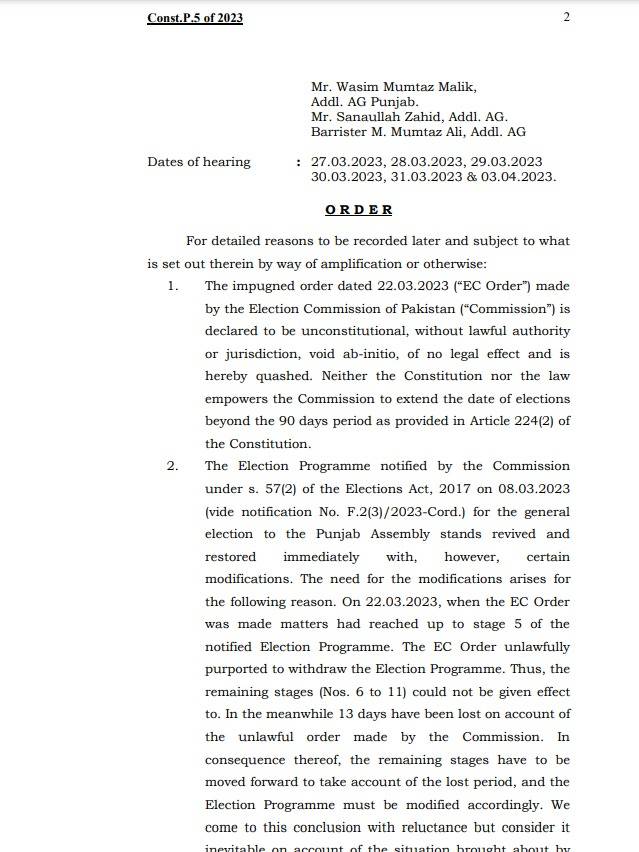
Pronouncing the six-page verdict in Punjab and Khyber Pakhtunkhwa poll delay case on Tuesday, Chief Justice of Pakistan Umar Ata Bandial ruled that the ECP has no power to forward the election date beyond 90 days.
He pronounced that as per the constitution, the elections must be held within 90 days after the dissolution of the assembly. The ECP cannot extend the poll date under Article 224 of the Constitution.
He went on to say that the court voids the March 22 decision of the ECP regarding postponement of the election.
He said that the President’s order regarding Punjab poll will remain effective, but with some changes.
The CJP declared that the elections in Punjab will now be held on May 14 instead of April 30.
The ECP told the court that if the commission gets resources, it is ready to hold elections on time.
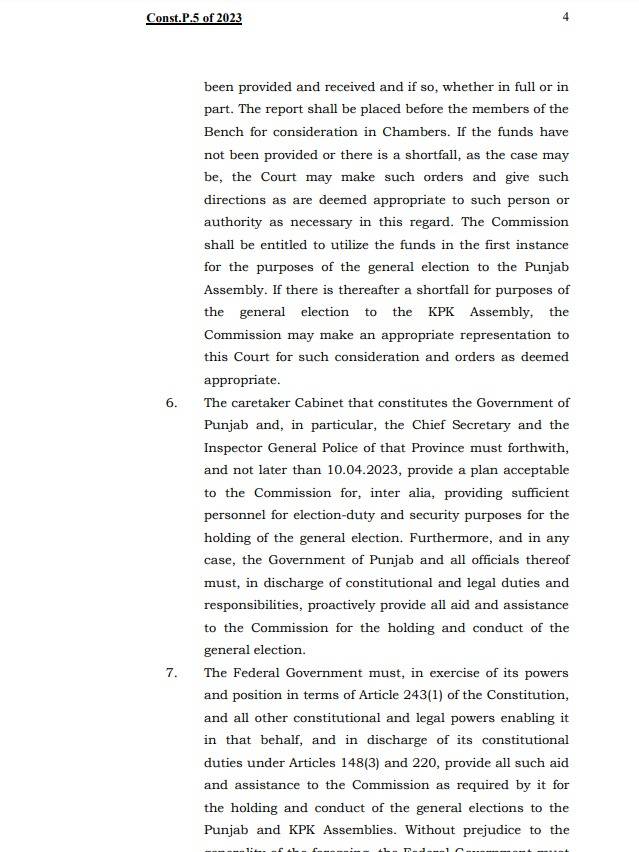
The court ordered the federal government to provide Rs21 billion to the ECP by April 10 for the election expenses, warning that in case of non-provision of funds, the court will take action against the relevant officials.
The court directed the interim Punjab government, chief secretary and IG police to provide a complete security plan by April 10.
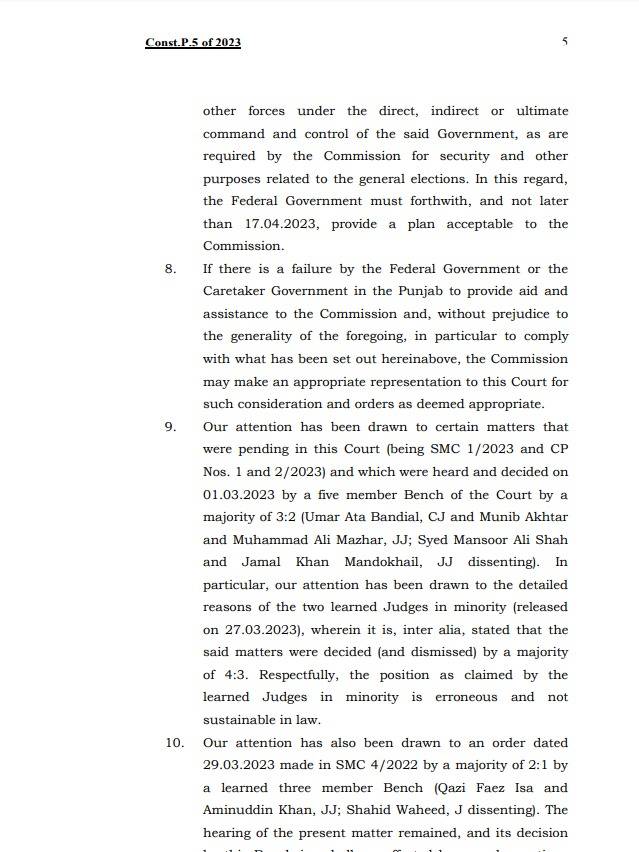
The court also directed the federal government to arrange for security during the conduct of the elections with the help of armed forces and Rangers.
It asked the ECP to inform the Supreme Court if the federal and interim governments do not assist it.
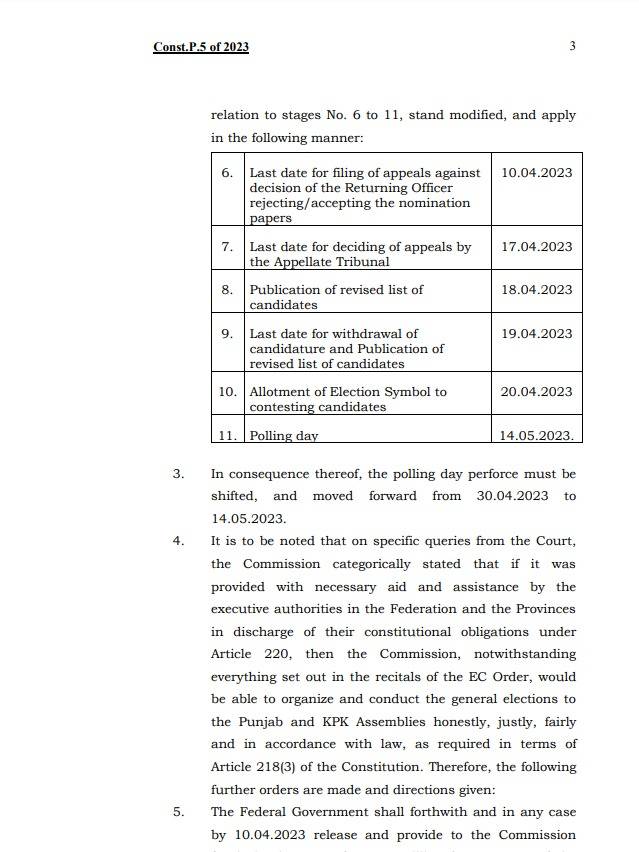
The court ordered that for the Punjab Assembly polls, the nomination papers will be submitted by April 10.
The last date to file an appeal will be April 17 and appeals will be reviewed on April 18.
The final list of candidates will be released on April 19. And candidates will be allotted election symbols on April 20.
The court ordered the ECP to submit the report regarding the provision of funds to the court on April 11. The report will be submitted to the chamber of bench members. In case of non-provision of funds, the court will issue an appropriate order in light of that report.
The court ordered the Punjab government to fully cooperate with the ECP so that it can fulfil its constitutional responsibilities.
It warned that if the Centre or the Punjab caretaker government failed to provide aid and assistance to the ECP, the commission could approach the court and an appropriate order would be passed on the matter.
According to the verdict, in the first stage, funds for the Punjab election should be collected.
A fair and transparent election must be ensured, the order said.
In its verdict, the SC said that other matters were also raised during the court proceedings. Two judges recused themselves from hearing the case.
It also mentioned its March 1 verdict in today’s order. In a 3-2 order last month, the SC had ruled that elections in KP and Punjab should be held within 90 days.
However, the government had disputed the court directions, calling the verdict 4-3 instead after Justice Jamal Khan Mandokhail and Justice Syed Mansoor Ali Shah — who were among the four judges who had written additional notes in the Feb 23 order — raised objections on the constitution of the bench as well as the invocation of the apex court’s suo motu jurisdiction by the chief justice.
In its verdict today, the court said: “Respectfully, the position as claimed by the learned Judges in minority is erroneous and not sustainable in law.”
The order said that Justice Qazi Faez Isa and Justice Aminuddin Khan’s March 29 judgement did not have any effect on any observations made in today’s order.
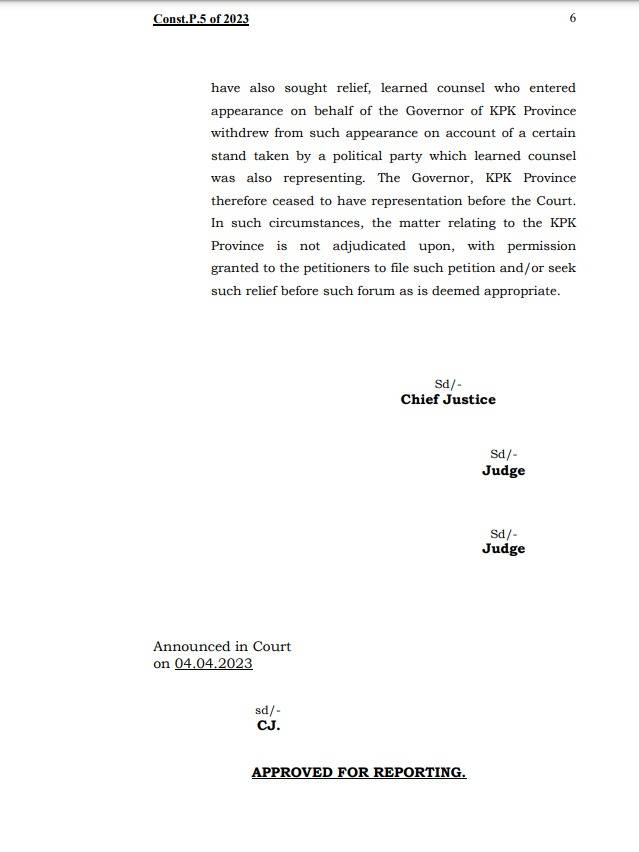
The CJP also announced that the court will continue to hear the matter pertaining to the holding of elections for the Khyber Pakhtunkhwa Assembly.
He said that he could not give decision on the KP poll case right now. He directed the KP advocate general to submit his reply to the court regarding the election in the province.
“The Governor, KP province, therefore, ceased to have representation before the court,” the court maintained, pointing out that the matter on elections in KP was not adjudicated upon. “Permission is granted to the petitioners to file such petition and/or seek such relief before such forum as is deemed appropriate.”
The CJP said that the detailed order of the court will be released later.
Earlier, the defence ministry submitted its sealed report to the Supreme Court.
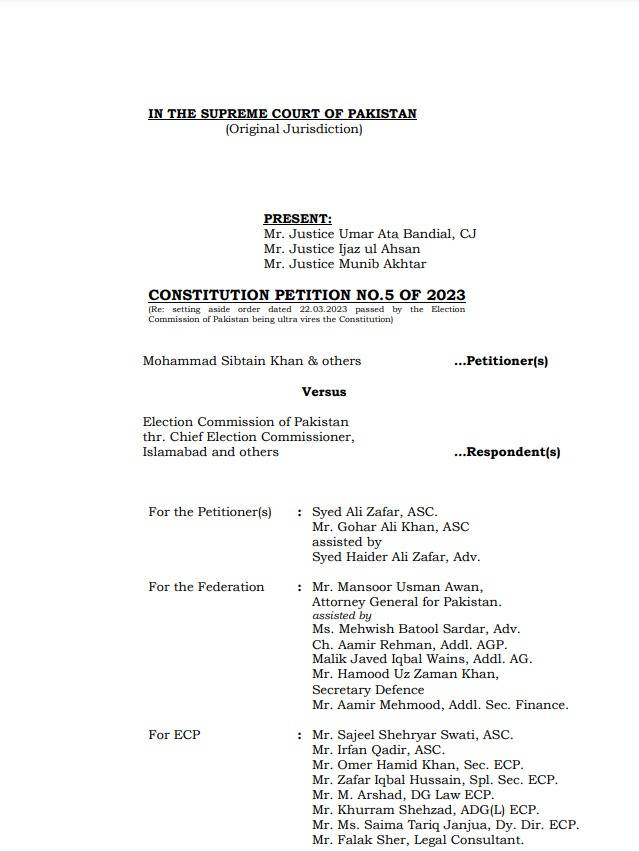
Chief Justice of Pakistan Justice Umar Ata Bandial, Justice Munib Akhtar and Justice Ijaz-ul-Ahsan analyzed the report in their chamber.
A three-member bench of the SC headed by CJP Bandial and comprising Justice Munib Akhtar and Justice Ijaz-ul-Ahsan reserved its verdict on the PTI petition challenging the ECP decision to defer polls in Punjab and KP yesterday after holding proceeding of the case for nearly six hours.
The verdict was announced in Courtroom 1 which was full of coalition leaders, journalists and lawyers.
Strict security arrangements were made outside the SC building. A large number of police officials were deployed at the main entrance.
As many as six hearings were conducted on the case.
The court had sought a report on security from the defence secretary and a report from the finance secretary regarding the provision of funds before the announcement of the verdict today.
Yesterday, the defence secretary requested the court for an in-camera briefing but the court asked him to furnish what he wanted to say in a sealed envelope which would be returned to him in the same manner.
Dissolution of benches
CJP Bandial originally constituted a 9-member bench to hear the petition but it was reduced to five-member bench later after four of the judges wrote dissenting notes rejecting the suo motu proceedings.
The five-member larger bench constituted by the chief justice also faced dissolution twice following the recusal first by Justice Aminuddin Khan and then by Justice Jamal Mandokhail.
Justice Mandokhail’s recusal came on Friday after Justice Aminuddin Khan withdrew himself from the bench a day earlier saying that he was a signatory to an order issued by a different bench, proposing the postponement of all cases instituted under Article 184(3) of the Constitution
Justice Yahya Afridi and Justice Athar Minallah have already attached their dissenting notes.
Yesterday’s proceedings
Yesterday, the Supreme Court refused to hear the arguments of the lawyers of the PDM parties including PPP, PML-N and JUI.
When PPP lawyer Farooq H Naek came to the rostrum, CJP Bandial stopped him from presenting arguments saying ‘have you withdrawn your boycott? If you want to argue then bring it in writing whether you have confidence in the bench or not.
The CJP regretted that it was rather a sense of loss that the court could not hear lawyers of the PDM partners, remarking that political agendas always come in the way during cases of political nature, resultantly depriving the court of able assistance from the other side.
The coalition partners in their meeting on Saturday, expressed their dissatisfaction over the bench hearing the election petition and dropped a hint to boycott the court’s proceedings.
Before the start of yesterday’s proceedings, the government submitted a miscellaneous petition seeking reconstitution of the bench and dismissal of the PTI petition in the light of what it said was a 4-3 majority order issued by the apex court on March 1.
The apex court had in a 3-2 verdict, ruled on March 1 that elections in Khyber Pakhtunkhwa and Punjab should be held within 90 days.
But the government disagreed saying the verdict was 4-3.
During Monday’s hearing, CJP Bandial has again ruled out the constitution of a full court to hear the case, suggesting the government could instead request for a larger bench to hear the case.
Chief Justice Bandial said he had discussed the matter with senior apex court judges in the past few days. He said the court had always taken caution when it came to taking suo motu notice, recalling that the first such notice this year was taken when the SC received requests from the speakers of two assemblies.
The CJP disagreed with the argument that this case was different from other cases under Article 184(3) of the Constitution. He questioned how the court could stop action on cases whose rules had already been established and emphasised that the procedure for jurisdiction under Article 184(3) was very strict.
Justice Akhtar wondered over conflicting statements, as one side demanded a full court and the other side argued against holding a hearing at all. He asked the AGP to clarify whether a hearing could be held or not. He further commented that if the AGP’s argument was accepted, even a full court could not go ahead with proceedings.
Cabinet meeting summoned
Prime Minister Shehbaz Sharif has summoned the federal cabinet meeting once again today.
The meeting will be held under the chair of Prime Minister Shehbaz at Parliament House at 2:30pm.
The members will hold consultation on the Supreme Court verdict and discuss other legal affairs.
The federal cabinet also met yesterday.
It decided to withdraw the services of the Registrar Supreme Court and directed him to report to the Establishment Division.
The Cabinet, which met in Islamabad with Prime Minister Shehbaz Sharif in the chair, considered the issue of the circular issued by the Registrar of the Supreme Court against the order of the court.
The Cabinet also demanded of President Dr Arif Alvi to sign the Supreme Court's Practice and Procedure Act 2023 at the earliest so that the country can get rid of the constitutional and political crises.
Earlier, Law Minister Azam Nazir Tarar and Attorney General briefed the Cabinet on various issues.
Reporter Amanat Gishkori