
Ex-servicemen chief calls for national unity, stronger local governance and improved veterans’ welfare
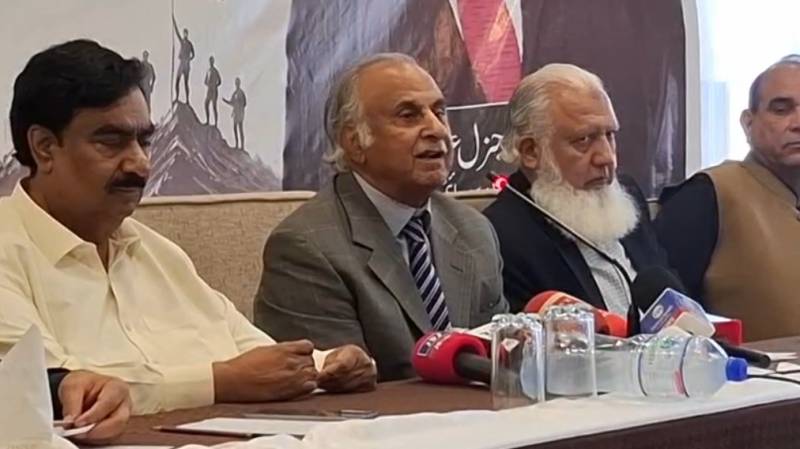

President of the Pakistan Ex-Servicemen Society Lieutenant General (retd) Abdul Qayyum Thursday stressed the need for national unity, stronger local government institutions, improved welfare for retired soldiers and better diplomatic engagement with Afghanistan, while addressing an Eid Milan Party in Islamabad.
Speaking on the occasion, he described journalism as the “fourth pillar of the state” and emphasised the importance of responsible reporting.
“Journalism is both an art and a science,” he said, adding that Pakistani journalists had enhanced the country's image internationally by effectively presenting Pakistan’s case during recent tensions with India.
“If information is not reported accurately, the world cannot receive the correct picture,” he said.
Abdul Qayyum said the Pakistan Ex-Servicemen Society was a non-political platform aimed at strengthening the nation.
Referring to recent regional tensions, he said the organisation had conveyed a message that Pakistan’s 3.4 million retired soldiers stood alongside the armed forces whenever the country’s security was threatened.
Commenting on regional security, he said Pakistan sought peaceful and diplomatic relations with Afghanistan despite concerns over militant activity originating from Afghan territory.
“We have deep affection for our Afghan brothers and do not want conflict with them,” he said, adding that Pakistan could not afford hostility from India on one border and tensions with Afghanistan on the other.
He alleged that weapons left behind after the withdrawal of US forces from Afghanistan had fallen into the hands of militant groups including the Tehreek-e-Taliban Pakistan (TTP) and Daesh-Khorasan.
Abdul Qayyum further alleged that India and Israel were supporting terrorism targeting Pakistan from the western border, while praising Pakistani security forces for defending the country and making sacrifices in the fight against terrorism.
He stressed that Pakistan, as a nuclear power, possessed the capability to defend itself and that national security required the support of the entire nation.
“Armies alone do not defend countries; nations defend countries,” he said.
The retired general also called for improved relations with Afghanistan, advocating open trade and border links while urging the Afghan leadership to ensure that its territory is not used against Pakistan.
Turning to international affairs, Abdul Qayyum criticised what he termed the “illegal” wars waged by the United States and Israeli Prime Minister Benjamin Netanyahu, claiming that regional conflicts were being driven by broader geopolitical objectives.
He praised Pakistan’s leadership for its handling of recent challenges, commending the roles of the prime minister, parliament and military leadership.
“The greatest credit goes to the Pakistani nation,” he said.
On welfare issues, Abdul Qayyum appealed to Prime Minister Shehbaz Sharif and Finance Minister Muhammad Aurangzeb to improve pensions for retired soldiers.
He said the pension of a soldier who had fought in two wars was currently around Rs14,000 and urged the government to ensure that no retired soldier received less than Rs37,500 per month.
The ex-servicemen chief also emphasised the importance of empowering local administrations and local government institutions, describing them as essential for both governance and national security.
Referring to the 18th Constitutional Amendment, he said decentralisation of powers and consensus-based administrative reforms were necessary for effective governance.
He advocated creating new provinces through national consensus, arguing that smaller administrative units could improve governance and ensure a more equitable distribution of power and resources.
“New provinces are necessary for good governance and equal transfer of powers, but consensus among all stakeholders is essential,” he said.