
Smog intensifies: NASA detects crop residue fires in Indian Punjab
Large-scale rice crop remains burning in Indian Punjab worsens Pakistan’s air pollution crisis: Lahore remains world’s most polluted city as smog intensifies: Pollution in Kasur, Sheikhupura, Faisalabad, Arifwala worsens: Authorities issue health warnings: Govt urges farmers to cooperate: Rains likely to hit Lahore, Islamabad in next 24 hours
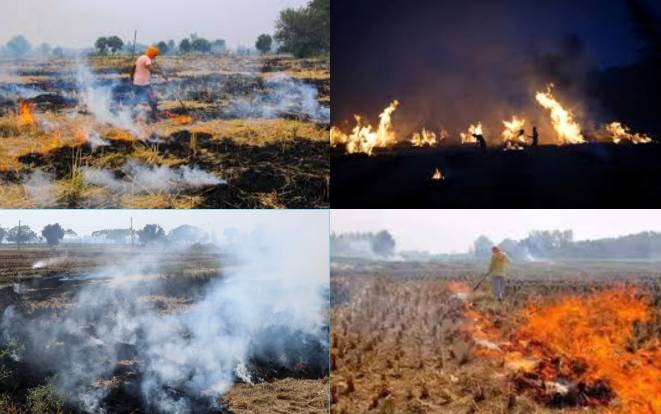

In Indian Punjab, rice crops cultivated over three million acres are being set ablaze after harvest on a large scale, according to satellite evidence confirmed by NASA.
At the start of November, the widespread burning of crop residues continues across Indian Punjab, becoming a major source of cross-border pollution, the 24NewsHD TV channel reported on Tuesday.
The polluted particles (PM₂.₅ and PM₁₀) from Indian Punjab are drifting into eastern Pakistani Punjab, increasing air pollution levels in Lahore, Kasur, Sheikhupura, and Faisalabad.
Meanwhile, in Pakistani Punjab, the use of 5,000 super seeders, Kubota machines, and balers has helped save around 7,000 acres from stubble burning.
The Punjab government has encouraged farmers through environment- and farmer-friendly policies to avoid burning crop residues and instead supply baled straw to industries.
According to the Smog Monitoring and Forecasting System, winds are currently blowing from the Indian Punjab districts of Amritsar, Jalandhar, and Ludhiana toward Lahore, Kasur, and Faisalabad.
In Lahore, wind speeds are expected to remain between 8 and 14 kilometres per hour from the east and southeast. Daytime temperatures are forecast to reach between 31°C and 32°C, while morning temperatures will range from 18°C to 21°C.
The monitoring report warns that between midnight and 9 am, moderate winds, low temperatures, and high humidity will trap pollutants near the ground, pushing the Air Quality Index (AQI) to unhealthy or very unhealthy levels.
During the day (10 am to 4 pm), stronger winds and higher temperatures may help disperse pollution slightly, though cross-border smoke will keep overall air quality poor. From evening to late night (5 pm to 11 pm), falling temperatures and calmer winds are likely to cause pollutants to accumulate again near the surface.
The Punjab government and the Environmental Protection Department have appealed to citizens to avoid unnecessary travel and to wear protective masks. The Smog Monitoring Unit has confirmed that air quality across Punjab continues to be closely monitored.
In Arifwala, local authorities have launched a crackdown against those responsible for air pollution, registering 24 cases and imposing fines exceeding seven lakh rupees. Assistant Commissioner Arifwala said that operations are ongoing against brick kiln owners, smoke-emitting vehicles, and factories involved in burning crop residues.
Lahore remains the most polluted city in the world, with today’s AQI level reaching 336. The Meteorological Department has predicted rain within the next 24 hours, which could bring temporary relief. Winds are blowing at 17 kilometres per hour, with humidity levels recorded at 73 percent.
Karachi has climbed to fifth place among the world’s most polluted cities. The Met Office forecasts a slight drop in temperature over the coming days.
In the federal capital, Islamabad, temperatures have dropped noticeably, and the Meteorological Department has predicted rainfall today. The city’s current temperature has been recorded at 17°C.
Reporters: Faran Yamin, Shehzad Ahmad, Aqsa Sheikh, and Saad Raja