
JI chief says Pakistan's powerful feudal elites subverting legal system
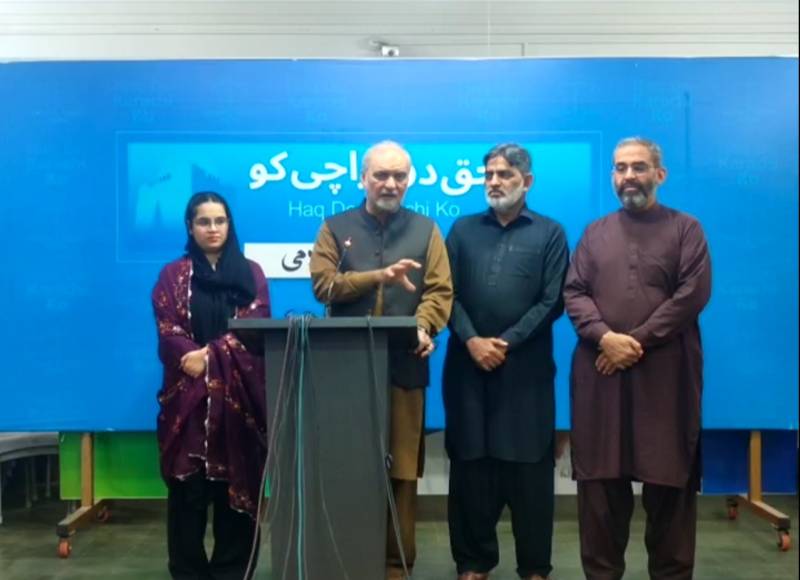

Jamaat-e-Islami (JI) chief Hafiz Naeem-ur-Rehman on Sunday accused Pakistan's powerful feudal elites of subverting the legal system and leaving ordinary citizens without protection or recourse.
Addressing a gathering at Idara Noor-ul-Haq in Karachi, the JI ameer said that despite the existence of evidence in serious cases, justice continues to evade victims due to pressure exerted by influential figures. “They are powerful people; even judges fall prey to pressure,” he stated, calling the situation a “profit of injustice” rather than justice.
Drawing attention to a long-standing culture of fear, Hafiz Naeem said speaking against entrenched feudal powers remains “very dangerous,” recounting that a victim’s father and uncle had been killed eight years ago. He warned that such incidents reflect a broader pattern in which vulnerable citizens are persecuted while the state fails to ensure accountability.
The JI chief raised alarm over threats to what he described as a “brave daughter of Sindh,” who was being intimidated by tribal chiefs. He placed responsibility squarely on the provincial government, warning that any harm to her would expose the state’s inability to protect its citizens from powerful actors.
Linking individual cases to systemic failure, Hafiz Naeem referenced high-profile incidents such as the killings of Nazim Jokhio and the abduction of Priya Kumari, suggesting that these cases illustrate a consistent pattern where justice is delayed or denied under elite influence. “You should look at the situation in entire Sindh — there is a herd bigger than the herd,” he remarked, criticizing what he described as a deeply entrenched feudal order.
He highlighted the dire socio-economic conditions in Sindh, noting that over 7.8 million children are present in the province, yet more than half of its schools lack basic systems. “Those who should get employment on merit are suppressed,” he added, arguing that inequality is perpetuated both socially and institutionally.
Despite the sharp criticism, Hafiz Naeem emphasized that his party would continue to pursue legal avenues rather than chaos. “We will approach the courts and act according to the law,” he said, while urging authorities to “rein in” feudal elements before the situation worsens.
Meanwhile, in Rawalpindi, JI leaders echoed similar concerns during demonstrations against inflation, unemployment and governance failures. Deputy Ameer Raza Ahmed Shah said rising fuel prices and economic hardship have further marginalized the poor, accusing the government of prioritizing external pressures over public welfare.
District Ameer Syed Arif Shirazi linked domestic challenges with broader regional instability, but stressed that ordinary Pakistanis are already “hanging in the mill of poverty,” with state policies making survival increasingly difficult.
Across both cities, the protests and speeches converged on a single theme: that justice and governance systems are failing to protect ordinary citizens, particularly when they come into conflict with entrenched power structures.