
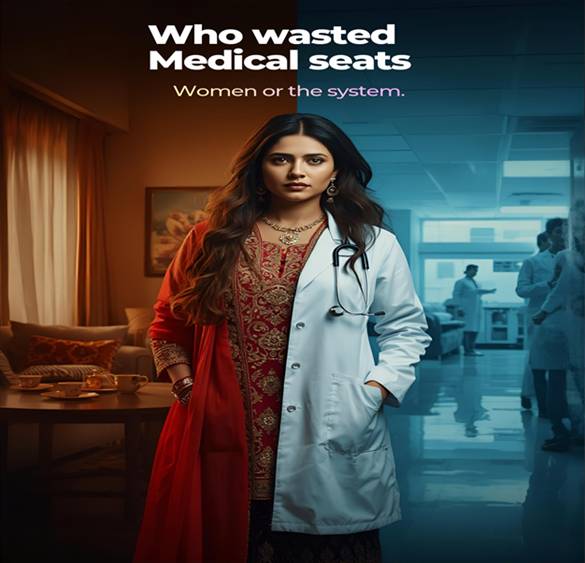
Who Wasted the Medical Seats: Women or the System?

By: Dr Wajiha Rizwan, President Medical Women’s Association of Pakistan
The myth of the “doctor bride” has long been used in Pakistan to explain away a deep and uncomfortable truth. It is easier to blame women than to confront a broken system. An editorial titled Beyond The White Coat: Journey of Female Physicians in Pakistan, published in the Proceedings of S.Z.M.C. Volume 39 Issue 2 2025 and written by the representatives of the Medical Women’s Association of Pakistan, forcefully rejects this narrative and exposes the real reasons behind the disappearance of women doctors from the workforce.
Pakistan proudly celebrates that women now make up nearly two-thirds of medical college admissions. Yet, once these women graduate, the system quietly shuts its doors on them. The gap between qualification and employment is not imagined; it is measurable and alarming. In June 2024, the Primary and Secondary Healthcare Department of Punjab announced just 374 Women Medical Officer seats. Against these, 11,712 female doctors applied. This single statistic shatters the illusion that women are voluntarily abandoning medicine. The truth is far more uncomfortable. The system neither can accommodate women doctors nor the vision to retain them.
Despite this, society continues to circulate the term “doctor bride,” suggesting that families send girls to medical colleges merely to improve marriage prospects. This label is not only unfair, but it is also dishonest. It ignores the years of relentless study, financial sacrifice and emotional endurance required to earn a medical degree. It also conveniently hides the structural failures of a patriarchal society that places the burden of childcare, household responsibilities and family care almost entirely on women, while offering them workplaces that are rigid, unsafe and unsupportive.
The editorial highlights that the crisis of doctor retention is not exclusive to women. Male doctors also leave Pakistan’s healthcare system due to poor salaries, limited postgraduate training opportunities, overwhelming patient loads and increasing violence against healthcare workers. Pakistan produces nearly fifteen thousand doctors each year, yet many remain unemployed, underemployed or forced to migrate. This is not a problem of numbers. It is a problem of governance, planning and priorities.
For women, however, the barriers are deeper and more punishing. Cultural expectations restrict their mobility and autonomy. Long working hours and night duties clash with domestic responsibilities that society refuses to redistribute. Childcare support is almost nonexistent. Leadership pathways are blocked despite women outperforming men academically in medical colleges. As a result, women remain underrepresented in senior and decision-making roles, reinforcing a cycle where policies continue to be made without their voices.
To move beyond blame and rhetoric, the Medical Women’s Association of Pakistan conducted a comparative survey of male and female physicians across specialities. The findings are telling. Women identified a lack of support from families and in-laws as a primary barrier to continuing their careers. Men largely attributed women’s absence from the workforce to domestic responsibilities. Nearly two-thirds of women considered long working hours and night duties as major obstacles, while less than half of men viewed these as significant. Very few respondents from either gender believed that women leave medicine due to a lack of interest.
When asked what would help women thrive, both men and women pointed to the same solutions. Supportive families, flexible working hours, mentorship and leadership training were seen as essential. Women further emphasised the need for strong professional networks that provide safety, solidarity and opportunity in a culturally sensitive environment.
The editorial does not merely diagnose the problem. It demands action. It calls for institutional childcare facilities, adaptable work schedules and genuine work-life balance policies. It urges society to engage husbands and families as allies rather than obstacles. It stresses the importance of mentorship and leadership development to prepare women not just to serve, but to lead.
The message is clear and uncomfortable. Women do not waste medical seats. Pakistan wastes its women doctors. Every time a qualified female physician is forced out by neglect, rigidity or stigma, the country loses skill, investment and lives that could have been saved. Continuing to hide behind the myth of the “doctor bride” only delays accountability. If Pakistan truly values its healthcare system, it must first learn to value the women who sustain it.