
Why Devolution of Power to the Grassroots Is Essential for Pakistan's Democratic Future
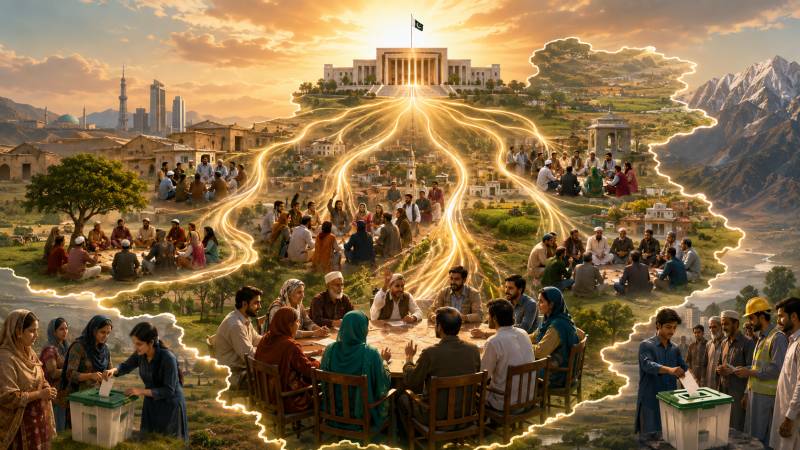

Pakistan's Constitution guarantees the establishment of local governments and the transfer of administrative authority to the grassroots. Successive governments have repeatedly pledged to strengthen local governance, while citizens have consistently demanded a more responsive and accountable system of public administration. Yet, despite these constitutional commitments and political promises, local governments remain among the weakest institutions in the country's democratic framework. Ironically, nearly every major political party—including the Pakistan Muslim League-Nawaz (PML-N), the Pakistan Peoples Party (PPP), Pakistan Tehreek-e-Insaf (PTI), Jamiat Ulema-e-Islam (JUI), and various regional parties—has championed devolution while in opposition. However, once in power, these same parties have either postponed local government elections, curtailed the authority of elected local bodies, or rendered them practically ineffective. This recurring pattern reinforces the perception that while Pakistan's political elite publicly advocates empowering the people, it remains reluctant to surrender meaningful authority.
The true purpose of devolution is to transfer political, financial, and administrative authority from provincial capitals and influential political elites to democratically elected representatives at the district, tehsil, and union council levels. Such a system naturally reduces excessive centralization within provincial governments and distributes decision-making closer to the citizens. However, political parties that have long operated through centralized structures often view this transition as a threat to their influence. Genuine decentralization weakens their control over policymaking, development funds, and administrative resources—assets that have traditionally reinforced political authority.
The Eighteenth Constitutional Amendment, passed in 2010, is widely regarded as one of the most significant milestones in Pakistan's democratic evolution. Through this landmark reform, numerous powers were transferred from the federal government to the provinces, substantially strengthening provincial autonomy. Yet the process largely stopped there. Instead of continuing the transfer of authority to districts, municipalities, tehsils, and union councils, many provincial governments evolved into new centers of centralized power. While Islamabad devolved authority to the provinces, the provinces themselves largely refused to share that authority with local governments, creating a governance structure that remains incomplete.
One of the principal reasons behind resistance to empowered local governments is political control over development funds. For decades, members of the National Assembly and Provincial Assemblies have exercised considerable influence over public development projects, including roads, schools, hospitals, drainage systems, water supply schemes, and other civic infrastructure. These projects frequently serve as instruments of electoral politics, enabling legislators to build and maintain political support. If local governments were granted genuine authority, the planning, execution, and monitoring of such projects would naturally shift to elected mayors, district councils, and union councils. Consequently, legislators would lose much of their direct influence over local development, making many reluctant to support meaningful decentralization.
Political patronage represents another major obstacle. Pakistani politics continues to revolve more around personalities and personal networks than around strong institutions. Rather than seeking solutions through administrative channels, citizens often approach legislators directly for assistance with government jobs, official transfers, utility connections, licenses, municipal services, and countless local administrative issues. This dependency strengthens the political leverage of elected parliamentarians. A robust local government system would fundamentally change this dynamic by enabling locally elected representatives to resolve most community-level problems, allowing national and provincial legislators to concentrate on their constitutional responsibilities instead of functioning as local administrators.
Financial autonomy is equally critical to successful decentralization. Effective local governments require constitutionally protected financial resources, predictable transfers from provincial governments, limited authority to generate local revenue through taxation, and transparent budgeting mechanisms. Yet provincial governments are often reluctant to relinquish fiscal control because financial resources are powerful instruments of political bargaining, administrative influence, and electoral advantage. In Pakistan's political culture, control over public finances frequently translates into political survival.
Institutional tensions between the bureaucracy and elected representatives also complicate the issue. Provincial bureaucracies often resist the transfer of extensive powers to local governments because decentralization reduces their administrative dominance. Historically, senior civil servants have exercised significant authority over district administration. In a genuinely empowered local government system, however, bureaucratic institutions become accountable to elected local representatives. Such a transformation inevitably alters long-established power relationships and frequently generates institutional resistance.
Another concern for political leadership is the emergence of new political competitors from the grassroots. Local government elections create mayors, chairpersons, and councilors who gradually establish strong public support within their communities. Over time, these local leaders can become credible challengers to the provincial leadership of their own political parties. Consequently, many party leaderships prefer to retain centralized control over candidate selection, organizational structures, and political decision-making rather than encouraging the independent growth of local leadership.
This reluctance is not confined to any single political party. The Pakistan Peoples Party presents itself as a champion of democracy and constitutional rights, yet local government elections in Sindh have repeatedly faced delays and controversies. The Pakistan Muslim League-Nawaz built much of its political identity around administrative efficiency in Punjab, but it largely retained authority within the provincial government instead of empowering local institutions. Pakistan Tehreek-e-Insaf announced ambitious local government reforms during different periods of its rule, but implementation was repeatedly delayed by legislative amendments, administrative restructuring, and political uncertainty. Religious and regional parties have likewise focused more on provincial and national politics than on strengthening grassroots democracy. This pattern demonstrates that the challenge lies not with a particular political ideology but within the broader structure of Pakistan's political system, where institutional interests frequently outweigh democratic principles.
The consequences of this governance model are evident in the daily lives of ordinary citizens. Essential municipal services—including sanitation, waste management, clean drinking water, street lighting, neighborhood roads, parks, and public maintenance—are divided among multiple government departments with overlapping responsibilities. As a result, many issues remain unresolved because no single institution accepts clear responsibility. Citizens themselves often struggle to identify which authority is accountable for their grievances, while bureaucratic complexity further delays solutions.
Weak local governments also undermine democratic accountability. Members of Parliament and Provincial Assemblies are constitutionally expected to legislate, oversee executive performance, and formulate national and provincial policies. Instead, much of their time is consumed by resolving neighborhood disputes, repairing roads, managing drainage systems, and addressing other municipal concerns. This misallocation of responsibilities prevents legislators from fully performing their constitutional duties while simultaneously leaving local governments too weak to discharge theirs effectively.
Economic development also suffers under an ineffective local governance structure. Modern cities require efficient urban planning, integrated transportation systems, environmental protection, zoning regulations, digital governance, and investment-friendly municipal administration. When decisions are delayed by centralized bureaucracies, urban expansion becomes chaotic, infrastructure deteriorates, and investors face uncertainty. Around the world, successful democracies have demonstrated that strong local governments are indispensable drivers of sustainable economic growth and competitive urban development.
Public confidence in democracy is ultimately shaped not by constitutional debates but by the quality of public services citizens experience every day. When garbage remains uncollected, roads crumble, drinking water becomes scarce, and municipal complaints remain unresolved, citizens gradually lose confidence in democratic institutions regardless of political rhetoric or electoral promises. Governance is judged by performance, not slogans.
The solution does not require another constitutional experiment. Pakistan already possesses the constitutional framework necessary for an effective local government system. What has been lacking is consistent political commitment. Provincial governments must hold regular local government elections in accordance with constitutional requirements, ensure timely transfer of financial resources, delegate clear administrative authority, and respect the institutional autonomy of elected local bodies. Independent Provincial Finance Commissions should distribute resources transparently, while modern auditing systems must ensure accountability without undermining local autonomy.
Equally important is redefining the constitutional role of legislators. Members of the National and Provincial Assemblies should devote their energies to legislation, public policy, executive oversight, and long-term development planning. Responsibilities relating to municipal services and local administration should be entrusted to elected local governments. Such a division of responsibilities would enable every tier of government to perform its constitutional functions more effectively and improve overall governance.
Political parties must also strengthen internal democracy. Encouraging grassroots leadership, empowering district and union-level party organizations, and promoting capable local representatives would deepen Pakistan's democratic culture. International experience consistently demonstrates that many successful national leaders begin their political careers in local government, where they gain firsthand experience in public administration, community engagement, and practical governance.
Ultimately, genuine devolution is far more than an administrative reform; it represents the very philosophy of democratic governance. Democracy becomes meaningful only when ordinary citizens possess real influence over decisions that directly affect their everyday lives. Pakistan's governance challenges cannot be solved solely through reforms at the federal or provincial levels. Sustainable development will remain elusive unless neighborhoods, towns, districts, and cities receive sufficient authority and financial resources to address local problems independently and efficiently.
Pakistan's political leadership frequently speaks of strengthening democracy, improving governance, and serving the people. Yet the true measure of those commitments will not be campaign manifestos or political speeches. It will be whether those who hold power are genuinely willing to share it. The maturity of a democracy is not measured by how much authority its rulers accumulate, but by how much authority they have the courage to place in the hands of the people they govern.