
Punjab on high flood alert as situation worsens in Jalalpur Pirwala, Army called in
Chenab, Sutlej floodwaters enter urban and rural areas in South Punjab, thousands displaced, crops destroyed and roads washed away, several embankments breached, water rises at Head Trimmu and Head Panjnad, heavy rain, thunderstorms expected in Karachi in next two days
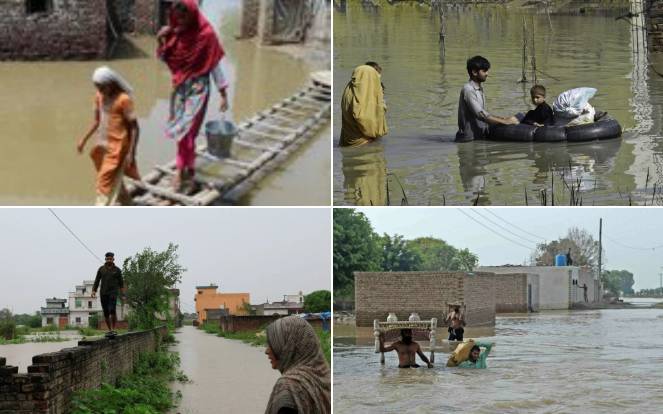

Punjab has been placed on a high flood alert after India shared fresh data on the flood situation, prompting authorities to seek military assistance in Jalalpur Pirwala where conditions have deteriorated. The Provincial Disaster Management Authority (PDMA) Punjab confirmed that the army was called in as floodwaters worsened the crisis.
According to PDMA Punjab, the Indian High Commission informed Pakistan that water levels in the Sutlej River will continue to rise. High-level flooding has already been reported at Harike downstream and Ferozepur downstream, intensifying concerns across southern Punjab. The Pakistan Meteorological Department (PMD) has forecast widespread heavy to very heavy rains across Sindh over the next two days, warning of an "unusual spell" triggered by a deepening weather system.
According to the Met Office, a depression currently lying over southwest Rajasthan and Gujarat has intensified into a deep depression and is likely to enter southeastern Sindh within the next 24 hours. The system is feeding strong monsoon currents into Sindh, with the PMD cautioning that the impact could persist until September 10. Heavy downpours accompanied by thunderstorms and strong winds are expected in Tharparkar and Umerkot, while Mirpurkhas, Sanghar, Khairpur, and Shaheed Benazirabad districts are also likely to be affected.
Karachi is forecast to experience intermittent heavy showers with gusty winds and thunder over the coming days.
Provincial Disaster Management Authority (PDMA) Punjab Director-General Irfan Ali Kathia on Sunday said that the Indian High Commission informed Pakistan about the flood situation, reported 24NewsHD TV channel on Sunday.
Kathia said that there is a high flood at Harekay Downstream and Ferozpur Downstream. He said there is a fear of high flood in River Sutlej too. The DG PDMA said that the Pakistan Army, civil administration, and other relevant departments are already on high alert. The flood situation in the country also turned alarming as the Provincial Disaster Management Authority (PDMA) Punjab’s Director General Irfan Ali Kathia warned during a press conference that the water flow at Trimmu Headworks could surge to 590,000 cusecs within hours.
He further stated that a massive wave of around 650,000 cusecs is expected at Head Panjnad within 24 hours, while flood conditions in Multan will persist for the next 72 hours. Additionally, Guddu Barrage is expected to receive flows ranging from 700,000 to 750,000 cusecs.
Pak Army’s help sought to control worsening flood situation in Multan
Due to the worsening flood situation in Jalalpur Peerwala in Multan, Pakistan Army's has been called in to control the situation and help the flood victims in the area. According to the CPO, 14 Pakistan Army boats are participating in the rescue operation while 8 rescue boats are engaged in rescue operations.
Floodwaters of Chenab and Sutlej enter urban, rural settlements:
On the other hand, multiple regions across Punjab are facing a worsening humanitarian crisis as floodwaters from the Chenab and Sutlej rivers have breached protective embankments and entered both urban and rural settlements, leaving a trail of destruction in their wake, 24NewsHD TV channel reported on Sunday.
According to the channel report, in Daulatpur Bypass, several embankments broke under pressure, allowing floodwater to gush into dozens of villages.
Widespread devastation in Tarranda Muhammad Panah:
In Tarranda Muhammad Panah, the Chenab River caused widespread devastation as multiple agricultural embankments gave way, submerging dozens of villages.
A major breach occurred in the government-built Manchan dyke at Beet Zahir Pir, flooding Tarranda Muhammad Panah, Beet Bhutto, Beet Bhattar, Tibbi Jhullan, Bakhshu Bhattar, and Beet Murad. Meanwhile, areas such as Bana Raviya, Beet Sui, Noor Wala Shehr, and Ghafoorabad have also been flooded, with roads severed and entire towns like Noor Wala now underwater.
Lodhran's outskirts flooded:
In Lodhran’s outskirts, specifically in Ghulam Shah, the collapse of a protective embankment resulted in severe flooding. Hundreds of homes and acres of crops were destroyed, submerging key link roads and trapping numerous families inside their homes. Victims are urgently appealing to authorities for evacuation to safer locations.
Hundreds of homes destroyed in Rangpur:
Rangpur continues to bear the brunt of the flood, with hundreds of homes and thousands of acres of crops destroyed. Although water levels in the Chenab are reportedly decreasing, fear of more incoming flood waves keeps residents on edge. At Trimmu Headworks, current discharge has already reached 526,000 cusecs, with flood victims claiming they are stranded atop embankments without any aid or basic facilities.
Water at Head Panjnad rises:
Near Uch Sharif, water at Head Panjnad has risen to 490,000 cusecs, submerging low-lying villages including Makhan Bela, Beet Bakhtiyari, Kachi Lal, Chak Kahl, and Rasool Pur. Thousands of acres of crops have been ruined, and mass displacement is ongoing. Local administration has issued warnings for people to relocate to safer ground as the water level continues to rise.
High flood in Sutlej at Arifwala:
In Arifwala, flood conditions in the Sutlej River have grown critical, with the rising water engulfing several villages. Thousands of families have been displaced, and mud houses and standing crops have been swept away.
70 villages in Qaboola affected:
In Qaboola, the situation has become dire as nearly 70 villages have been severely affected by rising Sutlej waters. Several feet of floodwater have entered homes, mud structures have collapsed, and there is now growing concern over the outbreak of waterborne diseases due to the prolonged submersion. More than 30,000 people have already abandoned their homes.
Rescue operation continues in Ahmadpur Sial:
Rescue efforts are ongoing in Ahmadpur Sial, where Rescue 1122 teams continue their operation in Union Council Samandwana, having already evacuated over 10,000 people to safer areas.
Authorities are urging residents in flood-prone and low-lying areas to evacuate immediately and follow safety advisories.
NDMA warns of heavy rainfall in Sindh
The National Disaster Management Authority (NDMA) on Sunday has issued a warning for extremely heavy rainfall across southeastern Sindh from September 7 to 10, cautioning that the downpours may lead to urban flooding in low-lying coastal districts.
According to NDMA, the rains are being driven by a weather system currently positioned over the Gujarat-Rajasthan border, which is moving westward and expected to bring intermittent rainfall across Sindh, southern Punjab, and parts of Balochistan until September 10.
The National Disaster Management Authority (NDMA) has issued a warning of urban flooding in various parts of Sindh, Balochistan and Southern Punjab, along with the risk of rising water levels in the Kirthar and Sulaiman ranges. According to details, heavy rainfall is expected in south-eastern Sindh till Wednesday, which may lead to urban flooding in low-lying coastal districts. The rain is also likely to cause flash floods in the streams of Lasbela and Khuzdar in the Kirthar ranges, Balochistan.
Furthermore, heavy to very heavy rainfall is predicted at several locations in the Sulaiman range and Southern Punjab, which could increase water flow in rivers and streams. The NDMA has advised public to avoid crossing rivers and streams during this period and follow the instructions of local authorities.
Reporters: Ali Ramay, Ghulam Ali, Sajjad Hussain, Raza Malik, Rana Parvez Akhtar, Bilal Shakir Joiya, Imran Joiya, Shehzad Ahmad, Tanveer Hussain, Ahmar Khan