
China’s Xi calls on world powers to help Russia, Ukraine 'resume direct dialogue'
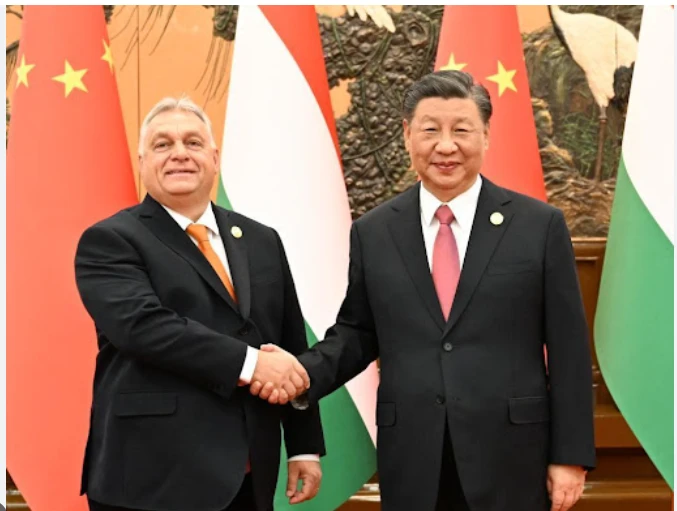

Chinese President Xi Jinping on Monday told visiting Hungarian leader Viktor Orban that world powers should help Russia and Ukraine re-start direct peace talks, state broadcaster CCTV reported.
"The international community should create conditions and provide assistance for the two sides to resume direct dialogue and negotiations," Xi told Orban, adding: "Only when all major powers exert positive energy rather than negative energy can the dawn of a ceasefire in this conflict appear as soon as possible."
Orban, who has recently visited Moscow and Kyiv, said earlier his unannounced trip to the Chinese capital was a "Peace mission 3.0".
The visit comes a day before NATO is due to hold a summit to mark its 75th anniversary, with setbacks in Ukraine set to dominate discussions, and follows Orban's surprise trips to Russia and Ukraine in the past week.
CCTV said Xi and Orban's talks "focused on in-depth communication on the Ukrainian crisis".
"Xi Jinping appreciated Orban's efforts to promote a political solution to the Ukrainian crisis and elaborated on China's views and propositions," the broadcaster reported.
"Xi Jinping stressed that it is in the interests of all parties to cease fire and seek a political solution as soon as possible," CCTV said in a readout.
"The current focus is to abide by the three principles of 'no spillover of the battlefield, no escalation of the war, and no fueling of the flames by all parties' to cool down the situation as soon as possible," it added.
Earlier, Hungarian Prime Minister Viktor Orban met Chinese President Xi Jinping in Beijing on Monday, state media reported, in a visit the European leader has branded as a "Peace mission 3.0" after recent trips to Moscow and Kyiv.
The unannounced visit comes a day before NATO is due to hold a summit to mark its 75th anniversary, with setbacks in Ukraine set to dominate discussions, and follows Orban's surprise trips to Russia and Ukraine in the past week.
Orban, the friendliest EU leader towards Moscow, held talks with President Vladimir Putin on Friday about the war in Ukraine during a trip criticised by both Kyiv and the EU, which said it threatened to undermine the bloc's stance on the conflict.
Putin told Orban, that Ukraine must withdraw its troops from regions that Moscow has annexed if it wants peace.
Hungary took over the European Union's rotating presidency at the start of July, and the EU's foreign policy chief Josep Borrell said Orban's trip to Russia was purely a bilateral affair and he "has not received any mandate from the EU Council to visit Moscow".
In a short statement earlier, the Chinese foreign ministry said the Hungarian leader would meet Xi "for in-depth communication on issues of mutual interest".
Close to both Xi and the Kremlin, Orban has refused to send weapons to Kyiv, unlike his fellow EU leaders.
China and Russia's strategic partnership has grown closer since the invasion of Ukraine.
Beijing presents itself as a neutral party in the war and says it is not sending lethal assistance to either side, unlike the United States and other Western nations.
It has however offered a critical lifeline to Russia's isolated economy, with trade booming since the conflict began.
Orban was greeted at the airport by Chinese foreign ministry spokeswoman Hua Chunying, according to a photo the nationalist leader posted on social media platform X.
- Major investment -
Xi visited Hungary in May this year, for the final leg of a European tour that also led him to France and Serbia.
Following a meeting with Orban, Xi said Beijing placed "great importance" on its relations with the EU.
Despite its small size, the Central European country of 9.6 million people has attracted a flood of major Chinese projects in recent years, mostly related to battery and electric vehicle (EV) manufacturing.
The Hungarian government boasted about having around 15 billion euros ($16 billion) worth of ongoing projects originating from the Asian country.
Orban has been championing an "Eastern opening" foreign policy since his return to power in 2010, seeking closer economic ties to China, Russia and other Asian countries.
Last October, the Hungarian premier was the sole EU leader to attend the summit for Xi's flagship Belt and Road initiative in Beijing.