
SIPRI report shows Pakistan among top arms importers and nuclear powers
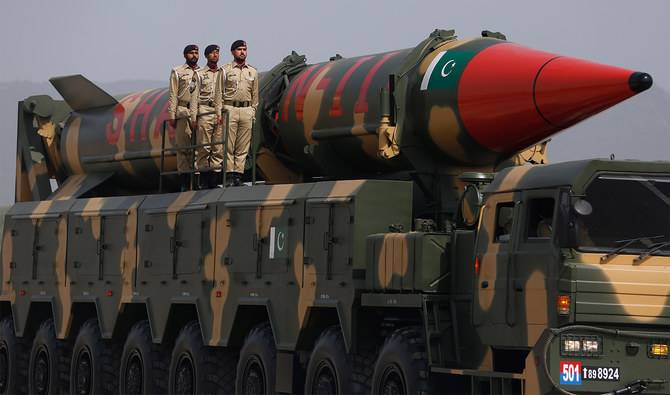

Pakistan has emerged as one of the world's largest arms importers and remains among the nine nuclear-armed states as global military spending, arms transfers and geopolitical tensions continue to rise, according to the latest Stockholm International Peace Research Institute (SIPRI) Yearbook 2026.
The annual report paints a picture of an increasingly unstable international security environment marked by intensifying great-power competition, growing interstate conflicts, expanding nuclear arsenals and record levels of military expenditure worldwide.
The report comes weeks after the military confrontation between Pakistan and India in May 2025, which SIPRI identified as one of six interstate armed conflicts recorded globally during the year. The institute described the crisis as one of several regional flashpoints in Asia that continue to carry the risk of escalation into major interstate warfare.
According to SIPRI, the number of interstate conflicts doubled from three in 2024 to six in 2025, with the India-Pakistan conflict listed alongside wars and confrontations involving Russia and Ukraine, Iran and Israel, Afghanistan and Pakistan, Cambodia and Thailand, and the Democratic Republic of Congo and Rwanda.
Pakistan among world's largest arms importers
One of the most significant findings for Pakistan is its position among the world's leading arms-importing countries.
SIPRI reported that Pakistan was the fifth-largest recipient of major conventional weapons during the 2021-2025 period, accounting for 4.2 percent of total global arms imports. Only Ukraine, India, Saudi Arabia and Qatar imported more major weapons systems during the period.
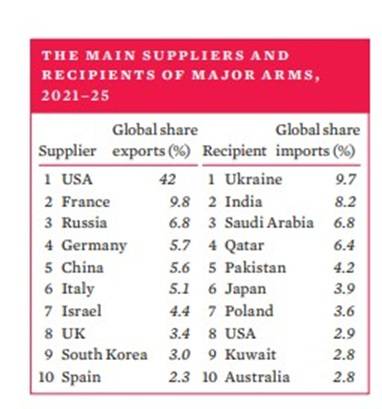
The report noted that the five largest recipients—Ukraine, India, Saudi Arabia, Qatar and Pakistan—together accounted for 35 percent of all global arms imports.
Globally, the volume of international transfers of major arms during 2021-2025 reached its highest level since the end of the Cold War, increasing by 9.2 percent compared to the previous five-year period. SIPRI said demand for advanced weapons is expected to continue rising amid ongoing conflicts and geopolitical tensions.
Pakistan retains nuclear arsenal of 170 warheads
The report estimates that Pakistan possesses around 170 nuclear warheads, placing it among the world's nine nuclear-armed states.
The reports mentions that Pakistan continued to develop new delivery systems and accumulate fissile material in 2025, suggesting that its nuclear arsenal might expand over the coming decade.
Globally, SIPRI estimates that the nine nuclear powers collectively possess about 12,187 nuclear weapons, including 9,745 held in military stockpiles and roughly 4,012 deployed with operational forces. More than 2,000 warheads remain on high operational alert.
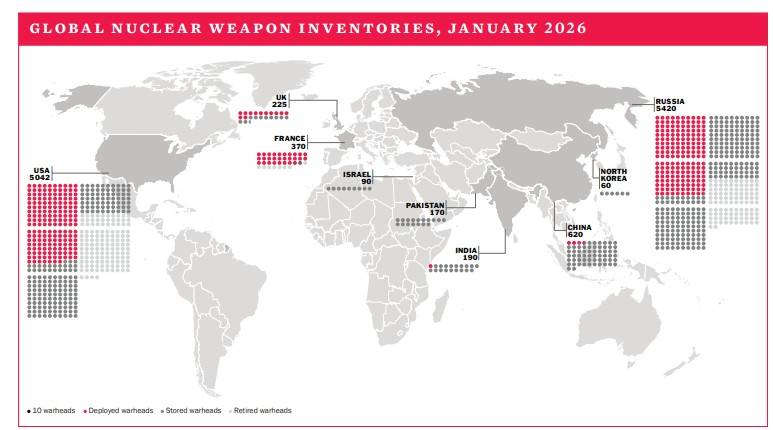
India is believed to have once again slightly expanded its nuclear arsenal in 2025 and continued development of new types of nuclear delivery systems. The modernization programme is increasingly focused on developing long-range weapons capable of reaching targets throughout China, although planning also continues to be focused on India’s long-standing rivalry with Pakistan.
SIPRI estimates that China now has around 620 nuclear warheads. China is expanding its nuclear arsenal faster than any other country and showcased several new nuclear systems during its 2025 military parade. By January 2026, China had loaded hundreds of missiles into three large missile silo fields in the north of the country, while working to complete 30 silos in three mountainous areas in the east. China could potentially have at least as many ICBMs as either Russia or the USA by the turn of the decade.
Russia and the USA together possess around 83 per cent of all stockpiled nuclear warheads (i.e. useable warheads). This combined share is shrinking somewhat due to the growth in the world’s other nuclear arsenals. The sizes of the Russian and US military stockpiles appear to have stayed relatively stable in 2025, but both states’ extensive modernisation programmes seem likely to increase the size and diversity of their arsenals in the future.
Although the UK is not thought to have increased its nuclear weapon arsenal in 2025, its operational warhead stockpile is expected to grow in the future, after the 2021 Integrated Review announced the UK’s intention to raise the ceiling on warhead numbers.
In 2025, France continued to upgrade its nuclear-powered ballistic missile submarine (SSBN) force, introducing its enhanced M51.3 submarine-launched ballistic missile (SLBM) and pressing ahead with development of a third-generation SSBN. The government also announced plans to establish a new nuclear airbase in eastern France for two new nuclear-capable Rafale aircraft squadrons equipped with France’s next-generation hypersonic nuclear air-launched cruise missile.
North Korea continues to develop its nuclear capabilities to fulfil its stated goal of ‘exponentially’ expanding its nuclear arsenal. SIPRI estimates that the country has possibly assembled around 60 warheads, possesses enough fissile material to produce at least 30 more and is accelerating the production of fissile material. In 2025 North Korea continued to unveil and test new missile systems, including the ‘next-generation’ solid-fuelled Hwasong-20 ICBM, as well as medium-range, highly manoeuvrable systems designed to evade missile defences.
Israel—which does not publicly acknowledge possessing nuclear weapons—is also believed to be modernizing its nuclear arsenal. In 2025 Israel intensified construction at a new site at the Negev Nuclear Research Center near Dimona, which could be related to its nuclear capabilities.
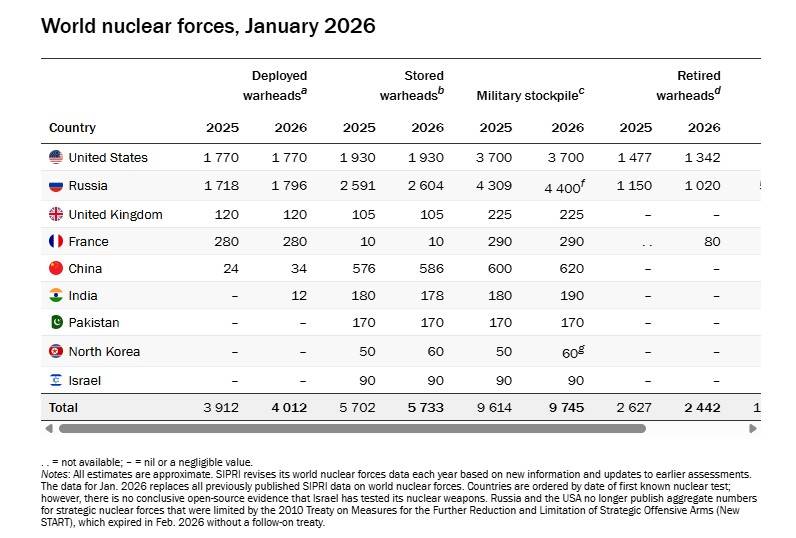
The report warns that all nuclear-armed states continued to modernize and strengthen their arsenals during 2025. It highlights growing concerns over the erosion of arms-control agreements, the deployment of new nuclear-capable systems and the increasing overlap between conventional and nuclear weapons technologies.
Particular attention was drawn to developments in the Indo-Pacific region, where submarine-based nuclear delivery systems are expanding among several nuclear powers.
Military spending reaches record level
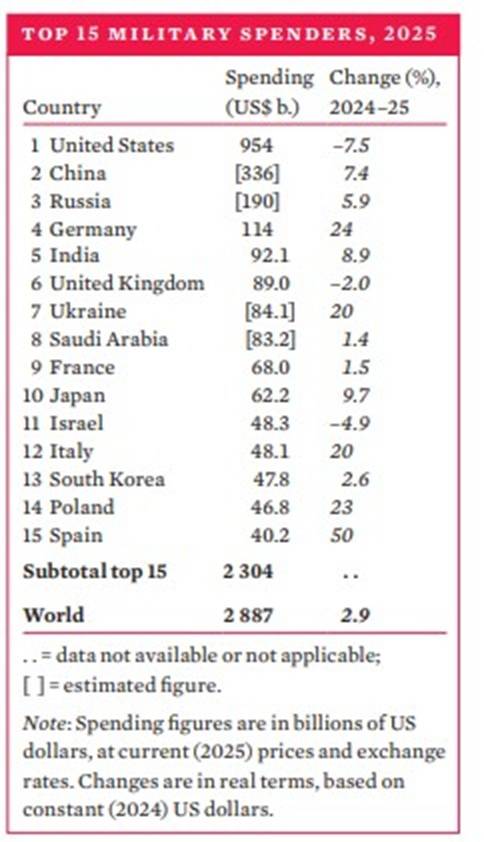
The SIPRI report says global military expenditure rose for the eleventh consecutive year in 2025, reaching a record $2.9 trillion, equivalent to 2.5 percent of global GDP.
The United States remained the world's largest military spender with expenditure of $954 billion, followed by China at $336 billion and Russia at $190 billion. India ranked fifth globally with military spending of $92.1 billion.
Asia and Oceania recorded an 8.1 percent increase in military spending during 2025, reflecting growing strategic competition and security concerns across the region.
Global security environment deteriorating
The report warns that the international security environment has entered a period of "systemic disruption" driven by major-power rivalry, regional conflicts and the weakening of multilateral institutions.
SIPRI said armed conflicts continued at high levels across the world in 2025, with 49 countries experiencing conflict. Although overall conflict-related fatalities declined slightly to 238,000, the figure remained among the highest recorded in recent years.
The institute also highlighted the growing use of advanced military technologies, including artificial intelligence-assisted targeting, autonomous weapons systems, drones and cyber warfare, raising new legal and ethical concerns.
Asia remains key strategic battleground
In its regional assessment, SIPRI said Asia's security landscape continues to be dominated by strategic competition between China and the United States, accompanied by military buildups, political instability and unresolved territorial disputes.
The report specifically cited the India-Pakistan military crisis of May 2025 as evidence that several regional flashpoints remain capable of escalating rapidly into major interstate conflicts.
SIPRI concluded that the global trend toward increased militarisation, rising arms transfers, nuclear modernization and weakening international security frameworks presents growing risks for regional and global stability, with South Asia remaining one of the world's most closely watched strategic regions.