
Stargazers enjoy Blood Moon in Pakistani skies
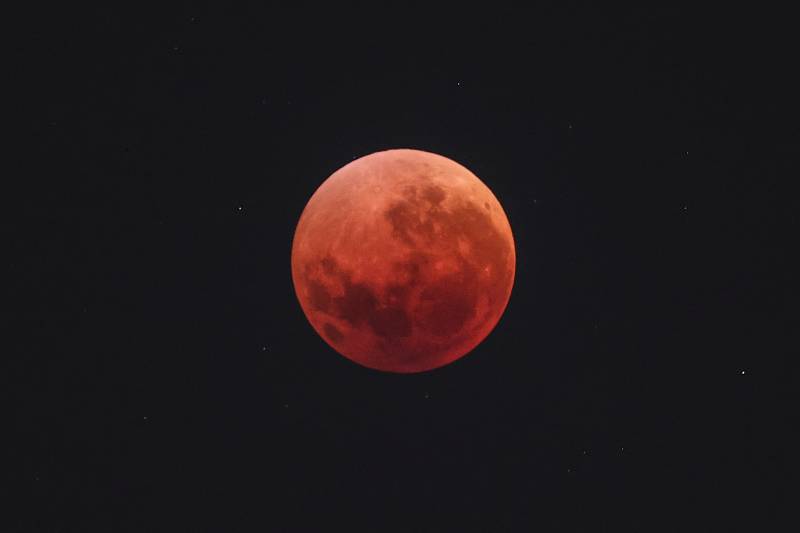

Stargazers including astronomy enthusiasts, students and the general public enjoyed late Sunday night a rare lunar eclipse, commonly called the “Blood Moon”, in the Pakistani skies, reported 24NewsHD TV channel on Monday.
The rare event occurs when the Sun, Earth and Moon line up, causing the planet to cast a giant shadow across its satellite. But as the Earth’s shadow creeps across the Moon, it does not entirely blot out its white glow and instead the Moon glows a reddish colour.
According to the Pakistan Space and Upper Atmosphere Research Commission (SUPARCO), unlike solar eclipses, lunar eclipses are completely safe to observe with the naked eye, binoculars or telescopes.
The fascinating celestial phenomenon, which began in Pakistan at 0830pm, reached its maximum at 1157pm and concluded at 0155am in the wee hours of Monday, when a portion of the Moon appeared darkened as it passed through Earth’s shadow.
“The eclipse was visible in Asia, Africa, and parts of Europe, with clear visibility expected in most regions of Pakistan, weather permitting,” SUPARCO said in a statement.
This phenomenon happens because the only sunlight that reaches the Moon is “bent and scattered” as it goes through Earth’s atmosphere.
'Blood Moon' rises
Stargazers enjoyed a "Blood Moon" Sunday night during a total lunar eclipse visible across Asia and swathes of Europe and Africa.
When the Sun, Earth and Moon line up, the shadow cast by the planet on its satellite makes it appear an eerie, deep red colour that has astounded humans for millennia.
People in Asia, including India and China, were best placed to see Sunday's total eclipse, which was also be visible on the eastern edge of Africa as well as in western Australia.
The total lunar eclipse lasted from 1730 GMT to 1852 GMT.
Stargazers in Europe and Africa also got a brief chance to see a partial eclipse just as the Moon rose during the early evening, but the Americas missed out.
The Moon appears red during lunar eclipses because the only sunlight reaching it is "reflected and scattered through the Earth's atmosphere", said Ryan Milligan, an astrophysicist at Queen's University Belfast, Northern Ireland.
Blue wavelengths of light are shorter than red ones, so are more easily dispersed as they travel through Earth's atmosphere, he told AFP.
"That's what gives the Moon its red, bloody colour."
While special glasses or pinhole projectors are needed to safely observe solar eclipses, all that is required to see a lunar eclipse is clear weather -- and being in the right spot.
The last total lunar eclipse was in March this year, while the one before that was in 2022.
A rare total solar eclipse, when the Moon blocks out the light from the Sun, will be visible in a sliver of Europe on August 12, 2026.
Next year's totality -- the first in mainland Europe since 2006 -- will be visible only in Spain and Iceland, though other countries will be able to see a significant partial eclipse.
In Spain, the totality will be visible in a roughly 160-kilometre (100-mile) band between Madrid and Barcelona, but neither city will see the full phenomenon, Milligan said.
It will be the first total solar eclipse since one swept across North America in April 2024.
Reporter Tauqeer Akram-AFP