
ADB cuts Pakistan’s growth forecast and raises inflation outlook
Growth forecast for the current fiscal year reduced from 4.5% to 3.7%: Inflation estimate raised to 8.3%: Bank warns continuing tensions in Middle East could increase inflation: ADB to provide Pakistan with financing worth $4b


The Asian Development Bank (ADB) has lowered Pakistan's economic growth forecast for the 2026-27 fiscal year while raising its inflation outlook, citing regional uncertainty and risks to energy markets.
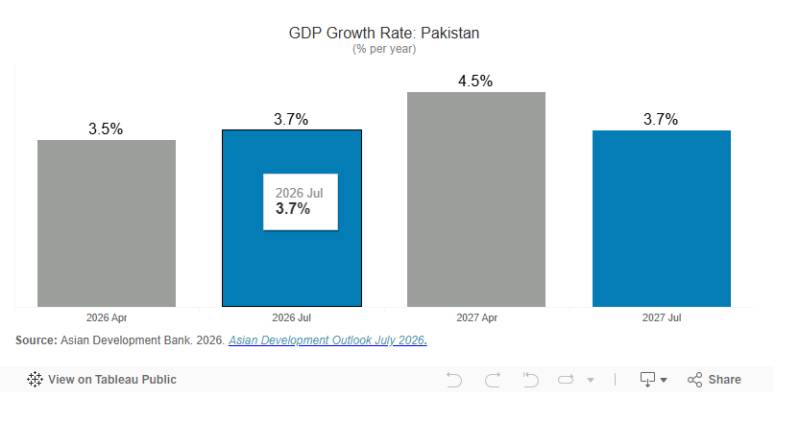
In its latest 'Asian Development Outlook' report, the ADB revised Pakistan's projected gross domestic product (GDP) growth from 4.5 percent to 3.7 percent for the current fiscal year.
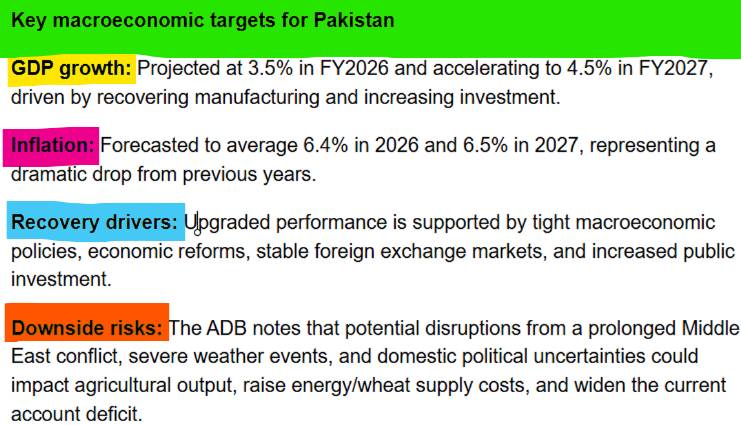
The bank also increased its forecast for average annual inflation from 6.5 percent to 8.3 percent.
According to the report, the federal government has set a GDP growth target of 4 percent for the 2026-27 fiscal year, while aiming to keep average inflation at 8.2 percent.
The ADB warned that continuing tensions in the Middle East could place additional upward pressure on inflation.
It said uncertainty in regional energy markets remains a significant risk that could affect prices and the broader economic outlook.
Meanwhile, according to 24NewsHD TV, the Asian Development Bank has also decided to provide Pakistan with financing worth four billion US dollars.
Growth forecast for DAP
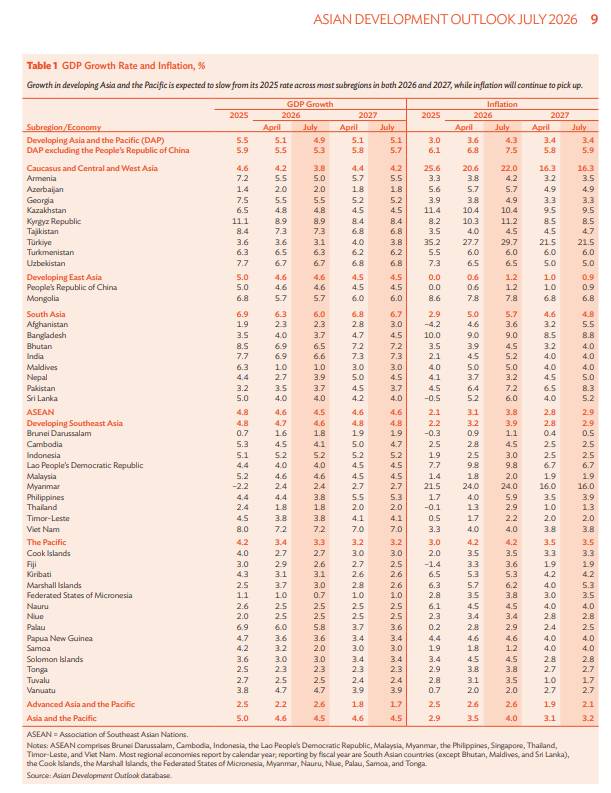
The ADP outlook also highlighted the growth forecast for developing Asia and the Pacific (DAP) is lowered to 4.9% in 2026—down from the 5.1% projected in April and 0.6 percentage points below the 5.5% growth recorded in 2025. The Middle East conflict has led to prolonged disruption to energy and supply chains, raising production costs and dampening economic activity. The growth projection is maintained at 5.1% in 2027, reflecting recovering activity as these pressures ease.
In developing East Asia, the outlook is maintained at 4.6% in 2026 and 4.5% in 2027 on the strength of resilient exports and continued infrastructure investment in the People’s Republic of China (PRC), despite weak private consumption and rising geopolitical risks.
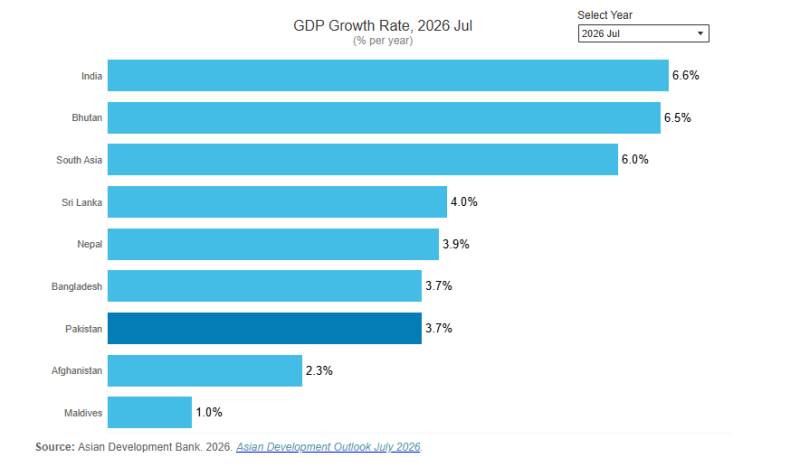
South Asia’s growth forecasts are reduced to 6.0% in 2026 and 6.7% in 2027, weighed down by higher oil prices, rising freight costs, and uncertainty over remittances stemming from the conflict.
Developing Southeast Asia’s growth forecast is downgraded slightly to 4.6% in 2026, reflecting heightened uncertainty, weaker external demand, and rising commodity costs linked to the conflict. The 2027 projection is maintained at 4.8%.
Growth forecasts for the Caucasus and Central and West Asia are lowered to 3.8% in 2026 and 4.2% in 2027 in response to trade disruption, rising trade costs, and prolonged geopolitical tensions.
The Pacific’s growth outlook is lowered to 3.3% in 2026 as higher fuel, food, and input costs stemming from the conflict dampen economic activity despite government mitigation measures. The 2027 projection is unchanged.
Inflation in DAP is projected to rise to 4.3% in 2026, from 3.0% in 2025, driven by elevated oil and gas prices and spillover to other commodities that broadens price pressures across the region. It will ease to 3.4% in 2027.
Downside risks to the outlook are significant: renewed escalation of the Middle East conflict; prolonged energy market uncertainty; tighter global financial conditions; a sharp correction in global equity markets and re-pricing of AI-related stocks; rising trade policy uncertainty; food price pressures; and a deeper property downturn in the PRC.
Reporter: Waqas Azeem