
Major targets missed as govt rolls out Economic Survey 2024-25
Finance Minister Aurangzeb speaks of gradual economic recovery: Says inflation was a fantastic story: Policy rate cut down to half: Slight decrease in public debt: Provinces to be consulted on NFC Award: Govt to borrow money from banks on its terms
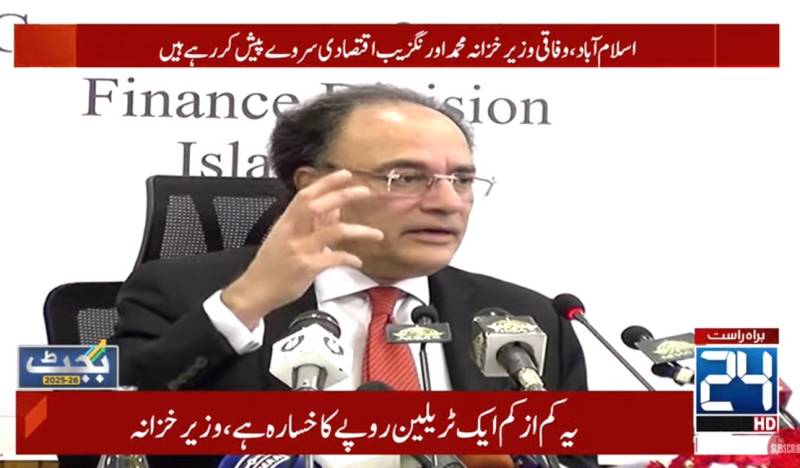

Federal Minister for Finance and Revenue Senator Muhammad Aurangzeb launched on Monday the Pakistan Economic Survey 2024-25, containing the details of socio-economic performance during the outgoing fiscal year 2024-25 and mentioning government’s gains and pains during this period, reported 24NewsHD TV channel.
The Economic Survey serves as a vital document a day ahead of the annual federal budget, offering detailed insights into the country’s socio-economic achievements over the outgoing fiscal year.
Some of the major sectors in which the government missed its set targets were economic growth, decline in five major crops including wheat, foreign investment off target, agriculture, services, production sector, industrial output and fishing.
The three major achievements the government was able to achieve during the outgoing fiscal year were inflation, remittances and policy rate.
Addressing the media, Finance Minister Aurangzeb said the government was heading in the right direction, the economic fundamentals are strong due to the improvement in the governance.
The finance minister said economy grew by 2.7 percent in 2025. “Pakistan’s economic heartbeat is growing gradually. Inflation has come down to 4.6 percent from 29 percent. Police rate is now at 11 percent from 22 percent. There was a record surge in foreign exchange reserves," he added.
The healthy increase in the GDP is a sign of economic development, he stressed.
Talking about the global economic outlook, the finance minister noted that global GDP growth was estimated to decline to 2.8pc in 2025 from 3.5pc two years ago. “Our recovery needs to be looked at in a global context,” he added.
The minister said Pakistan’s GDP growth in 2023 was -0.2pc, which rose to 2.5pc in 2024. “This year, we announced a 2.7pc growth for 2025. This is a gradual recovery and the right way to go about it is to focus on sustainable growth. “The last thing we want is to go through another round of boom and bust cycles,” he stressed.
Inflation, he said, had been a fantastic story for Pakistan: 6.8pc global inflation in 2023, 5.7pc in 2024 and the estimate for 2025 is 4.3pc in terms of CPI inflation.
He noted that the Consumer Price Index (CPI) had crossed 29pc in 2023 but now had plunged to just 4.6 percent. “So, I think we’ve moved in the right direction in terms of the global figures.”
About monetary policy, the minister recalled that the interest rate was at a record 22 percent in 2023, following which “steps were taken” to reduce it, and now the key policy rate stood at 1,100 basis points, he added.
Talking about macroeconomic indicators, the minister said, “Public debt and debt-to-GDP ratio was 68pc, which is now 65pc. Forex reserves as of June 30, 2024, were $9.4 billion, which was a huge and remarkable recovery from where we were back in 2023, where we were down to two weeks of import cover. The recovery continued and we consolidated it in 2024-25.”
IMF loan programme
Talking about the International Monetary Fund (IMF) loan programme, Aurangzeb said “Our credibility and trust was re-established under Prime Minister Shehbaz Sharif’s leadership.”
Highlighting that the premier had signed the Stand-by Arrangement (SBA) before the caretaker administration took over, the finance minister also praised the efforts of caretaker finance minister Dr Shamshad Mirza as her “discipline allowed us to continue”.
He then highlighted two reasons for Pakistan desiring an IMF loan, with the first one aiming to “bring permanence to macroeconomic stability” and remove fragility.
The second reason, Aurangzeb added, was to continue with structural reforms. “We needed to fundamentally change the economy’s DNA, and for that, we needed structural reforms which are elusive in this country. We needed to proceed with a structured programme,” he said.
The international finance institutions are standing with Pakistan, he said and added, the Indian executive director strongly opposed lending money to Pakistan at the IMF Board meeting. “India even tried to block the IMF Board meeting or at least Pakistan should not be on the agenda of the IMF Board meeting,” he added.
Record revenue generation
About revenue, the finance minister said, “Our tax-to-GDP has hit a five-year high and the prime minister is leading this personally. This whole transformation is around people, processes, and technology. “Tech played a big role — digital invoicing, production tracking, AI audits, faceless customs regime,” he added.
“Any transformation takes two to three years, and I think we have done a good job in terms of where we wanted to take things,” Aurangzeb said, adding recoveries in the power sector had been “remarkable”.
Aurangzeb then highlighted that industrial and household energy tariffs had been slashed, while private sector and professional boards were introduced for power distribution companies. “Distribution losses will be reduced going forward,” he added, noting the National Transmission and Despatch Company (NTDC) dividing into three companies was an important step toward reducing the bottleneck in transmission.
He also highlighted a 26pc increase in terms of revenue collection, “on the back of 30pc growth in revenue last fiscal year”. “There has been a deepening and expanding of the tax base,” he added.
“Individual filers doubled to 3.7 million filers. High-value filers also increased by 178pc,” he said, recalling there were 74pc additional retail registrations in the last fiscal year.
Circular debt
Aurangzeb said resolving the Rs1.275 trillion circular debt would “play an important role”. “SOEs (state-owned enterprises) have been talked about at length, and Rs800 billion have been spent, if you add up equities and guarantees, this goes into the trillions. Those trillions are better spent elsewhere,” he underscored.
Speaking about the government’s decision to privatise 24 SOEs, the minister affirmed that it would be “completed with renewed vigour and energy next year under adviser to the PM, Mohammad Ali”.
Aurangzeb said “Debt servicing is the single-largest expense for the federation. In the past year, the policy rate fell and saved us Rs800bn in debt servicing costs.”
On reforms in pension, he said contributions must be defined for new government colleagues joining from July 2024. “Our biggest step is to stop bleeding and then solve legacy issues. But if we don’t stop leakages, it will become very difficult for us to start tackling legacy issues,” he emphasised.
Rightsizing in govt depts
Shedding light on the ongoing rightsizing efforts by the government, Aurangzeb said that “forty-three ministries and 400 attached departments” were to face reduction. “It’s not about what and why the federal government has to be rightsized. The question is how,” he said, adding they will “continue with five ministries at a time”.
The minister then invited ministries and the heads of their attached departments to give their input on the matter, including “why a department is so critical to the running of the government”.
About current account deficit, the minister said there was a surplus of $1.9 billion from July 2024 to April 2025 compared to a $1.3 billion deficit last year. “This entire year will be completed on a surplus,” he added.
Aurangzeb termed the 7pc increase in exports, especially in the IT sector as a “big jump”, adding money earned by freelancers was close to $400 million.
He also noted that imports had increased by 12pc, with non-oil imports almost at the same level as back in 2022, which he said was “a time before the country’s economic crisis.”
While the minister said machinery and transport imports had risen by 16.5pc and 24pc, respectively, he asserted that these would help the agricultural sector, where cotton was being imported.
Remittances and Roshan Digital Accounts
“Remittances, like inflation, have been an outstanding story,” Aurangzeb remarked. “You can see a 31pc increase year-on-year from $31 billion and a record $4.1 billion in March. When we close June, we expect our overall remittances to be $37-38 billion,” he added, noting the figure was $10 billion less two years ago. “It is very critical that we mention the momentum of the Roshan Digital account because that is investment and lifestyle-led,” he remarked.
Aurangzeb called RDAs a “different segment of our diaspora”, with inflows from it crossing $10 billion and 814,000 accounts opening. “When we talk about remittances, sometimes we forget about RDA, which is playing a very important role in terms of how we take our diaspora and their commitment to Pakistan,” he stressed.
Debt management
Speaking about debt management, the minister pointed out that the government had “brought back Rs1 trillion in local debt due to two reasons”.
“We reduced the prices and money going into mark-ups,” he said, adding the second reason was to give a signal to the banking system that the government was “not a desperate borrower anymore”.
“We will borrow, but at our terms. It is about time you start lending to the private sector. This was an important message for the banks and they can see the increase,” he maintained.
Industrial growth
Industrial growth for FY2024-25 was 4.8pc, compared to -1.4pc the previous year, Aurangzeb said and added “In addition to electricity, gas and water, construction went up by 6.6pc.”
Small-scale manufacturing up, large-scale down
He said while small-scale manufacturing had grown by 1.3pc, large-scale manufacturing had contracted, adding it was still less than the previous FY.
Aurangzeb also stressed the need to “do a deep dive” into the sectors that have declined, which he said included chemicals, iron and steel. “Autos went up by 40pc, wearable apparel rose by 8pc, textiles went up by 2pc, petroleum products increased by 4.5pc,” he said.
The minister maintained “The devil is always in the details. I will mention why I’m very confident in saying that this fiscal year will be a turnaround story.”
The services sector grew by 2.9pc against 2.2pc the previous fiscal year, while the information and communications sector expanded by 6.5pc, he said.
“Construction and real estate grew by 3.8pc, food services by 4.1pc,” he said, adding the transport sector had grown due to higher activity at ports, shipping lines and airlines.
About the agricultural sector which grew by 0.6pc, Aurangzeb said it would have been closer to the target rate if it had been the same as the 2.7pc overall growth rate.
The livestock sector surpassed the target growth rate of 3.8pc, recording a 4.7pc boost. Aurangzeb said: “Poultry did extremely well, 8.1pc. Fisheries and forestries also grew. Fruits and vegetables collectively grew by 4.8pc but our major crops fell below 13.5pc. This includes cotton, maize and wheat. “That’s what led to the 0.6pc delta on the agricultural side,” he said.
“Going forward, our discussion will be about how the government has to get out of this. The major crops we have exited, like rice and maize … maybe there were supply-demand factors,” he said, noting there was ample rice export but lower production. “Volume and prices have fallen at international levels. We need to consider volumes and prices always,” he elaborated.
Aurangzeb called doing away with the Pakistan Agricultural Storage and Services Corporation (Passco) the “right thing”. “In terms of mechanisation and seed tech, there is a big delta in the import of agricultural machinery such as wheat threshers. This is the right thing to do,” he added.
He also highlighted that the Punjab government had launched an electronic warehouse for seed financing but “storage capacity and private funding” were needed. “At the federal level, we will make sure we can provide that ecosystem and support to increase storage. Storage is a big issue. If we want to mitigate middlemen, farmers need a facility to store and retrieve their harvest at will. This is the biggest help we can offer to small farmers,” he said.
About financing for farmers, Aurangzeb said credit to the agricultural sector went up by 16pc from July 2024 to April 2025. “This has crossed over Rs2 trillion in that time period and we aim to increase it further around the entire supply chain.”
“Whatever we say may sound like we are patting ourselves on the back, but external validation is happening,” Aurangzeb said, recalling that global credit-rating agency Fitch had upgraded Pakistan’s credit rating to ‘B-’ and that Moody’s banking outlook for the country was positive.
“International institutions have faith in us, whether it is the World Bank’s country partnership framework, the International Finance Corporation (IFC) in terms of their commitment to multiple projects across the board or the IMF tranche we just received. This is against many odds,” he added.
The minister also mentioned a survey by Gallup which said household financial institution affordability has gone up by 27.5pc in one quarter, as well as an Ipsos survey that indicated that national optimism was at a six-year high.
“Now we have to take this forward. SIFC — focused on energy, IT, agriculture and mining — is going to be a real game changer for Pakistan’s future investments,” the minister asserted.
On the Benazir Income Support Programme, part of the social sector, Aurangzeb said Rs593bn were disbursed, supporting around 10m families.
NFC Award
Aurangzeb said next NFC Award meeting will be held in August. “Provinces will be consulted on the Award keeping in view the population,” he added.