
Justice Mansoor Ali Shah urges CJP Yahya Afridi to engage executive on proposed Constitutional Court
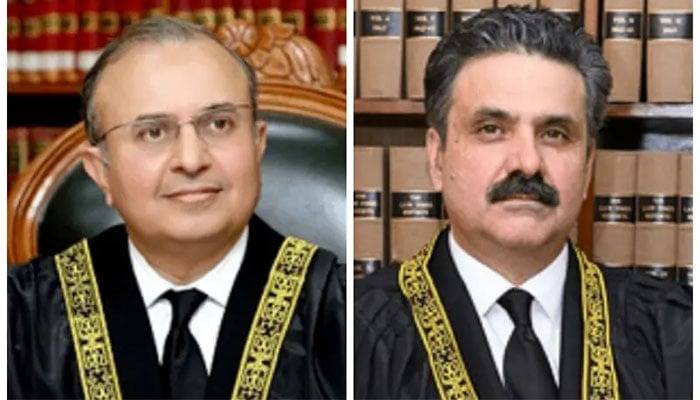

Justice Mansoor Ali Shah has written another letter to Chief Justice of Pakistan Supreme Court Yahya Afridi, urging him to immediately engage with the executive regarding the proposed constitutional amendment for the establishment of a separate constitutional court, 24NewsHD TV reported on Monday.
In his detailed letter, Justice Mansoor Ali Shah called for formal consultation within the judiciary, warning that the independence and integrity of the institution could be compromised if the judiciary remained divided.
“As head of the judiciary, you are not merely an administrator but also the guardian of this institution. This moment calls for leadership,” the letter stated.
Justice Shah proposed that the Chief Justice should convene a convention of judges from all constitutional courts—including the Supreme Court, High Courts, and the Federal Shariat Court—to formulate a unified institutional stance.
He emphasized that the judiciary’s official position should be communicated in writing to the government and parliament before any amendment is tabled.
“Until proper consultation is completed, the government should be informed not to proceed with the proposed amendment,” Justice Shah advised, clarifying that his letter was “not an act of dissent but an appeal for institutional solidarity.”
The judge questioned the rationale behind creating a new constitutional court while the 26th Constitutional Amendment remains pending.
“When the 26th Amendment is still unresolved, how can a new amendment be introduced?” he wrote.
“Why is there even a need to establish a new constitutional court?”
Justice Shah argued that strong democratic systems do not require separate constitutional courts, noting that major countries such as the United States, Canada, and the United Kingdom have only one Supreme Court.
He also reminded that the idea of a constitutional court in Pakistan was originally limited to a six-year term under the Charter of Democracy, signed after the end of General Pervez Musharraf’s military rule.
Challenging the justification for such a move, Justice Shah noted, “At present, there is no constitutional vacuum in the country that warrants a new court. About 82 percent of pending cases are in the district judiciary, so delays cannot be used as an excuse to form another court.”
Concluding his letter, Justice Mansoor Ali Shah stressed that remaining silent on constitutional matters would violate the spirit of the judicial oath.
“My letter is not against any individual but in favor of constitutional supremacy and judicial independence.
Protecting a free and dignified judiciary for future generations is our collective responsibility,” he wrote.