
Finance Minister warns of Rs500b addl taxes if MPs fail to pass tax laws
Aurangzeb says additional Customs duties on 4,000 tariff lines slashed to boost exports: Govt links pensions, salaries to inflation rate: No new tax on agriculture: Provinces to be consulted on NFC Award changes: Journalists boycott finance minister’s post-budget press conference: Govt to launch new housing finance scheme to enable individuals to build homes through accessible credit
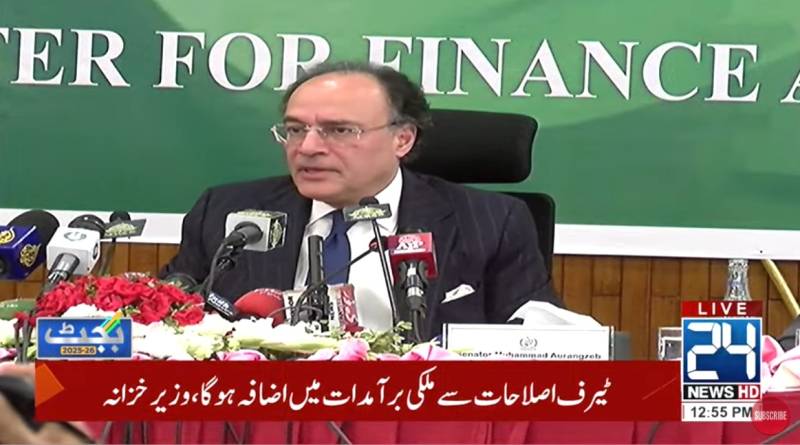

Federal Minister for Finance and Revenue Senator Muhammad Aurangzeb has warned that the government would have to impose additional taxes of Rs500 billion if the lawmakers did not pass the tax laws in parliament, reported 24NewsHD TV channel.
Finance Minister said this while addressing his post-budget press conference in Islamabad on Wednesday which was marred by a boycott by the journalists.
The whole army of newsmen walked out of the hall as the finance minister was getting ready to deliver his opening statement.
The journalists resorted to boycott to protest the refusal by Federal Board of Revenue (FBR) to give a technical briefing on new taxes.
The penmen were of the view that this was an attempt to hide facts about the new taxes in Federal Budget 2025-26.
Journalists staged a walkout as soon as Finance Minister Muhammad Aurangzeb took his seat to address the post-budget press conference.
The reporters voiced their concerns about not being briefed yesterday on the Finance Bill 2025, which details the legislation for the proposed measures under the budget. Subsequently, they walked out of the conference room in protest.
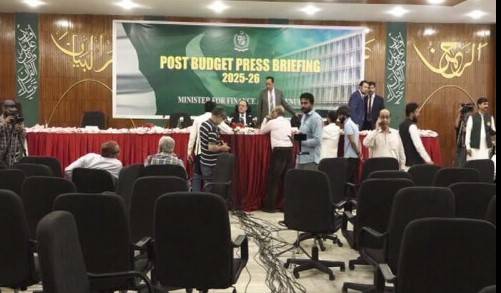
FBR Chairman Rashid Mahmood Langrial and Finance Secretary Imdadullah Bosal went after the journalists and tried to persuade them to return to the press conference. Later, the journalists agreed to return to the hall after successful talks with Federal Minister for Information Attaullah Tarar .
Addressing the press conference, Senator Aurangzeb emphasized that tariff reforms have been introduced in the next federal budget. “People tell them that this will lead to lesser revenues but I am telling you these tariff reforms will spur the country’s exports,” he added.
The finance minister said the significance of the tariff reforms under the National Tariff Policy. “People ask us that the revenue will decline but if we have to take this country forward towards an export-led discussion. I want to go into the details of the steps we have taken.”
He noted that additional customs duties were removed in four “lines”, while they were reduced in 2,700 tariff lines, which were “directly linked with those raw materials on the basis of which exporters will benefit”. He stressed these steps were just for the upcoming year and more measures will be taken eventually.
Aurangzeb stressed that the government tried to give relief “as much as possible” while considering the fiscal space. He also pointed out the 0.5pc reduction in super tax for the corporate sector.
Detailing the measures proposed for property buyers and sellers, the minister said: “Selling side still gets capital gains but the buying side should get some relief.”
The minister also termed the mortgage financing “as important as the fiscal side of things and what we have to do on the taxation side”.
Finance Minister Aurangzeb said the government has eliminated 4,000 out of 7,000 existing tariff losses, paving the way for export growth through new tariff reforms.
In a major step towards structural reforms, the federal government has eliminated additional customs duties on 4,000 tariff lines out of a total 7,000, and also reduced duties on a further 2,700, Aurangzeb said.
Aurangzeb described the tariff rationalisation as a “major and important step” in aligning Pakistan’s trade and industrial policy with global standards. The initiative, he said, marks the beginning of a phased plan towards a simplified tariff regime, ultimately targeting an average tariff rate of just over 4 per cent.
“Overall, there are 7,000 tariff lines. Additional customs duty has been removed on 4,000 lines, and in 2,700 of those, the customs duty has also been reduced,” the finance minister explained. “Of these, around 2,000 tariff lines are directly linked to raw materials and intermediary goods used by the exporters.”
“This is a structural reform that hasn’t been undertaken in the past 30 years. This is a huge step, and we’re committed to taking it forward gradually.”
The government’s broader goal, according to Aurangzeb, is to reshape Pakistan’s tariff architecture in a way that supports industrial growth and integrates the economy more deeply into global supply chains.
Aurangzeb acknowledged that additional taxes and measures were also talked about last year. “We had to impose those as when we were speaking to international institutions, they were not agreeing with our stance that there can be enforcement in this country,” he added.
Expressing the aim to reach a tax-to-GDP ratio of 10.9pc by the next year, the minister said additional taxes were around Rs312 million of the total 2.2 trillion target. “We have two ways — either we ensure enforcement or we introduce additional measures. This is why we will go to the parliament to help us out with the enabling amendments and legislation,” he added.
The minister said: “We have laws, legislation and taxes but we were not able to enforce it, so in this fiscal year, we have worked on enforcement, which has exceeded Rs400 billion.”
He emphasised that around the world, pensions and salaries are adjusted in accordance with the inflation inflation, and Pakistan must adopt the same practice by linking public sector wages and pensions to the inflation rate.
He reassured that no additional taxes have been imposed on the agriculture sector in the current budget. The government will collaborate with provincial authorities to work on support mechanisms for small farmers. He said that the federal government will work with the provinces for the development of agriculture and livestock.
He also gave assurances that no changes to the National Finance Commission (NFC) Award would be made without full consultation with the provinces, maintaining the spirit of fiscal federalism.
Commenting on the broader economic picture, the finance minister stated that government spending remains reliant on borrowed funds, raising the question: Why are expenses not decreasing despite the financial burden?
When asked about the proposed 400 per cent increase in the salaries of parliamentarians, the minister clarified that the last salary hike for parliament members and federal ministers occurred in 2016, underscoring the need for revision after nearly a decade.
Finance Minister Aurangzeb said that he has requested the parliamentary leaders to approve the tax laws; if the tax laws are not approved, additional taxes of Rs 400 or 500 billion will have to be imposed.
https://www.youtube.com/watch?v=17y8dc6xcf0&ab_channel=24NewsHD
The finance minister said the tariff reforms were more than a fiscal measure, they mark a fundamental shift in Pakistan’s economic model, aimed at dismantling the long-standing protectionist regime and laying the foundation for sustainable, export-led growth.
Highlighting the significance of the policy shift, Aurangzeb said the reduction and elimination of customs duties on thousands of tariff lines will enable more efficient allocation of both capital and human resources within the economy.
The reforms are designed to gradually replace import substitution with export promotion, a pivot the government considers essential for addressing Pakistan’s recurring balance of payments crises and dollar liquidity pressures.
“If we want to structurally reposition the country towards export-led growth, we need to change the very DNA of the economy,” Aurangzeb said. “That’s how we avoid falling into the same cycle of dollar shortages every time we try to grow.” He noted that the government has offered as much relief as possible to the salaried class within the constraints of available fiscal space.
“This is the direction of travel, where do we want to take the salaried class?” he said. “Different slabs, including at the highest levels, have been carefully considered. From both my perspective and the Prime Minister’s, we provided as much relief as the fiscal space allows.”
Addressing recent concerns around construction-related taxes, the minister clarified that while overall tax liability has not been reduced, the government restructured the system to lower transaction costs, particularly for buyers.
In a bid to promote homeownership, the government is also prioritising access to mortgage financing. “As important as the fiscal side is, access to credit is equally important,” the minister said.
He informed that, in collaboration with the State Bank of Pakistan, the government is preparing to launch a new housing finance scheme to enable individuals to build homes through accessible credit.
He said the tax-to-GDP ratio was projected to reach 10.4% this year and 10.9% in FY2025-26. He reaffirmed the government’s commitment to agriculture as the central engine of economic growth, with a particular focus on dairy and livestock, which account for 60% of the sector’s GDP.
On the fiscal front, he reported a modest 1.9% rise in government expenditure, crediting prudent financial management.
Reporter Waqas Azeem