
Trump says Putin helping Iran 'a little bit', Iran govt will fall, but maybe not immediately
One die as blast rocks Al Quds rally in Tehran, oil holds above $100 as Iran's spiritual leader wants closure of regional bases hosting US forces: Fresh missile wave targets Israeli cities: French soldier killed in Iraq attack: Tehran says it’s allowing some ships to cross Strait of Hormuz
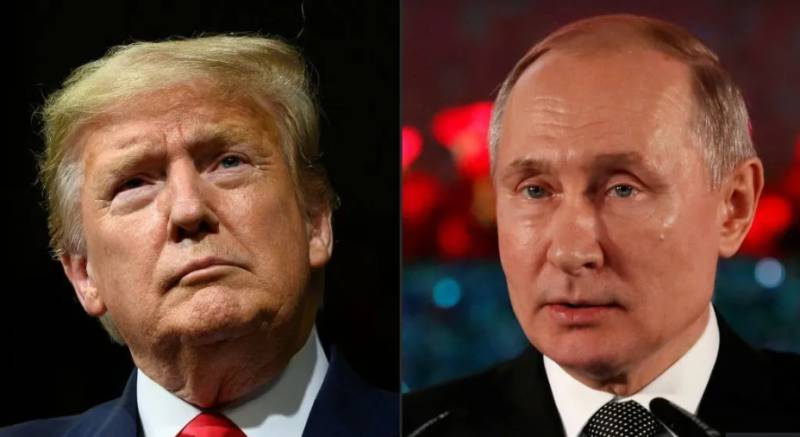

US President Donald Trump voiced confidence that the Iranian people would rise up to replace their government following American and Israeli military strikes -- but added in an interview aired Friday that it may not happen straight away.
"I really think that's a big hurdle to climb for people that don't have weapons. I think it's a very big hurdle... It'll happen, but it probably will be, maybe not immediately," Trump told Fox News Radio.
Meanwhile, US President Trump said in an interview aired Friday he suspected Russian leader Vladimir Putin was aiding Iran in the war against the United States and Israel.
"I think he might be helping him a little bit, yeah, I guess. And he probably thinks we're helping Ukraine, right?" Trump said in an interview with Fox News Radio.
Several US media outlets have reported that Russia has provided targeting information to Iran for attacking US forces during the ongoing conflict.
Meanwhile, in a swift defensive action amid rising tensions in the Middle East, UK Royal Air Force (RAF) Typhoon fighter jets successfully neutralised two unmanned aerial threats overnight, protecting key allies in the region.
The British Ministry of Defence (MoD) confirmed that one uncrewed aerial system (UAS) was taken out in defence of Jordan, while another drone heading toward Bahrain was intercepted.
"The UK has begun defensive air sorties in support of the United Arab Emirates," the MoD stated on X.
“To support defensive operations, the UK has deployed additional air operations experts to the Gulf — ensuring an accurate picture across the region and assisting partners with airspace management."
Update on UK operations in the Middle East, 12 March 2026. pic.twitter.com/nf2OfCMBQv
— Ministry of Defence ???????? (@DefenceHQ) March 12, 2026
Deadly blast rocks Iran as leaders attend Al Quds rally in Tehran
At least one person was killed on Friday in an explosion that went off close to an annual pro-government rally in Tehran marking support for the Palestinian cause, Iran's official IRNA news agency said.
No further details were given but the Israeli army earlier called on people to evacuate two areas in the city centre of Tehran close to the site of the rally, on the 14th day of a war that is engulfing the Middle East.
Deadly explosions rocked Tehran close to a pro-government rally attended by top officials on Friday, as Israel and Iran unleashed fresh strikes in a war that has ignited the Middle East and threatens to torpedo the world economy.
Since erupting on February 28 with US-Israeli attacks on Iran, the war has cascaded throughout the region, drawn in global powers, and sparked a major oil shock.
AFP journalists in Tehran reported loud blasts over the city skies, as Israel's military said it had hit more than 200 targets in western and central Iran in the past day.
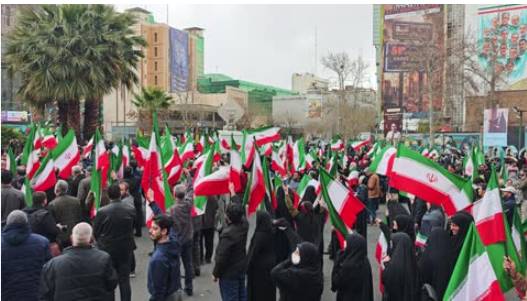
Iran's state media said at least one person was killed when blasts hit an area near a pro-government demonstration, where large crowds had gathered waving flags and brandishing banners reading "Death to America" and "Death to Israel."
"These attacks are out of fear, out of desperation," said Ali Larijani, secretary of the Supreme National Security Council, who attended the rally to mark Quds Day, the last Friday of Ramadan.
"One who is strong wouldn't bomb demonstrations at all. It's clear that it (the enemy) has failed," said Larijani in a speech broadcast on state TV.
President Masoud Pezeshkian and Foreign Minister Abbas Araghchi also attended the rally, while images shared by Iranian media the head of the judiciary being interviewed just as a blast occurred.
Iran's Revolutionary Guards, the ideological arm of the country's military, warned Friday that any new anti-government protests would be met with a stronger response than in January, when several thousand people were killed.
Iranians speaking to AFP under cover of anonymity have painted a grim picture of life under the bombs, with cities in ruins and cash running short.
"People are desperately trying to withdraw their savings from the banks, as trust in them has vanished," one 30-year-old woman in Kermanshah, western Iran, told AFP.
"Bread is now rationed. The population is extremely tense and outraged."
The United Nations refugee agency has estimated that up to 3.2 million people have been displaced inside Iran since the war started.
Iran's health ministry said on March 8 that more than 1,200 people have been killed, a figure AFP has not been able to verify independently.
Iran has launched waves of drone and missile strikes against neighbouring states hosting US military assets throughout the region.
Saudi Arabia's defence ministry said Friday its forces had intercepted dozens of drones, including one targeting its capital's Diplomatic Quarter.
AFP images showed black smoke hanging over the iconic skyline of Dubai after an attack on what was once considered a safe haven in a chaotic region.
Two people died from drone debris in Oman, according to state media there, while sirens rang out early Friday at Turkey's Incirlik airbase, a key NATO facility housing US troops.
Later Friday, Turkey's defence ministry said NATO defences had intercepted a ballistic missile from Iran in Turkish airspace, the third such incident in just over a week.
In another sign of the war's spread, President Emmanuel Macron announced the death of France's first soldier, in an attack in the Erbil region of Iraq.
Macron gave no details on the attack, or who was behind it, but France's military said earlier that drones hit a base where troops were taking part in counter-terrorism training with Iraqi counterparts.
Elsewhere in Iraq, a US refuelling aircraft crashed, killing four crew members, though the military said it was "not due to hostile fire or friendly fire."
In Israel, a strike on the town of Zarzir injured around 60 people, according to police, with AFP images showing burned-out vehicles and craters in the ground.
The conflict has also battered Lebanon, with authorities reporting 687 people killed by Israeli attacks, including at least 12 in a strike Thursday on Beirut's seafront, where displaced families are camping in tents.
Dalal al-Sayed told AFP she had pitched her tent there after fleeing attacks in southern Lebanon. Her family cannot afford to rent an apartment, she said.
"We won't leave, we will stay here even if we die."
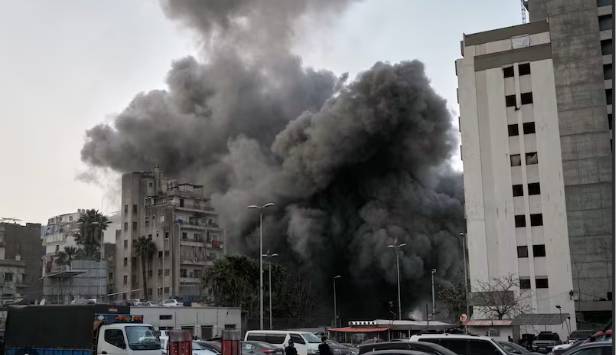
AFP images from central Beirut showed buildings reduced to husks of rubble and burned-out shells of overturned vehicles as small fires flickered from the aftermath of strikes.
Crude oil stayed above the benchmark price of $100 per barrel after Iran's leader vowed to choke the Strait of Hormuz, a critical artery for global energy transport.
Mojtaba Khamenei, reportedly wounded in the strike that killed his father, has not appeared publicly since taking charge. His message calling for vengeance was read by an anchor on state television.
The statement said the "lever of blocking the Strait of Hormuz must definitely be used," referring to Iran's effective closure of the waterway.
Blocking the strait is a powerful weapon for Iran, massively outgunned by Israel and the US, by hitting a sensitive pinch point for the global economy.
A Chinese sailor on an LPG tanker marooned north of Dubai, unable to pass through the strait, shared footage of smoke rising from a nearby vessel.
"Every day on the ship, I can see missile launches and hear explosions, making me feel like I am in danger," Wang Shang, 32, told AFP.
The war, which has also seen energy infrastructure targeted in oil-rich Gulf states, is creating "the largest supply disruption in the history of the global oil market," the International Energy Agency has said.
As prices at the pump soar around the world, US President Donald Trump has eased some oil sanctions on Russia, which has warned the global energy market "cannot remain stable" without its supplies.
Khamenei calls for opening new fronts
Oil prices held around $100 Friday and most equity markets dropped after Iran's leader called for the blocking of the crucial Strait of Hormuz and opening up of new fronts in the war against the United States and Israel.
With the conflict heading towards its third week and showing no signs of ending, investors are growing increasingly worried about an extended crisis that could fan inflation and hammer the global economy.
Tehran has targeted energy facilities this week across the Gulf, with ships hit near Iraq, fuel tanks attacked in Bahrain and drones fired at oilfields in Saudi Arabia.
And it warned on Thursday that it would "set the region's oil and gas on fire" if its own energy infrastructure and ports were targeted.
In his first public comments since succeeding his father four days ago, Ayatollah Mojtaba Khamenei said the Strait of Hormuz -- through which a fifth of global oil and gas passes -- must remain effectively shut. Khamenei also called for bases hosting US forces in region to close or attacks will continue.
"The lever of blocking the Strait of Hormuz must definitely be used," Khamenei said in a message read by an anchor on state television.
He also said "studies have been conducted into opening other fronts where the enemy has little experience and would be highly vulnerable, and their activation will take place if the state of war persists".
Khamenei vowed to avenge the Iranian casualties in the conflict.
Khamenei himself was wounded in the strikes, according to some Iranian officials and state TV. His whereabouts and details of his physical condition are unknown, prompting Israeli leader Benjamin Netanyahu to call on him to "show his face".
Video from northern Israel captured the moment an Iranian missile impacted a residential area early Friday morning injuring 33 people, according to Israeli news reports. pic.twitter.com/TMgOAbTy7Q
— Al Jazeera Breaking News (@AJENews) March 13, 2026
Crude surged more than nine percent Thursday, with Brent ending above $100 for the first time since 2022 when Russia launched its invasion of Ukraine. Brent is up around 40 percent since the Middle East war began on February 28.
And it held there in early Friday business, with analysts saying the record 400 million barrels released from International Energy Agency stockpiles had little impact.
The IEA said Thursday that the war "is creating the largest supply disruption in the history of the global oil market".
Meanwhile, Donald Trump has faced intense political pressure as the global economic fallout of the crisis has mounted, while markets have brushed off his assertions that the battle would be short-lived.
The US president struck a defiant tone in a social media post Thursday, writing that the United States "is the largest Oil Producer in the World, by far, so when oil prices go up, we make a lot of money".
"BUT, of far greater interest and importance to me, as President, is stopping an evil Empire, Iran, from having Nuclear Weapons, and destroying the Middle East and, indeed, the World."
However, Pepperstone's Chris Weston said: "With crude closing near its highs, markets are increasingly pricing in a longer duration for the conflict and the continued impact of a potential closure of the Strait of Hormuz.
"Donald Trump may continue to explore the idea of assisting vessels through the strait, and if that were to materialise the market could see a strong relief rally.
"For now, however, the dominant features are higher energy prices and extremely elevated volatility markets."
Air attacks have targeted military bases across Iraq belonging to Iran-backed forces.
— Al Jazeera Breaking News (@AJENews) March 12, 2026
Members of the Popular Mobilisation Forces have blamed the strikes on the US. pic.twitter.com/21989GQrlQ
Two dead as Oman thwarts drone attack
Two people died after security forces intercepted a drone in northern Oman, state media said on Friday, without giving further details.
Both victims in the incident at Al Awahi industrial area were expatriates, the Oman News Agency said, adding that other people were injured.
Sirens heard at Nato airbase in Turkey
Siren were heard early on Friday at Turkey's Incirlik airbase, a key NATO facility where US troops are stationed near the southeastern city of Adana, state news agency Anadolu reported.
There was no immediate official comment on the incident, which took place four days after NATO air defences shot down a ballistic missile in Turkish airspace that was fired from Iran, the second in five days.
8 killed in Israeli strike on south Lebanon village
An Israeli strike killed eight people in a south Lebanese village near the port city of Sidon on Friday, according to the health ministry, which added that nine others had been wounded.
An AFP photographer on the scene saw paramedics working to evacuate people from the targeted building in the village of Miyeh w Miyeh. The building is part of a complex, most of whose residents are Palestinians.
Dubai building hit by debris from attack
A building in central Dubai was hit by debris from an intercepted attack, the government media office said on Friday, after blasts shook the Middle East financial hub.
An AFP correspondent described hearing a huge double blast that rattled buildings and left a large cloud of black smoke hanging over a central district.
Dubai's media office confirmed a building had been struck. The United Arab Emirates' air defences have intercepted more than 1,500 Iranian drones and nearly 300 missiles during the Middle East war.
"Authorities confirmed that debris from a successful interception caused a minor incident on the facade of a building in central Dubai," the media office posted on X, adding that no injuries were reported.
The latest incident comes after a drone fell near Dubai's financial district on Thursday. Iran had threatened to hit economic institutions, prompting some companies to evacuate staff from the area.
The oil-rich UAE and other countries in the wealthy Gulf have come under constant Iranian fire since the war started on February 28.
Dubai's airport, one of the world's biggest, has been repeatedly targeted as well as its port and luxury real estate including the Palm Jumeirah and Burj Al Arab hotel.
- French soldier killed in Iraqi Kurdistan -
A French soldier was killed in an attack in Iraq's autonomous Kurdistan region, President Emmanuel Macron said on Friday, confirming the first French military death in the Middle East war.
Since US-Israeli strikes on Iran last month engulfed the Middle East in war, multiple attacks attributed to pro-Iranian factions have targeted the region where foreign forces are based as part of an international anti-jihadist coalition.
- New missile wave targets Israel -
The Israeli military said early Friday that Iran fired a new barrage of missiles toward Israel, with emergency services reporting that two were injured in the country's north.
"A short while ago, the IDF identified missiles launched from Iran toward the territory of the State of Israel. Defensive systems are operating to intercept the threat," the military posted on Telegram.
- Saudi Arabia intercepts drones -
Saudi Arabia intercepted dozens of drones entering its airspace, the defence ministry said Friday, as Iran carries out attacks on oil-rich Gulf countries in response to US-Israeli strikes.
"Twelve drones were intercepted and destroyed after entering Saudi airspace," a ministry spokesperson posted on X, after authorities reported at least 16 other drones were also shot down.
- Trump: war moving 'rapidly' -
US President Donald Trump told reporters the war against Iran was moving "very rapidly."
"It's doing very well, our military is unsurpassed," he said at the White House, not directly responding to the latest comments from Iran's new supreme leader.
- Israel strikes Basij force -
Israel's military said it had struck checkpoints set up in the Iranian capital Tehran by the Basij paramilitary force of Iran's Revolutionary Guards as part of efforts to undermine control by the authorities.
Later, the Israeli military said it launched a new broad wave of strikes in Tehran on Thursday evening, pressing ahead with its campaign against Iran for a 13th day.
Al Jazeera’s Tohid Asadi shows the aftermath of US-Israeli airstrikes on a residential neighbourhood in Iran, where rescue teams have been searching for survivors among the rubble. pic.twitter.com/s3XXUnAxYe
— Al Jazeera English (@AJEnglish) March 12, 2026
- Iraq-Syria border strikes -
Air strikes killed at least 11 Iran-backed fighters in Iraq on Thursday near the Iraqi-Syrian border and in the capital Baghdad, senior security and armed faction officials told AFP.
Iraqi authorities denounced the "blatant attacks" on bases that belong to the Hashed al-Shaabi, a former paramilitary group now integrated into the regular army, which also encompasses brigades from Iran-backed armed groups.
- Hormuz mines -
Iran is not laying mines in the Strait of Hormuz, its deputy foreign minister said, after Trump said US forces had struck 28 Iranian mine-laying vessels in the waterway.
He told AFP that Iran was allowing ships from some countries to cross the narrow shipping lane that has remained effectively closed during the war.
- Beirut strikes -
Israel continued striking Beirut as it threatened to expand operations and seize territory in Lebanon if the militant group Hezbollah did not stop its attacks.
AFPTV footage showed dark smoke rising into the sky above Bashoura, in the heart of Beirut.
- IEA: biggest oil shock ever -
The war "is creating the largest supply disruption in the history of the global oil market", as Iran's chokehold on regional supplies forces Gulf producers to slash production, the International Energy Agency said.
An IEA market report said crude oil production was currently down by at least eight million barrels per day.
- Israel moves deeper into Lebanon -
The Israeli military moved further into southern Lebanon, telling residents to "move immediately north of the Zahrani River", 40 kilometres (25 miles) from the Israeli border.
It said the Iran-backed Lebanese group Hezbollah had launched "approximately 200 rockets" towards it overnight, in what it said was the biggest barrage of the war so far.