
Iranian military says won’t allow US weapons to transit Hormuz into regional bases
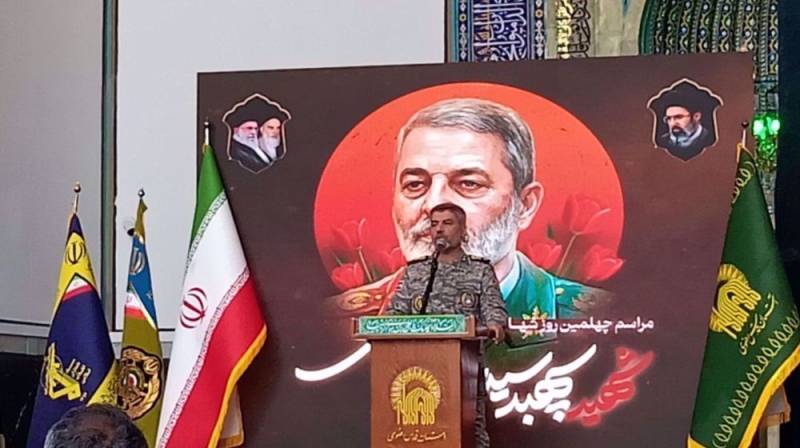

Iran has said it will no longer allow US weaponry to transit the Strait of Hormuz to regional bases, with the army declaring that the strategic waterway is now under the coordinated strategic control of the Iranian armed forces, state broadcaster Press TV reports.
“From now on, we will not allow American weapons to transit the Strait of Hormuz and enter regional bases,” Army spokesman Brigadier General Mohammad Akraminia says, addressing a ceremony. “Any country wishing to transit the waterway must do so under the supervision of Iran’s armed forces, ensuring a ‘passage without harm’.” According to Akraminia, the western part of the strait is under the command of the Islamic Revolution Guards Corps (IRGC) Navy. At the same time, its eastern section is controlled by the Iranian Navy.
The general further asserted that despite two decades of planning by enemies to attack Iran, the country’s armed forces not only maintained their combat capability but also actively thwarted hostile objectives through missile strikes and ground operations.
He noted that in the recent war, all of the enemy’s goals, including the destruction of missile and nuclear capabilities, the fragmentation of the country, and the overthrow of the system, failed. Akraminia maintained that Iran’s military doctrine is now offensive in nature and any mistake by an enemy will be met with the most severe response.
“After the first revolution that expelled the Shah and the second revolution that expelled America from Iran, today we will expel America from the entire region, and its presence will be eliminated from this region forever,” he said.
In a separate address on Wednesday in Amol, IRGC Navy Cultural and Psychological Operations deputy Saeed Siahsorani issued a direct warning to the United States and its president, Donald Trump.
“If America and Trump personally want to do something stupid, we will turn the Persian Gulf into the largest blue graveyard of American marines,” Siahsorani said. He emphasized that the Strait of Hormuz has become the “Strait of the Honor of Islam.”
Siahsorani said while Iran has not yet entered a war with the US at sea, “smart blocking” is already being implemented, and asymmetric warfare against the enemy continues.
He noted that 70 percent of US military bases in the region, including Arifjan, Al Udeid, Sheikh Isa, and Ali Al Salem, have been leveled to the ground. Referring to the strategic importance of the Strait of Hormuz, he noted that in the past, 20 million barrels of oil, one-fifth of the world’s gas, one-quarter of global oil, and 80 percent of agricultural fertilizer transited the strait daily.
Since the February 28 US-Israeli war of aggression, which assassinated Leader of the Islamic Revolution Ayatollah Seyyed Ali Khamenei and struck civilian infrastructure, the IRGC Navy and the Army’s Navy have undertaken joint administration of the Strait of Hormuz.
Iranian officials have repeatedly warned that the United States has maintained an illegal naval blockade of Iranian ports and that Tehran is ready for a long-term war if the April 8 ceasefire collapses.