
Complaint filed in SJC against 8 judges who stayed SC reform bill
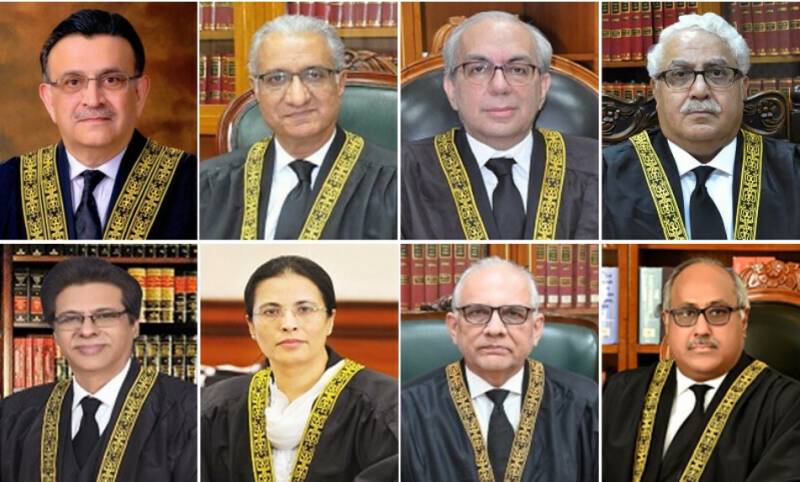

A complaint has been filed in the Supreme Judicial Council against Chief Justice of Pakistan Justice Umar Ata Bandial and seven other judges seeking their removal for taking up pleas against the Supreme Court (Practice and Procedure) Bill, 2023 and ruling that the act if it “comes into being shall not be acted upon in any manner”, reported 24NewsHD TV channel.
The complaint was filed Friday in the SJC by Mian Daud Advocate against all the eight members of the SC larger bench which on Thursday took up three pleas against the government bill aimed at clipping the powers of chief justice of Pakistan and passed by the joint session of parliament on Monday after it was sent back by the President unsigned who said that the bill ‘travels beyond the competence of Parliament’.
The government has again sent the bill to the President after getting it approved by the joint session of parliament for seeking his assent. But if the President opts not to sign the bill, it will automatically become law after an expiry of 10 days.
The complaint was registered against CJP Bandial, Justice Ijazul Ahsan, Justice Munib Akhtar, Justice Muhammad Ali Mazhar, Justice Mazahar Ali Akbar Naqvi, Justice Ayesha Malik, Justice Hassan Azhar Rizvi, and Justice Shahid Waheed.
The complainant said that the chief justice unconstitutionally constituted an 8-member bench under his head.
The chief justice became liable to ‘misconduct’ by supervising a bench which took up the petitions.
The complainant further contended that other seven judges who were part of the bench also violated the law and code of conduct by suspending the Supreme Court (Practice and Procedure) Bill, 2023.
Photocopies of the complaint were also dispatched to all members of the Supreme Judicial Council.
In its detailed order, the Supreme Court raised objections over the “substantial, immediate and direct interference with the independence of the judiciary in the form of multiple intrusions, in the guise of regulating the practice and procedure of this court and conferring upon it a jurisdiction that appears not to be permissible under any constitutional provision…
“It is therefore hereby directed and ordered as follows. The moment that the bill receives the assent of the president or (as the case may be) it is deemed that such assent has been given, then from that very moment onwards and till further orders, the act that comes into being shall not have, take or be given any effect nor be acted upon in any manner.”
Reporter Amanat Gishkori