
COAS, US defence secy take up regional security and defence ties at Pentagon meet
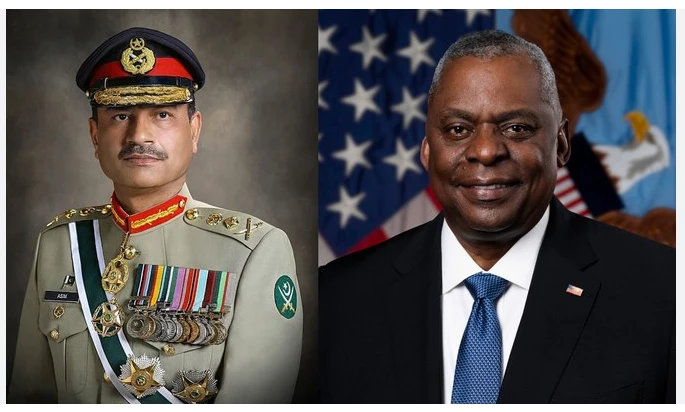

Chief of the Army Staff General Syed Asim Munir held in-depth talks with US Defence Secretary Lloyd J Austin in Washington on Wednesday with focus on regional security and bilateral defence cooperation, reported 23NewsHD TV channel on Thursday.
According to a statement issued by Pentagon Press Secretary Maj-General Pat Ryder, Secretary of Defence Lloyd J. Austin III hosted Pakistan's Chief of Army Staff General Asim Munir at the Pentagon on Wednesday where the two officials discussed recent regional security developments and potential areas for bilateral defense cooperation.
The army chief’s visit was also discussed at a Pentagon briefing on Tuesday, where a journalist reminded Patrick Ryder that Defence Secretary Lloyd Austin would have his first face-to-face meeting with Pakistan’s new army chief and asked what the US defence chief was looking for in this meeting.
“Will they be talking about the deportation of Afghans from Pakistan or potentially buying munitions to go to Ukraine?” the journalist asked.
Gen Ryder replied, “I don’t have any meetings to read out from the podium. Certainly, as you know, when the secretary meets with foreign counterparts and leaders, we provide a readout. So, if we have a readout to put out, we’ll certainly do that.”
Another journalist asked, “How would you assess US-Pakistan military relations at this point?”
Gen Ryder said, “Pakistan continues to be an important partner in the region. And so obviously, through Centcom, we continue to stay in close contact with them, particularly when it comes to issues like counter-terrorism.”
General Asim Munir is also expected to meet US Secretary of State Antony Blinken and National Security Adviser Jake Sullivan.
Islamabad seeking US help against Pakistani Taliban in Afghanistan: VOA
Pakistan's army chief is in Washington this week seeking US assistance against what Islamabad alleges are terrorist havens in neighbouring Afghanistan, reported VOA.
General Asim Munir is trying to convince US security and defence officials that militant groups such as Tehreek-e-Taliban Pakistan (TTP) and Islamic State's Khorasan offshoot (IS-K) pose a threat not only to Pakistan but also to US and global security, experts say.
"In seeking US sympathy and support for Pakistan's counterterrorism concerns, he may note the many years of US-Pakistan military cooperation that includes some counterterrorism collaborations, as well as many years of military education and training exchanges," said Michael Kugelman, director of the South Asia Institute at the Wilson Center.
"He will likely also note that both countries face threats emanating from Afghanistan, whether IS-K or TTP," Kugelman added.
On Wednesday, Munir met with Secretary of Defence Lloyd Austin and discussed "recent regional security developments and potential areas for bilateral defence cooperation," according to a brief statement from the Pentagon.
Despite the withdrawal of troops from Afghanistan over two years ago, the United States has retained what US officials term over-the-horizon capabilities in the region: the ability to strike targets in response to security threats.
In July 2022, a US drone strike killed Ayman al-Zawahiri, the former al-Qaeda chief, in Kabul.
On Wednesday, Jan Achakzai, Balochistan caretaker information minister, posted on X and subsequently deleted a series of proposed actions in response to a deadly attack on a military camp in northwest Pakistan on Tuesday. The attack, involving a vehicle-borne blast and shooting, resulted in at least 25 deaths and over 40 injuries.
Achakzai suggested, among other measures, that Pakistan should propose offering US drone bases to target terrorist sanctuaries in Afghanistan.
The Taliban authorities in Afghanistan have consistently rejected Pakistan's allegations, saying they do not permit groups and individuals to pose threats to any country from Afghan soil.
Pakistan has grappled with the TTP insurgency for nearly two decades, but Pakistani officials claim that the group has escalated its terrorist activities since the Afghan Taliban regained power in Afghanistan in 2021.
US response
Before coming to Washington, Gen Asim Munir met Thomas West, the US special representative for Afghanistan, in Islamabad.
"The United States stands with Pakistan against terrorism in the region," Thomas West wrote on X, adding that the TTP poses "grave security challenges."
While expressing sympathy and understanding, the US — at least for now — does not seem to be considering military action specifically against TTP hideouts in Afghanistan.
"With respect to relations between Pakistan and Afghanistan, obviously we support diplomatic resolution to all of the various issues between those two countries," State Department spokesperson Matthew Miller told reporters on Monday.
The United States has funded several counterterrorism capacity-building programmes in Pakistan focused on law enforcement and justice, Miller said Wednesday when asked what kind of support the US would offer Pakistan.
Washington's position appears grounded in its own risk assessment.
A recent US intelligence assessment indicated that "al-Qaeda has reached its historical nadir in Afghanistan and Pakistan" is unlikely to revive itself.
The other terrorist group of particular US concern, IS-K, has reportedly been weakened by Taliban counterterrorism operations, according to the assessment.
Senior US officials have said they will hold the Afghan Taliban accountable for their counterterrorism commitments made under the US-Taliban Doha agreement.
"The US, and particularly the current administration, is fed up with military involvement in South-Central Asia," Robert Grenier, the former head of counterterrorism at the Central Intelligence Agency, told VOA in written comments. "Absent attacks on US interests clearly emanating from Afghanistan, the US will remain neutral," he said.