
Presidents Xi, Trump agree Strait of Hormuz 'must remain open'
President Xi warns Trump Taiwan issue could lead to 'conflict': Tells Trump US, China should be 'partners not rivals': US presdient says both countries would have 'fantastic future together'
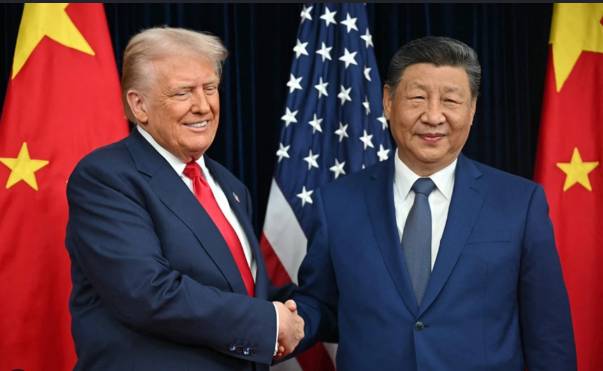

US President Donald Trump and his Chinese counterpart Xi Jinping held a "good" meeting on Thursday in which they agreed that the Strait of Hormuz "must remain open", the White House said.
Iran has largely blocked shipping through the vital waterway, through which a fifth of the world's oil and natural gas normally passes, since the outbreak of war with the United States and Israel on February 28.
"The two sides agreed that the Strait of Hormuz must remain open to support the free flow of energy," the White House said.
China is directly affected by the lack of petroleum crossing the Strait of Hormuz.
More than half of the crude imported by sea to China comes from the Middle East and mainly transits through the strait, according to maritime analytics firm Kpler.
According to the White House, Xi expressed an interest in purchasing more American oil to reduce China's dependence on the strait in the future.
Beijing's own readout of the meeting did not mention any such interest.
For its part, the White House statement did not mention any discussions between the two leaders on Taiwan, the self-ruled island claimed by Beijing and a sensitive subject in US-China diplomacy.
Xi earlier warned that "conflict" between China and the United States could break out, should the issue be mishandled, Chinese state media had reported.
Xi warns Trump over Taiwan
Chinese President Xi Jinping warned his US counterpart Donald Trump that the issue of Taiwan could push their two countries into "conflict" if mishandled, a stark opening salvo as a superpower summit set to tackle numerous thorny issues began in Beijing Thursday.
Trump had arrived in China with accolades for his host, calling Xi a "great leader" and "friend", as he predicted that their countries would have "a fantastic future together".
But beyond the pomp as he welcomed Trump, Xi used less effusive tones, saying the two sides "should be partners and not rivals" and highlighting the issue of self-ruled democratic Taiwan -- which Beijing claims as its territory -- straight off the bat.
"The Taiwan question is the most important issue in China-US relations," Xi said, according to state broadcaster CCTV.
"If mishandled, the two nations could collide or even come into conflict, pushing the entire China-US relationship into a highly perilous situation."
The trip to Beijing is the first by a US president in nearly a decade, with the grand reception belying a host of unresolved trade and geopolitical tensions between the two countries.
Xi greeted Trump with a red-carpet welcome at the opulent Great Hall of the People, with military band fanfare, a gun salute and a host of schoolchildren jumping and chanting "welcome!".
Seemingly enjoying the ceremony, Trump said "the relationship between China and the USA is going to be better than ever before".
Xi instead referenced an ancient Greek political theory about the risks of war when a rising power rivals a ruling power, as he questioned if China and the US could find ways to work together as equals instead.
"Can China and the United States transcend the so-called 'Thucydides Trap' and forge a new paradigm for major-power relations," Xi asked, adding that "cooperation benefits both sides, while confrontation harms both".
There has been plenty of the latter since Trump's last visit in 2017, with the two countries having spent much of 2025 embroiled in a dizzying trade war and at odds on many major global issues.
Trump told President Xi Jinping their countries would have "a fantastic future together", as they began a superpower summit in Beijing on thorny issues including Iran, trade and Taiwan.
Heaping praise on his host, Trump told Xi it was "an honour to be your friend", as the Chinese leader, in less effusive tones, said the two sides "should be partners and not rivals".
Xi had greeted Trump with a red carpet welcome at the opulent Great Hall of the People with military band fanfare, a gun salute and a host of schoolchildren jumping and chanting "welcome!".
The trip to Beijing is the first by a US president in nearly a decade, with the grand reception belying a host of unresolved trade and geopolitical tensions between the two countries.
Xi questioned if China and the US could build cooperation rather than head for confrontation, as he underlined that "a stable China-US relationship is a boon for the world.
"Cooperation benefits both sides, while confrontation harms both," Xi said.
There has been plenty of the latter since Trump's last visit in 2017, with the two countries having spent much of 2025 embroiled in a dizzying trade war and at odds on many major global issues.
A new addition to that list, the Iran war, threatens to weaken Trump's position in the talks, having already forced him to postpone his trip from March.
The US president said he expected a "long talk" with Xi about Iran, which sells most of its US-sanctioned oil to China, but insisted that "I don't think we need any help with Iran" from Beijing.
US Secretary of State Marco Rubio, known throughout his career as a fierce opponent of Beijing, struck a somewhat different tone.
"We hope to convince them to play a more active role in getting Iran to walk away from what they are doing now, and trying to do now in the Persian Gulf," Rubio told broadcaster Fox News in an interview aired Wednesday.
.@POTUS meets with President Xi at the Great Hall of the People in Beijing:
— Rapid Response 47 (@RapidResponse47) May 14, 2026
"It's an honor to be with you, it's an honor to be your friend, and the relationship between China and the U.S.A. is going to be better than ever before. Thank you very much!" pic.twitter.com/aepz02qOgj
Trump, Xi discuss Mideast
US President Donald Trump and China's leader Xi Jinping discussed the war in the Middle East, along with the conflict in Ukraine and issues on the Korean Peninsula when they met in Beijing, the Chinese government said.
US Secretary of State Marco Rubio said earlier that the United States was looking for China to "play a more active role in getting Iran to walk away from what they are doing now, and trying to do now in the Persian Gulf".
- Trade and tariffs -
Top of Trump's wish list for the summit will be business deals on agriculture, aircraft and other topics.
Elite businessmen in the US leader's delegation, including Nvidia's Jensen Huang and Tesla's Elon Musk, were on the stairs of the Great Hall of the People on Thursday for the welcome ceremony.
Musk told reporters afterwards the meeting had been "wonderful", while Huang said the two presidents "were incredible".
Aboard Air Force One en route to Beijing, Trump vowed on social media to push Xi to "open up" China to US firms "so that these brilliant people can work their magic".
The long-simmering trade war between the two countries will also be top of the agenda, after Trump's sweeping tariffs last year triggered tit-for-tat levies that exceeded 100 percent.
Trump and Xi are set to discuss extending a one-year tariff truce, which the two leaders reached during their last meeting in South Korea in October, although a deal is far from certain.
On Taiwan, another issue that has bedevilled ties, Trump said Monday he would speak to Xi about US arms sales to the self-governing democracy claimed by China.
That would be a departure from historic US insistence that it will not consult Beijing on its support for the island, and one which will be closely watched by Taipei and US allies in the region.
China's controls on rare earth exports and AI rivalry are among other topics expected to be taken up by the two heads of state.
Trump will be treated to a state banquet in the evening with Xi, and will also visit the historic Temple of Heaven, a World Heritage site where China's emperors once prayed for good harvest.
Both sides will be looking to come out of the summit with whatever wins they can, while also stabilising an often tense bilateral relationship that has global implications.
Trump will also be hoping to leave with a firm date for a reciprocal visit by Xi to the United States later in 2026, to prove his rapport with his Chinese counterpart.
???? JUST NOW: One by one, President Xi shakes the hands of Marco Rubio, Scott Bessent, Pete Hegseth, Stephen Miller and others
— Eric Daugherty (@EricLDaugh) May 14, 2026
Secretary of War Hegseth is STONE COLD!
Looking our adversary in the eyes! pic.twitter.com/fBj6zCBMmC
- Taiwan, Iran -
Taiwan is a longstanding sore point. The United States recognises only Beijing but under domestic law is required to provide weapons to Taiwan so that it can defend itself.
China has sworn to take Taiwan and has not ruled out using force, ramping up military pressure around the island in recent years.
Trump said Monday he would speak to Xi about US arms sales to Taiwan, which would be a departure from historic US insistence that it will not consult Beijing on its support for the island.
A new addition to the list of contentious issues, the Iran war, threatens to weaken Trump's position in the talks, having already forced him to postpone his trip from March.
The US president said he expected a "long talk" with Xi about Iran, which sells most of its US-sanctioned oil to China, but insisted that "I don't think we need any help with Iran" from Beijing.
US Secretary of State Marco Rubio, known throughout his career as a fierce opponent of Beijing, struck a somewhat different tone.
"We hope to convince them to play a more active role in getting Iran to walk away from what they are doing now, and trying to do now in the Persian Gulf," Rubio told broadcaster Fox News in an interview aired Wednesday.
Xi invited to White House in September
US President Donald Trump said Thursday he had invited Chinese President Xi Jinping to visit the White House on September 24.
"It is my honor to extend an invitation to you, Madam Peng, to visit us at the White House this September 24, and we look forward to it," Trump said, addressing Xi and his wife Peng Liyuan at a banquet following talks in Beijing.