
After Sindoor failure, Modi promises Mission Sudarshan Chakra defence shield
Indian prime minister says new defence system would integrate latest technological tools to create a powerful, multi-layered shield around critical locations: Says Indus Waters Treaty ‘unjust, one-sided’ and not in India’s or farmers' interest: Vows self-reliance in face of US tariffs: Delhi announces 127 gallantry awards, 40 distinguished service awards for its soldiers
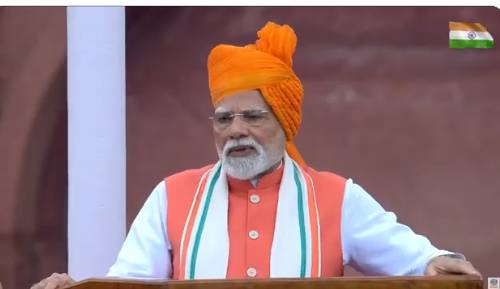

Indian Prime Minister Narendra Modi on Friday announced the launch of Mission Sudarshan Chakra, a state-of-the-art defence initiative aimed at bolstering India's security.
The mission will aim at creating a shield to protect India’s strategic, civilian, and religious sites from potential enemy attacks and also creating new weapons.
Speaking from the ramparts of the Red Fort in New Delhi during his Independence Day address, Modi said the system would integrate the latest technological tools to create a powerful, multi-layered shield around critical locations across the country.
"In the next ten years, by 2035, I want to expand, strengthen, and modernise this national security shield. Drawing inspiration from Lord Shri Krishna, we have chosen the path of the Sudarshan Chakra...The nation will be launching the Sudarshan Chakra Mission." The entire modern system should be researched, developed, and manufactured in India, harnessing the talent of our youth. This powerful system will not only counter terrorist attacks but also strike back at the terrorists," he said.
"India aims to develop its own Iron Dome-like defence system, named Mission Sudarshan Chakra, designed to safeguard critical sites, including civilian areas," he added.
The new system could give competition to Israel's famed Iron Dome, a multi-layered defence system known for stopping aerial attacks. Deployed in 2010s, the system has intercepted thousands of incoming rockets from Palestinian Hamas and Lebanon's Hezbollah, with Israel claiming a success rate of over 90 percent.
According to Modi, Mission Sudarshan Chakra will combine advanced surveillance, interception, and counter-attack capabilities, enabling swift neutralisation of threats in air, land, and sea domains.
Indus Treaty not in farmers' interest
Modi said the Indus Waters Treaty with Pakistan was “unjust" and “one-sided", reaffirming that blood and water could not flow together.
Modi was still adamant that Operation Sindoor was a success and also spoke about the suspension of the Indus Waters Treaty with Pakistan, saying India had delivered a punishment to the enemies beyond their dreams. “India has decided that blood and water will not flow together. Now, my fellow countrymen have clearly understood how unjust and one-sided the Indus agreement is. The waters of rivers originating in India have been irrigating the fields of our enemies, while the farmers and the land of my own country remain thirsty without water," he said.
“What kind of agreement was this that has caused such unimaginable loss to our farmers for the past seven decades? Only India has the right to its rightful share of water," he added. Modi stressed that India will no longer tolerate the loss caused by the Indus Waters Treaty, saying the agreement was not in the interest of farmers or the country.
Pakistan’s threats on Indus Waters Treaty
Modi’s fiery Independence Day speech came after Pakistani leaders, including Prime Minister Shehbaz Sharif, threatened India for keeping the Indus Waters Treaty in abeyance.
While addressing an event in Islamabad on Tuesday, Shehbaz Sharif said, “I want to tell the enemy today that if you threaten to hold our water, then keep this in mind — you cannot snatch even one drop of Pakistan." He said if India tried, it will be “taught such a lesson that you will be left holding your ears."
A day earlier, former Foreign Minister Bilawal Bhutto-Zardari called the suspension of the IWT an attack on the Indus Valley Civilisation, warning that the country would not back down if pushed into war.
Facing US tariffs, Modi vows self-reliance
Modi said that India is seeking self-reliance with energy independence and the development of its own powerful defence systems, vowing to defend his country's interests "like a wall".
"Self-reliance is the foundation of developed India," Modi said after a flypast of military helicopters scattered flower petals above an invited crowd of thousands.
"Freedom becomes meaningless if someone becomes too dependent on others".
"We know that we remain dependent on many countries to meet our energy needs", said Modi. "But to build a truly self-reliant India, we must achieve energy independence."
Modi urged scientists and engineers to focus on building key sectors and technologies including fighter jet engines, semiconductor chips and military hardware systems.
"We will have India-made semiconductor chips in the market by the year's end," Modi said.
He added that the country was also working towards building its own space station and would have a "defence shield" in the next decade, without giving further details.
He did not speak directly about Trump, but said he would "stand like a wall" against any policy that hurts the interests of farmers. "When economic selfishness is rising day by day... we must not just sit and worry about the crisis but instead focus on our strengths," Modi said.
Awards for Indian soldiers
India on Thursday also acknowledged the heroism of its soldiers who took part in Operation Sindoor and played a pivotal role in hitting targets in Pakistan and Pakistani Kashmir three months ago, with President Droupadi Murmu approving scores of wartime honours for them.
Among the 127 gallantry medals and 40 distinguished service awards cleared by the President on the eve of the 79th Independence Day are four Kirti Chakras, 15 Vir Chakras, 16 Shaurya Chakras, two bar to Sena Medals (Gallantry), 58 Sena Medals (Gallantry), six Nao Sena Medals (Gallantry), 26 Vayu Sena Medals (Gallantry), seven Sarvottam Yudh Seva Medals, nine Uttam Yudh Seva Medals and 24 Yudh Seva Medals, the Indian defence ministry said.–Hindustan Times/Agencies