
No water, then war…

There are two types of traitors in Pakistan: those labelled as such merely for holding dissenting opinions, and those who have genuinely hollowed out the foundations of this nation.
Among the latter is Jamaat Ali Shah—or rather, Jamaat Ali Siyah. Under the guise of poverty alleviation programmes, he served as Pakistan's Indus Water Commissioner a few years ago. During his tenure, India completed all its desired barrages and dams. Clearly, this would have been impossible without Jamaat Ali Siyah's support.
Then, one fine morning, it was discovered that Jamaat Ali Siyah had packed up his assets and migrated to Canada. The Kishanganga Dam is also a gift from this gentleman to India. As for the price he received for these gifts, I leave that to your imagination.
"No water, then war...!!!"
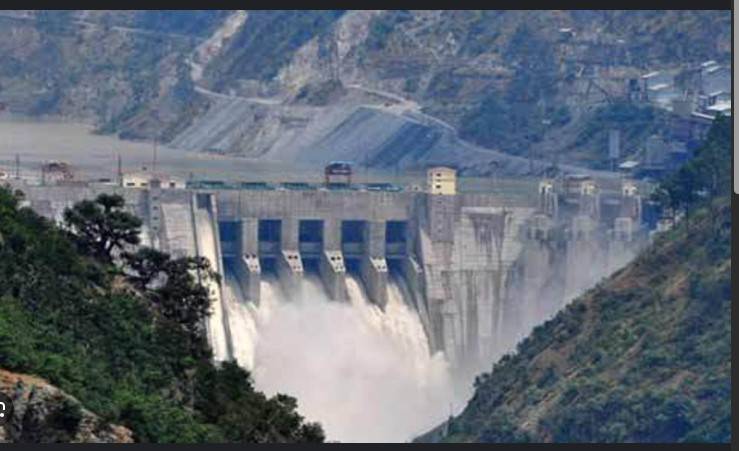
India has constructed the Kishanganga Dam on Pakistan's share of water, and Prime Minister Modi is set to inaugurate it in a few days. Pakistan, already facing a severe water crisis, is about to encounter a new catastrophe. Yet, in this ever-living and eternal nation, no one seems to care. The political leadership stages a new drama daily, and the media plays along, wasting precious time. In this environment of frivolity and dangerous superficiality, no one realizes what is about to happen to Pakistan.
The completion of the Kishanganga Dam presents an extremely horrifying scenario. The river known as Kishanganga in India is called the Neelum River in Pakistan. It flows through the Neelum Valley and joins the Jhelum River near Muzaffarabad. India has now constructed a 22-kilometer tunnel to divert its course. It will no longer flow through the Neelum Valley. Instead, for the Kishanganga project, it has been redirected through Wular Lake to Baramulla within Indian-occupied Kashmir, altering its natural flow. Soon, the Neelum Valley will only be known for a river that once flowed through it.
Consider this: if the Neelum River deserts the Neelum Valley, what will the valley look like? Its entire beauty will be destroyed. The once-thriving valley will become desolate and barren. Over 450,000 people in the Neelum Valley live below the poverty line. Their lives revolve around the river—they cultivate rice along its banks, their mills run on its water. This river is their lifeline. Note that the Neelum Valley does not receive monsoon rains; it's termed "non-monsoon." Approximately 41,000 acres in the valley are irrigated by the Neelum River.
From the point where the river's course is altered, a 230-kilometer stretch encompassing about 250 villages will soon be deprived of a flowing river. Annually, residents catch and sell 1,200 tons of trout fish in local markets—this too will vanish. The future of forests is also in jeopardy. Moreover, Pakistan's Neelum-Jhelum project faces an uncertain future.
Our water supply will decrease by 27%, leading to a 20% reduction in the Neelum-Jhelum Hydropower Project's output. If India decides to act more maliciously, the situation could worsen. Complete destruction is knocking at our door, yet no one cares.
Our government's display of shortsightedness, ignorance, and criminal negligence in this matter is even more terrifying. When India began work on this project, Pakistan approached the International Court of Arbitration. The court asked Pakistan to provide all data related to water usage. Pakistan was so unprepared that it had nothing to present. To save face, it requested a ten-day extension to gather the necessary information.
On June 25, 2013, Nawaz Sharif became Prime Minister, and six months later, on December 20, 2013, the court ruled in India's favour. On page 34 of the decision, the court stated:
"The Government of Pakistan did not present any data regarding current and projected agricultural water usage."
In any civilized society, such negligence would have led to the government's downfall. But in our semi-literate society, the Nawaz administration shamelessly claimed this decision as a victory.
Now, listen further. After the court granted India the right to build the dam, it began to play openly, tearing apart the Indus Waters Treaty. Throughout this period, Pakistani rulers continued to pamper Modi and host Sajjan Jindal. Now, as Modi prepares to inaugurate the dam, we suddenly realize the gravity of the situation and are pleading with the World Bank, the treaty's arbitrator, to hear our case.
We've wasted time here as well. Our successful diplomacy is such that we hoped to get an appointment in April, but were told that the World Bank President is busy and has no time. Now, there's no chance of meeting before the dam's inauguration, rendering any meeting afterward pointless.
Nawaz Sharif and Shahid Khaqan Abbasi set records for foreign trips at the poor nation's expense, yet the situation is such that the World Bank President doesn't even have time to meet the Pakistani delegation. And the apathy continues—our government doesn't care what's happening. Water is a matter of life and death for us, but we feel no shame in not taking it seriously. In any other country facing such a situation, a diplomatic storm would have been raised, compelling the world to take notice. But here, neither the government nor the opposition speaks about the Kishanganga incident. Our semi-literate and below-average leadership perhaps doesn't even grasp the severity of the issue.
The Kishanganga project also threatens our ecosystem. India has signed the UN Convention on Biological Diversity, the Convention on Climate Change, and the Convention on Wetlands. Yet, we haven't raised this issue on any forum.
The Kishanganga Dam is expected to cause an annual loss of $140 million to Pakistan, but this issue hasn't found a place in our national narrative. Here, our leaders are preoccupied with other matters. Unless someone rises above dirty politics, these issues won't be addressed.
Semi-literate leaders, spectacle-loving public, and media playing to the gallery—we're clapping while sitting on a volcano. Today, no one realizes it, but remember, the time isn't far when we'll all understand the terrifying water crisis we've plunged into.
The frivolity and recklessness of this society have become frightening. A severe water crisis is knocking at our door. If you can hear it, then listen.
All friends should consider it their duty to share this article, highlight this issue according to their capacity, and make it a topic of discussion in their circles. Use social media, print media, electronic media—wherever you have access—to spread this message. Perhaps, through this effort, we can repay our debt to our motherland, to which we've been unfaithful for 76 years.
_ Unknown author_